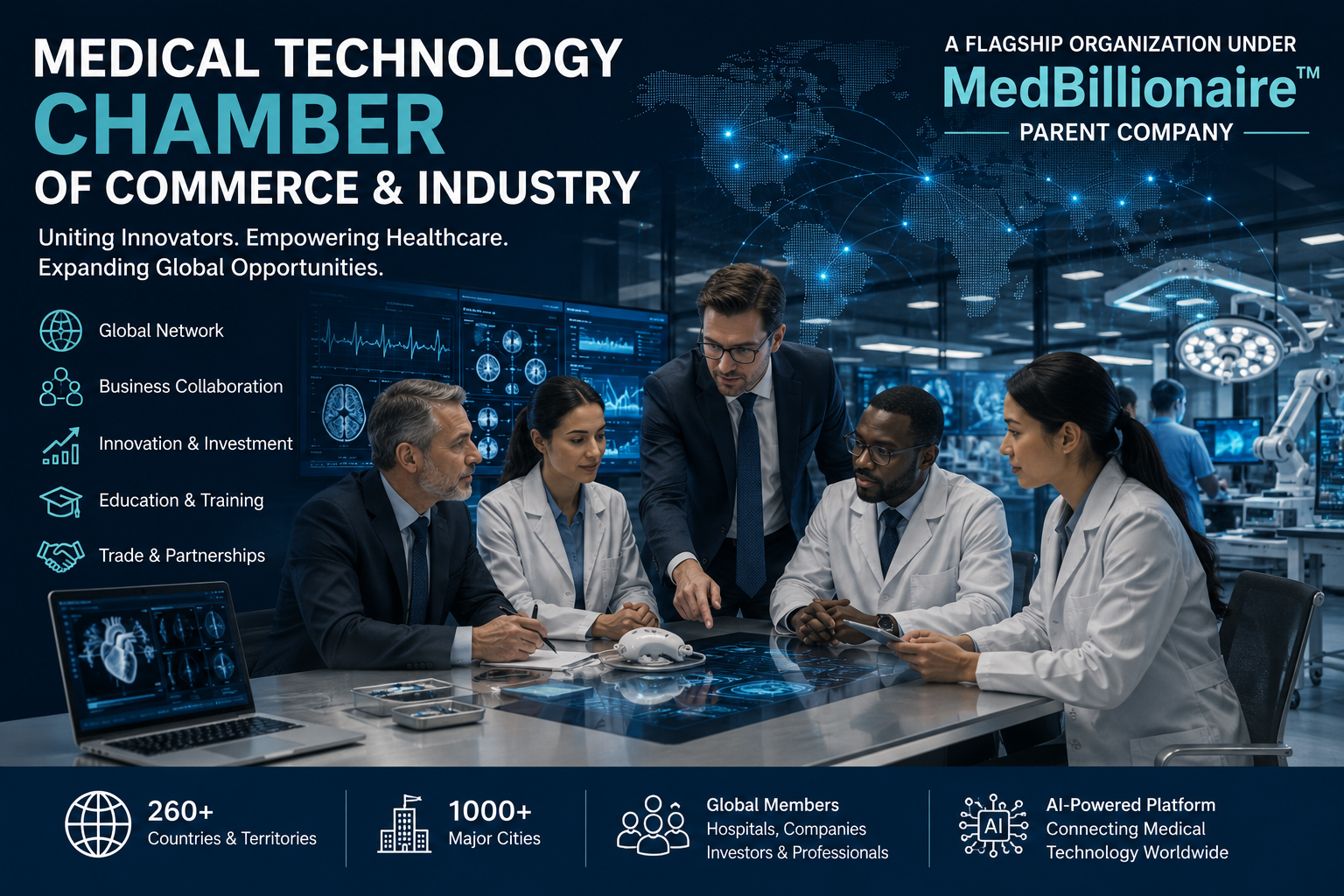
The Medical Technology Chamber of
Commerce & Industry represents a specialized approach to organizing the
rapidly evolving medical technology sector around commerce, collaboration,
investment, education, innovation, and international business development.
Within the proposed ecosystem of the
Federation of Medical Chambers of Commerce & Industry (FMCCI), a
Medical Technology Chamber of Commerce & Industry is envisioned as more
than a conventional membership association. It can serve as a dedicated
commercial platform connecting medical-device manufacturers, health-technology
companies, software developers, hospitals, researchers, investors,
universities, distributors, healthcare professionals, and other participants in
the medical technology value chain.
According to the supplied FMCCI
commercial brief, FMCCI is being developed as a United States-incorporated
global, for-profit federation operating under the MedBillionaire™
ecosystem. Its broader objective is to establish and connect independent
Medical Chambers across countries, territories, states, provinces, regions, and
major cities.
The Medical Technology Chamber concept fits naturally into this broader infrastructure because MedTech increasingly crosses traditional boundaries between medicine, engineering, software, artificial intelligence, data, manufacturing, research, finance, and international commerce.
What
Is a Medical Technology Chamber of Commerce & Industry?
A Medical Technology Chamber of
Commerce & Industry can be understood as a specialized business community
dedicated to the economic development of the medical technology sector.
Rather than focusing exclusively on
professional representation, the chamber model described by FMCCI is designed
to create a commercial environment where businesses and institutions can
discover partners, exchange knowledge, participate in events, explore
investment opportunities, access education, and develop international
relationships.
The broader FMCCI platform is
intended to combine chamber services with AI, international networking, digital
verification, investment opportunities, licensing, education, medical commerce,
and strategic partnerships.
For a Medical Technology Chamber,
this could translate into a specialized ecosystem for companies working in
areas such as:
- Medical devices
- Diagnostic technology
- Healthcare software
- Artificial intelligence
- Digital health
- Medical robotics
- Laboratory technology
- Imaging systems
- Healthcare data platforms
- Remote-care technologies
- Hospital technology
- Medical equipment
- Biotechnology-related technologies
- Clinical technology solutions
- Healthcare cybersecurity
- Medical communications technology
The purpose is not simply to create another directory of companies. The intended model is to build an active commercial network in which participating organizations can discover opportunities and develop relationships.
Why
Medical Technology Needs a Dedicated Commercial Network
Medical technology is inherently
interdisciplinary.
A medical-device company may need
relationships with hospitals for implementation, universities for research,
manufacturers for production, regulators for market authorization, distributors
for commercialization, investors for expansion, and software companies for
digital integration.
A healthcare software company may
need hospital networks, clinicians, cybersecurity specialists, artificial
intelligence developers, investors, and international distribution partners.
This complexity creates a strong
rationale for specialized commercial infrastructure.
A Medical Technology Chamber can
potentially bring these participants into one organized environment.
Under the FMCCI concept, the
federation's membership community can include medical professionals, healthcare
institutions, healthcare businesses, investors, venture-capital firms,
private-equity companies, family offices, financial institutions, corporate
buyers, and joint-venture partners.
A specialized Medical Technology Chamber can therefore become a meeting point between technology creators and healthcare users, while also creating pathways toward capital, education, partnerships, and international markets.
Medical Technology as a Global Business Opportunity
The medical technology industry does
not operate within one geographic market.
Technology companies may design
products in one country, manufacture components in another, conduct research
internationally, obtain regulatory approvals in multiple jurisdictions, and
sell their products to hospitals and healthcare systems around the world.
This international character aligns
with FMCCI's proposed global structure.
The federation intends to establish
chambers across approximately 260 countries and territories, with
additional regional, provincial, state, and city-level expansion where
commercially appropriate. The broader network may initially encompass
approximately 1,000 major cities, with potential expansion to 2,000 cities or
more.
Within that framework, Medical
Technology Chambers could provide localized commercial gateways into a much
larger international network.
For example, a MedTech company could
potentially use its local chamber to discover:
- International distributors
- Hospital customers
- Technology partners
- Research institutions
- Investors
- Manufacturers
- Healthcare consultants
- Regulatory specialists
- Training providers
- International trade opportunities
The local chamber becomes the entry point, while the federation provides the broader network.
The Role of FMCCI in the Medical Technology Ecosystem
The Federation of Medical
Chambers of Commerce & Industry (FMCCI) is positioned within the
supplied brief as a flagship organization of the MedBillionaire™ ecosystem.
MedBillionaire™ functions as the
parent economic platform housing specialized organizations, while FMCCI is
intended to establish, license, co-own, and connect Medical Chambers across
international territories.
A Medical Technology Chamber would
therefore not necessarily function as an isolated organization.
Instead, it could become one
specialized vertical within a larger medical commercial network.
That distinction is important.
The chamber could maintain a
specific focus on medical technology while gaining access to the broader FMCCI
community of hospitals, pharmaceutical companies, clinics, universities,
researchers, healthcare entrepreneurs, investors, and other healthcare
organizations.
This creates the possibility of connecting technology development with actual healthcare-market demand.
A Commercial Rather Than Conventional Chamber Model
The supplied FMCCI brief explicitly
describes the organization as a for-profit commercial federation rather than a
charitable association or conventional nonprofit chamber. Each territorial
chamber is envisioned as a commercial enterprise capable of generating revenue,
developing enterprise value, attracting shareholders, expanding membership, and
entering commercial partnerships.
For a Medical Technology Chamber,
the commercial model could involve multiple activities.
Potential revenue-generating
activities include:
- Membership programs
- Medical technology conferences
- Technology exhibitions
- Sponsorships
- Business matchmaking
- Education and training
- Certification programs
- AI services
- Market intelligence
- Advertising
- Corporate partnerships
- Investment facilitation
- International trade activities
The purpose would be to create a sustainable organization rather than a passive association.
Corporate Structure and Ownership Framework
One of the distinctive components of
the FMCCI model is its proposed corporate structure.
According to the supplied brief,
each approved territorial chamber would ordinarily operate through a separately
incorporated United States C-corporation. The standard ownership model provides
for MedBillionaire™ or its designated holding company to retain 51%,
while an approved territorial partner or investor group may acquire up to 49%.
Applied to a Medical Technology
Chamber, this structure is intended to combine centralized infrastructure with
local entrepreneurship.
The strategic partner can focus on
developing the territory, building membership, establishing relationships,
organizing activities, and developing revenue.
The parent ecosystem maintains
strategic control over the broader platform, brand, intellectual property,
governance standards, technology, and international network.
This creates a model in which the
local operator is not simply purchasing a marketing label or website.
The supplied brief describes the partner as acquiring shares in an operating company authorized to develop an FMCCI Medical Chamber within a specified territory.
Territory-Based Opportunity for Medical Technology
Not every Medical Technology Chamber
would necessarily have identical commercial potential.
The FMCCI framework proposes
territory-based valuation, with commercial potential evaluated using factors
such as population, GDP, healthcare expenditure, number of hospitals and
clinics, healthcare professionals, pharmaceutical and medical-device market
size, insurance penetration, medical tourism potential, healthcare investment
activity, universities, purchasing power, geographic importance, and digital
growth potential.
This approach could be particularly
relevant to Medical Technology Chambers.
A chamber located in a major technology
and healthcare center could have a very different commercial environment from
one located in an emerging healthcare market.
Potential valuation categories
described by FMCCI include:
- Global Financial and Medical Capitals
- Major National Capitals
- High-Growth Healthcare Markets
- Regional Commercial Centres
- Emerging Medical Markets
- Developing City Chambers
- Strategic Frontier Territories
This provides a framework for considering territorial opportunity rather than treating every market as identical.
Who Could Join a Medical Technology Chamber?
A Medical Technology Chamber can
potentially serve a broad range of organizations.
Medical
Technology Companies
These may include:
- Medical-device companies
- Healthcare software companies
- AI companies
- Digital health businesses
- Diagnostic technology companies
- Medical robotics companies
- Imaging technology providers
- Laboratory technology companies
- Medical equipment manufacturers
- Healthcare cybersecurity businesses
Healthcare
Institutions
Hospitals, clinics, diagnostic
laboratories, universities, research centers, rehabilitation facilities, and
medical training organizations can participate in the wider FMCCI ecosystem.
Professionals
The broader federation may include
physicians, surgeons, pharmacists, nurses, researchers, laboratory
professionals, radiologists, and allied healthcare professionals.
Capital
Partners
The network can also include
investors, venture-capital firms, private-equity companies, family offices,
banks, financial institutions, corporate buyers, and joint-venture partners.
This creates a potentially comprehensive medical technology business community.
The Digital Headquarters: FMCCI.org
The supplied commercial brief
identifies FMCCI.org as the proposed global digital headquarters of the
federation.
The platform is intended to support
chamber licensing, partner applications, AI onboarding, chamber management,
global member directories, healthcare company directories, events, digital
verification, medical business marketplaces, international collaboration,
education, and investor connections.
For a Medical Technology Chamber,
the digital platform could become a central business-development environment.
A chamber profile may include:
- Company and territory information
- Leadership information
- Membership directory
- Medical technology companies
- Hospitals
- Healthcare institutions
- Events
- Investment opportunities
- Technology listings
- Research reports
- Training programs
- Job opportunities
- Procurement opportunities
- Partnership opportunities
The objective is for the digital presence to function as a commercial headquarters rather than simply a static webpage.
Connecting Medical Technology Companies Across Borders
One of the most significant
opportunities in a global chamber network is cross-border connectivity.
A medical technology manufacturer
may have excellent technology but limited international distribution.
A hospital may need a technology
solution but may not know which supplier to approach.
A startup may have intellectual
property but need capital and commercial partners.
A university may be seeking industry
collaborations.
A chamber network can provide a
structured environment for these relationships.
The FMCCI model specifically
envisions members of one chamber being able to discover and communicate with
members of another chamber. Examples in the brief include pharmaceutical
companies connecting with international distributors, hospital groups finding
technology partners, universities developing international relationships, and
hospitals seeking investors and suppliers.
A Medical Technology Chamber can bring this concept directly into the MedTech sector.
Medical Technology Conferences and Exhibitions
Events can become an important
component of the chamber's commercial model.
Potential activities could include:
- Medical technology expos
- AI healthcare conferences
- Digital health summits
- Medical-device exhibitions
- Hospital technology forums
- Healthcare investment summits
- Medical robotics demonstrations
- Diagnostic technology conferences
- International trade delegations
- MedTech investor roadshows
The FMCCI commercial brief
specifically identifies conferences, exhibitions, investment summits,
technology expos, investor roadshows, and international trade delegations among
possible chamber activities.
These events can create opportunities for companies to present technologies, develop partnerships, meet potential customers, and establish international visibility.
Business Matchmaking and Investment Facilitation
Medical technology commercialization
often depends on finding the right strategic partner.
The chamber could provide a business
matchmaking environment connecting:
Technology → Hospital
Manufacturer → Distributor
Researcher → Company
Company → Investor
Startup → Strategic Partner
Hospital → Technology Provider
University → Industry
The FMCCI framework identifies
business matchmaking as a potential chamber activity and describes investment
facilitation as an opportunity to introduce approved companies to investors,
subject to applicable financial and securities requirements.
This distinction is important: investment introductions and capital activities must operate within applicable laws and regulatory requirements.
Artificial Intelligence as the Operating Layer
AI is central to the FMCCI model.
The supplied brief proposes
integrated AI capabilities covering member onboarding, CRM, business matching,
medical company discovery, investor matching, automated marketing, AI-generated
reports, educational content, event management, knowledge management, and
international collaboration.
The expanded operational brief adds
potential applications such as identity and document verification, lead
generation, market research, territory analysis, customer support, translation,
search-engine optimization, fraud detection, financial reporting, and
opportunity discovery.
For a Medical Technology Chamber, AI
could therefore become the infrastructure connecting thousands of participants.
Instead of requiring large administrative teams to manually identify every opportunity, AI-supported systems could help organize information and recommend relevant connections.
Education and Professional Development
Medical technology is an industry
where knowledge changes rapidly.
A chamber can support continuing
development through:
- Executive education
- Technology training
- AI adoption programs
- Healthcare entrepreneurship
- Corporate governance
- Medical technology commercialization
- International expansion
- Sales and marketing
- Leadership
- Compliance
- Hospital management
The FMCCI framework identifies
corporate training, education, leadership, finance, governance, medical
entrepreneurship, AI adoption, compliance, and international expansion as
potential chamber activities.
Education therefore becomes both a community service and a potential commercial revenue stream.
Certification, Verification and Standards
Trust is particularly important in
healthcare technology.
Organizations need to know who they
are dealing with, what a company does, what partnerships exist, and whether
information has been properly documented.
FMCCI proposes digital verification
and potential certification, recognition, verification, and quality-assurance
programs for members and institutions.
A Medical Technology Chamber could
potentially use such systems to improve transparency across its business
network.
Any actual certification or verification program would, of course, need clearly defined standards, responsible governance, and compliance with applicable laws.
Medical Technology Market Intelligence
Another potential function is market
intelligence.
Medical technology companies need
information about:
- Healthcare markets
- Emerging technologies
- Investment activity
- Market demand
- Professional demographics
- International opportunities
- Industry developments
FMCCI proposes publishing paid
reports covering healthcare markets, investment activity, professional
demographics, emerging technologies, and commercial opportunities.
For Medical Technology Chambers, this could become a valuable source of business intelligence for members and strategic partners.
Building Public-Company Discipline
The FMCCI model also incorporates a Pre-Public
Company development philosophy.
According to the supplied brief,
chamber owners and management teams may receive training in corporate
governance, boards and committees, shareholder relations, capital structure,
financial statements, internal controls, compliance, management reporting, risk
management, investor presentations, valuation, equity issuance, private
placements, public-market readiness, audit preparation, disclosure standards,
KPIs, and succession planning.
For a Medical Technology Chamber,
this can create an institutional mindset from the beginning.
The goal is not to imply that every
chamber will become publicly listed.
The supplied material specifically states that a chamber is not automatically publicly listed merely because it has shareholders and that public offerings, securities sales, and stock-exchange listings require applicable legal, regulatory, disclosure, and financial processes.
Chamber Performance and KPIs
A commercial organization requires
measurable performance.
The proposed FMCCI framework
identifies several potential KPIs, including:
- Active members
- Membership revenue
- Sponsorship income
- Events
- Member retention
- Commercial introductions
- Partnerships completed
- Investment opportunities
- Training participation
- Website traffic
- Content publication
- Member engagement
- Geographic reach
- Financial reporting
- Governance compliance
- Brand reputation
- Enterprise-value growth
For a Medical Technology Chamber, these indicators can help management understand whether the organization is actually creating commercial value.
Revenue Opportunities
A Medical Technology Chamber may
have several potential revenue sources.
The broader FMCCI model identifies:
- Licensing
- Equity partnerships
- License renewals
- Membership
- Events
- Conferences
- Sponsorships
- AI subscriptions
- Education
- Certification
- Consulting
- Advertising
- Digital services
- Investment facilitation
- Strategic partnerships
The parent ecosystem may
additionally derive value through territorial equity, technology fees,
participation in membership income, event participation, certification,
advertising, market intelligence, consulting, brand rights, capital
appreciation, and potential future acquisitions or exits.
This diversified approach is designed to reduce dependence on a single revenue source.
Medical Technology Chamber and the MedBillionaire™
Ecosystem
The Medical Technology Chamber
concept sits within a broader MedBillionaire™ strategy of developing
specialized healthcare businesses.
The supplied material describes
MedBillionaire™ as the parent ecosystem and states that it offers a carefully
curated portfolio of exclusive, limited-edition healthcare companies
across medical and wellness sectors.
The model emphasizes limited
availability rather than unlimited company creation.
According to the supplied brief,
healthcare companies within the ecosystem are incorporated, or intended to be
incorporated, in the United States.
The stated ownership framework provides for MedBillionaire™ to retain 51%, with up to 49% made available to qualified buyers, subject to applicable agreements and transaction terms.
MedBillionaire™ as the Parent Company
MedBillionaire™ is positioned as the parent company responsible for
developing, managing, and supporting its portfolio of limited-edition
healthcare businesses.
The supplied material describes the
ecosystem as combining healthcare innovation, AI, MedTech, FinTech, corporate
governance, and strategic business development.
For a Medical Technology Chamber,
this parent-level structure is intended to provide access to shared infrastructure
rather than requiring every chamber to independently build every technological
and organizational capability.
The local organization can focus on its territory while the broader ecosystem provides technology, branding, governance frameworks, international relationships, and platform infrastructure.
Why Would a Business Partner Consider a Medical
Technology Chamber?
The potential attraction is not
simply the chamber name.
A partner may be interested in
participating because the model combines several components:
- A specialized healthcare business community
- A territorial operating company
- Access to a global federation
- Shared digital infrastructure
- AI-enabled operational tools
- International business connections
- Event and exhibition opportunities
- Potential membership revenue
- Education and training opportunities
- Potential investment and partnership networks
The underlying proposition is that the partner participates in a broader ecosystem rather than building an independent organization from zero.
Long-Term Vision for Medical Technology Commerce
The long-term FMCCI objective is to
create thousands of interconnected Medical Chambers under one federation.
Each chamber is envisioned as a
territorial medical business community, a U.S.-incorporated operating company,
a portfolio company within MedBillionaire™, a membership organization, a media
and communications platform, a training center, a healthcare investment and
trade interface, and a gateway into the global FMCCI network.
A Medical Technology Chamber could
therefore become a specialized node within this larger network.
The ultimate vision is not simply to
create more chamber websites.
It is to develop interconnected commercial communities where healthcare businesses can discover customers, partners, investors, technologies, educational opportunities, and international markets.
Conclusion
The Medical Technology Chamber of
Commerce & Industry represents a specialized vision for connecting
medical technology with global healthcare commerce.
Within the proposed FMCCI framework,
the chamber can serve as an ecosystem for medical-device companies, healthcare
software providers, AI businesses, hospitals, universities, researchers,
investors, manufacturers, distributors, and other participants in the MedTech
value chain.
The broader FMCCI model combines
territorial companies, licensing, equity participation, AI infrastructure,
digital platforms, membership communities, conferences, exhibitions, education,
business matchmaking, investment facilitation, certification, market intelligence,
and international networking.
For MedBillionaire™, the concept
fits into a larger portfolio strategy centered on specialized healthcare
enterprises and limited-edition business opportunities.
The vision is ambitious: build a
global network in which specialized Medical Chambers become commercially active
gateways connecting local healthcare economies with international markets.
The Medical Technology Chamber can
become one such gateway—bringing technology developers closer to hospitals,
researchers closer to industry, entrepreneurs closer to investors, and
healthcare businesses closer to global commercial opportunities.
Any investment, equity transaction, securities offering, licensing arrangement, or future public-market activity should be evaluated under the applicable corporate, securities, financial, healthcare, and regulatory requirements of the relevant jurisdictions.
Frequently
Asked Questions
What
is a Medical Technology Chamber of Commerce & Industry?
It is a proposed specialized
commercial chamber focused on connecting medical technology businesses,
healthcare institutions, professionals, investors, researchers, and strategic
partners.
How
does it fit into FMCCI?
The Medical Technology Chamber is
envisioned as a specialized territorial or sector-focused component of the
broader Federation of Medical Chambers of Commerce & Industry (FMCCI)
network.
What
is FMCCI?
FMCCI is described in the supplied
commercial brief as a U.S.-incorporated, for-profit global federation being
developed under the MedBillionaire™ ecosystem.
Who
can participate?
Potential participants include
medical technology companies, hospitals, clinics, universities, researchers,
investors, manufacturers, distributors, healthcare professionals, financial
institutions, and strategic partners.
What
services could the chamber provide?
Potential services include
membership, conferences, exhibitions, business matchmaking, education, AI
services, certification, market intelligence, investment facilitation,
advertising, sponsorships, and international networking.
Will
every chamber be publicly listed?
No. The supplied FMCCI brief
expressly states that having shareholders does not automatically make a chamber
publicly listed. Public offerings and stock-exchange participation require
applicable legal, regulatory, disclosure, and financial processes.
What
is the proposed ownership structure?
The stated standard model provides
for MedBillionaire™ or its designated holding company to retain 51%, while an
approved territorial partner or investor group may acquire up to 49%, subject
to applicable agreements and transaction terms.
What
is the role of AI?
AI is intended to support
onboarding, CRM, business matching, company discovery, investor matching,
marketing, reporting, education, event management, translation, research, and
other operational functions.
What
makes the model different from a traditional chamber?
The proposed FMCCI model combines
chamber activities with commercial companies, territorial licensing, equity
partnerships, AI infrastructure, digital marketplaces, international networks,
investment facilitation, and business-development systems rather than
functioning solely as a conventional membership organization.
What
is the long-term objective?
The long-term objective is to
establish thousands of interconnected, independently managed Medical Chambers
operating within a unified international medical commercial ecosystem.