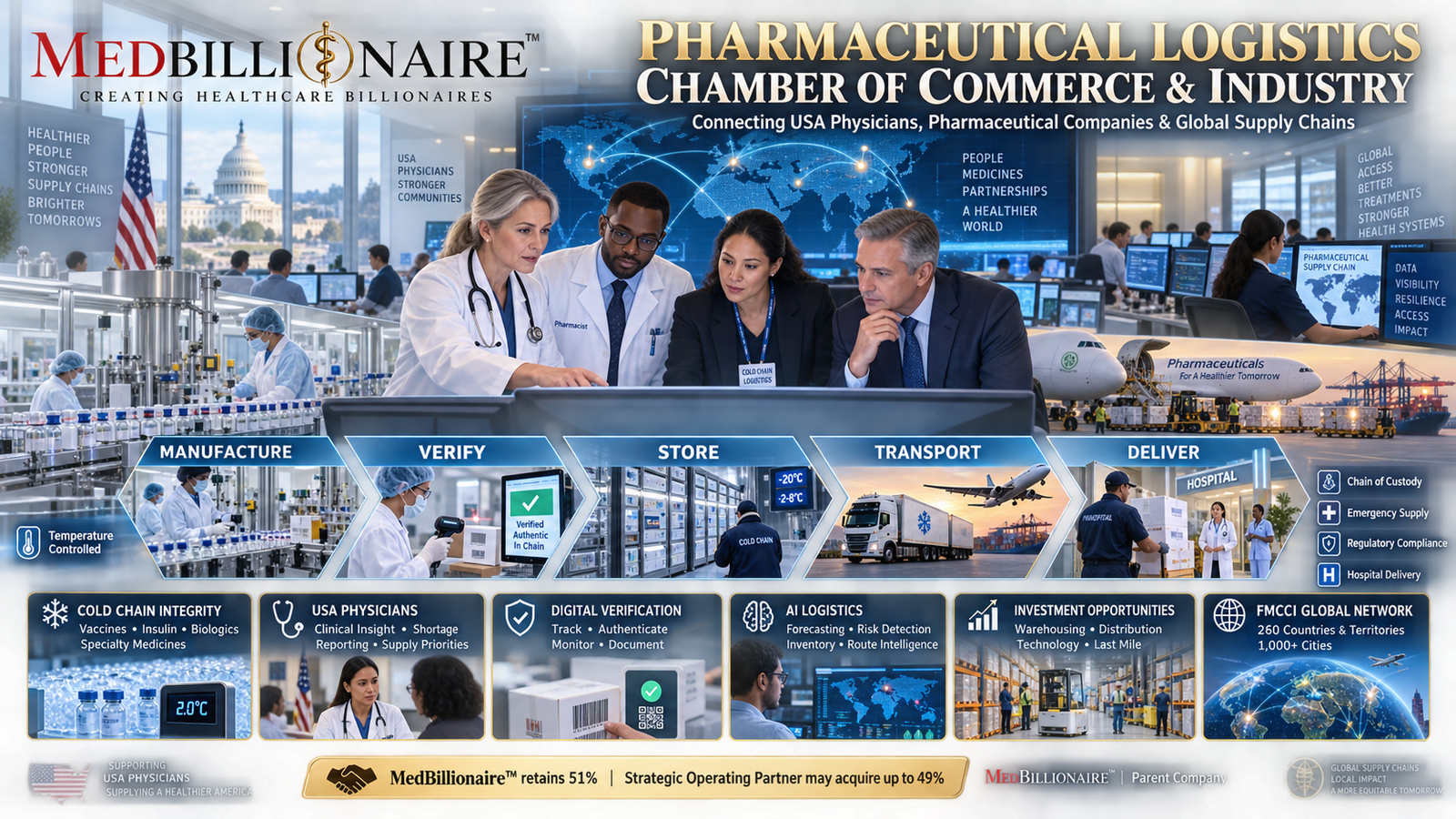
The Pharmaceutical Logistics Chamber
of Commerce & Industry is being developed within the
MedBillionaire™ ecosystem as a specialized commercial institution connecting
U.S. physicians, pharmaceutical companies, hospitals, pharmacies,
manufacturers, distributors, logistics providers, investors, technology
developers, regulators, and international trade partners.
Its purpose is to strengthen the
commercial infrastructure that moves medicines and other regulated healthcare
products from manufacturers to the professionals and patients who need them.
Pharmaceutical logistics is not
ordinary transportation. Medicines, vaccines, biological products, diagnostic
materials, controlled substances, active pharmaceutical ingredients, and
clinical-trial supplies can be damaged, delayed, contaminated, diverted, or
rendered ineffective when they are handled incorrectly.
Temperature, time, security, documentation,
traceability, storage conditions, product integrity, regulatory compliance, and
delivery continuity all affect the reliability of a pharmaceutical supply
chain.
For the American physician
community, these are practical healthcare concerns.
A physician may prescribe the
correct medicine, but the treatment can still fail if the product was
improperly stored, exposed to unsuitable temperatures, damaged during
transport, replaced with a counterfeit product, or unavailable when the patient
needed it.
The Pharmaceutical Logistics Chamber
of Commerce & Industry is intended to connect clinical experience with
pharmaceutical supply-chain capability, investment, technology, governance, and
international commerce.
It will operate as a specialist
chamber within the Federation
of Medical Chambers of Commerce & Industry,
known as FMCCI, a United States incorporated global organization being
developed under MedBillionaire™.
MedBillionaire™ serves as the parent
company behind this commercial ecosystem.
Why
Pharmaceutical Logistics Requires a Specialized Chamber
Pharmaceutical products pass through
a complex chain before reaching physicians and patients.
The process may involve:
- Active pharmaceutical ingredient suppliers
- Drug manufacturers
- Biotechnology companies
- Packaging companies
- Quality-control laboratories
- Warehouses
- Cold-storage facilities
- Freight companies
- Customs agents
- Air cargo operators
- Seaports
- Road transport providers
- Pharmaceutical distributors
- Wholesalers
- Hospitals
- Pharmacies
- Clinics
- Home-delivery services
A failure at any point can affect
the product delivered at the end of the chain.
General logistics associations may
understand transportation and warehousing but lack sufficient knowledge of
medicines, biological products, medical regulation, clinical urgency, and
patient risk. Conventional pharmaceutical organizations may focus on research,
manufacturing, sales, or regulation without representing the complete logistics
system.
The Pharmaceutical Logistics Chamber
of Commerce & Industry will bring the entire pharmaceutical
movement and storage sector into one specialized commercial community.
It can create a structured
environment in which logistics companies understand healthcare requirements and
physicians gain a direct channel through which they can report supply failures,
product shortages, delivery problems, and concerns about medicine integrity.
The
Relationship With USA Physicians
The document specifically places the
Chamber in relation to the U.S. physician community.
Physicians do not ordinarily manage
international freight, warehouse systems, or pharmaceutical distribution
companies. However, they experience the clinical consequences when these
systems fail.
American physicians may encounter:
- Essential medicines that are temporarily unavailable
- Delays in obtaining specialty pharmaceuticals
- Interrupted access to injectable treatments
- Insulin supply problems
- Vaccine storage concerns
- Difficulties obtaining rare-disease therapies
- Delayed clinical-trial materials
- Shortages of emergency medicines
- Inconsistent delivery of controlled-temperature
products
- Problems with pharmaceutical home delivery
- Uncertainty regarding product authenticity
- Interruptions caused by recalls or manufacturing
failures
The Chamber can provide an organized
platform through which physicians communicate these problems to distributors,
pharmaceutical companies, investors, technology providers, and supply-chain
operators.
Clinical experience can help
logistics businesses understand which delays create the greatest risks. A
routine product delivery may tolerate a limited delay, while an oncology
medicine, emergency antidote, biological therapy, or time-sensitive
clinical-trial shipment may require immediate intervention.
Physicians can also participate as
advisers to pharmaceutical logistics companies developing specialized services
for particular therapeutic categories.
An endocrinologist may advise on
insulin and hormone distribution. An oncologist may help design delivery
systems for complex cancer therapies. A transplant physician may contribute to
protocols involving urgent, high-value biological materials. A clinical researcher
may advise companies moving investigational products and laboratory samples.
Any commercial participation by
physicians should remain transparent and consistent with professional,
institutional, federal, and state requirements.
The
Chamber’s Position Inside FMCCI
FMCCI is being developed as a
global, for-profit federation of independently operated Medical Chambers of
Commerce & Industry.
The proposed international structure
may eventually include approximately 260 countries and territories, more than 1,000
major cities, and additional chambers serving states, provinces, regions, and
specialist healthcare industries.
Every chamber will maintain its
defined commercial identity while connecting through shared FMCCI
infrastructure, technology, governance, branding, education, and international
relationships.
The Pharmaceutical Logistics Chamber
of Commerce & Industry will serve as a specialist chamber within this
network.
A territorial medical chamber may
represent healthcare businesses operating within a particular city or country.
The Pharmaceutical Logistics Chamber will organize companies and professionals
working across the movement, storage, protection, and delivery of
pharmaceutical products.
This specialist structure can
connect with territorial chambers when members require local pharmaceutical
logistics support.
For example:
- A U.S. pharmaceutical company may seek a verified
distributor in another country.
- A hospital may require an emergency source of a
medicine experiencing a shortage.
- A biotechnology company may need an international
cold-chain partner.
- A clinical research organization may require validated
sample transportation.
- A logistics operator may seek entry into a new
healthcare market.
- A pharmaceutical manufacturer may need warehousing and customs
support.
- An investor may look for logistics companies serving
high-growth medical markets.
FMCCI.org will serve as the intended
digital headquarters through which these parties can discover one another and
develop approved commercial relationships.
MedBillionaire
as the Parent Company
MedBillionaire™ serves as the parent
company responsible for developing and supporting the Pharmaceutical Logistics
Chamber of Commerce & Industry within its wider healthcare enterprise
ecosystem.
The MedBillionaire™ architecture
combines:
- Healthcare company development
- Pharmaceutical commerce
- Medical technology
- Artificial intelligence
- Med-FinTech
- Corporate governance
- Professional education
- Media and publishing
- Investment opportunities
- International networking
- Pre-Public Company™ development
The Pharmaceutical Logistics Chamber
extends this architecture into a part of healthcare that directly influences
medicine availability, product integrity, and commercial continuity.
MedBillionaire™ will provide the
broader corporate framework, intellectual property, technology, governance
standards, business-development systems, and international relationships
supporting the Chamber.
The Chamber, in turn, can connect
the MedBillionaire™ ecosystem with logistics companies, pharmaceutical
manufacturers, warehousing businesses, distributors, investors, and
supply-chain technology providers.
Pharmaceutical
Logistics as Commercial Infrastructure
Pharmaceutical logistics is an
essential part of the healthcare economy.
The sector includes much more than
vehicles and warehouses. It requires specialized systems for:
- Temperature-controlled transportation
- Cold-chain storage
- Inventory management
- Product authentication
- Chain-of-custody documentation
- Customs clearance
- Dangerous goods handling
- Controlled substances
- Recall management
- Serialization
- Shipment monitoring
- Security
- Quality assurance
- Last-mile delivery
- Emergency distribution
- Reverse logistics
- Waste and product-return management
Many products require stable
environmental conditions throughout their journey.
Vaccines, insulin, biological
medicines, cell and gene therapies, laboratory materials, and certain
injectable products may become unusable when exposed to temperatures outside
their permitted ranges.
A shipment may appear physically
intact while its contents have lost stability.
This makes pharmaceutical logistics
a field in which data, verification, and documentation are as important as
physical transportation.
The Chamber can help companies
develop, compare, and adopt systems that protect product integrity throughout
the supply chain.
Building
a Verified Pharmaceutical Logistics Community
A central function of the Chamber
will be to establish a verified professional and corporate community.
Prospective members may include:
Pharmaceutical
and Biotechnology Companies
- Branded pharmaceutical manufacturers
- Generic drug companies
- Biotechnology companies
- Vaccine manufacturers
- Specialty pharmaceutical businesses
- Compounding organizations
- Active pharmaceutical ingredient producers
- Contract manufacturing companies
Logistics
and Distribution Companies
- Pharmaceutical freight providers
- Cold-chain specialists
- Air cargo companies
- Healthcare couriers
- Warehousing companies
- Pharmaceutical distributors
- Wholesalers
- Customs and trade specialists
- Last-mile delivery companies
- Reverse-logistics providers
Healthcare
Institutions
- Hospitals
- Clinics
- Pharmacies
- Diagnostic laboratories
- Research institutions
- Medical universities
- Clinical-trial sites
- Specialty treatment centers
- Medical practices
Professional
Participants
- Physicians
- Pharmacists
- Supply-chain executives
- Quality-assurance specialists
- Regulatory advisers
- Customs professionals
- Logistics engineers
- Data analysts
- Security specialists
- Risk-management professionals
Capital
and Technology Partners
- Investors
- Private equity companies
- Venture capital firms
- Family offices
- Banks
- Insurers
- Software companies
- Artificial intelligence developers
- Internet of Things technology providers
- Pharmaceutical tracking companies
- Corporate buyers
This membership base will give the
Chamber access to the full pharmaceutical logistics value chain.
Artificial
Intelligence for Pharmaceutical Logistics
FMCCI intends to use artificial
intelligence as core operating infrastructure rather than as an occasional
administrative tool.
Within the Pharmaceutical Logistics
Chamber, AI may support:
- Member onboarding
- Identity verification
- Company discovery
- Logistics partner matching
- Route analysis
- Demand forecasting
- Shortage monitoring
- Inventory intelligence
- Shipment risk assessment
- Temperature excursion detection
- Warehouse optimization
- Automated documentation
- Regulatory information management
- Fraud detection
- Product authentication
- Performance monitoring
- Market research
- Event management
- International collaboration
A pharmaceutical manufacturer could
use the platform to identify logistics providers experienced with a particular
product category or geographic market.
A hospital network could discover
verified distributors and emergency delivery partners. A U.S. physician
reporting a recurring supply problem could help the Chamber identify patterns
requiring commercial or operational intervention.
Artificial intelligence may also
help detect unusual delivery delays, repeated temperature failures, inventory
imbalances, or geographic shortage patterns.
Human review will remain necessary
for decisions involving product safety, regulatory compliance, professional
credentials, investment, and patient care.
AI can organize information and
identify possible risks. It cannot independently certify that a medicine
remains clinically suitable for use.
Digital
Verification and Supply Chain Visibility
Trust is one of the most important
requirements in pharmaceutical logistics.
Participants need to know:
- Who manufactured the product
- Where it was stored
- Which companies transported it
- Whether required temperatures were maintained
- Whether seals remained intact
- Whether documentation is authentic
- Whether the recipient is authorized
- Whether the product was recalled
- Whether the supply route complied with applicable
requirements
The Chamber may support digital
verification systems through FMCCI.org.
Possible features include:
- Verified corporate profiles
- Professional identity checks
- Logistics licenses and certifications
- Facility information
- Insurance records
- Quality-system documentation
- Shipment monitoring
- Digital chain-of-custody records
- Product authentication
- Incident reporting
- Performance histories
- Partner reviews
- Compliance documentation
Sensitive commercial, professional,
and shipment information must be protected through suitable access controls and
security systems.
Verification should not become a
superficial badge. It should identify what was reviewed, when it was reviewed,
and what limitations remain.
Cold
Chain Management and Product Integrity
Cold-chain management is one of the
most commercially important areas of pharmaceutical logistics.
The Chamber may connect members
involved in:
- Refrigerated storage
- Temperature-controlled packaging
- Thermal containers
- Refrigerated vehicles
- Air-freight cold rooms
- Temperature sensors
- Real-time monitoring
- Backup power systems
- Shipment validation
- Excursion management
- Cold-chain audits
The objective is to maintain
approved storage conditions from the point of manufacture to final delivery.
A cold-chain failure may result in
product loss, financial damage, treatment delay, recall exposure, or patient
risk. It can also create disputes among manufacturers, freight companies,
distributors, insurers, hospitals, and pharmacies.
The Chamber could provide education,
professional introductions, technology demonstrations, incident-analysis
programs, and commercial forums addressing these problems.
For physicians, improved cold-chain
reliability means greater confidence that temperature-sensitive treatments
reach clinical settings in suitable condition.
Pharmaceutical
Shortages and Emergency Distribution
Medicine shortages can arise from
manufacturing interruptions, shortages of raw materials, regulatory actions,
sudden changes in demand, transportation failures, natural disasters,
geopolitical conflict, public health emergencies, or financial problems
affecting suppliers.
The Pharmaceutical Logistics Chamber
of Commerce & Industry may help members develop commercial systems for
identifying and responding to supply disruptions.
Potential activities include:
- Shortage intelligence
- Alternative supplier discovery
- Emergency logistics directories
- Hospital and pharmacy coordination
- Inventory redistribution
- Rapid transport partnerships
- Manufacturer and distributor communication
- International sourcing support
- Regulatory referral
- Crisis-response conferences
- Contingency planning
The Chamber must not encourage
unauthorized substitution, unlawful importation, hoarding, price manipulation,
or avoidance of pharmaceutical regulation.
Its role would be to connect
verified parties, improve visibility, and help members find lawful commercial
solutions.
Physicians can contribute by
explaining the clinical seriousness of shortages and identifying which patient
groups are most vulnerable to interruptions.
Investment
Opportunities in Pharmaceutical Logistics
The pharmaceutical logistics
industry offers many types of business and investment opportunities.
These may include:
- Cold-storage facilities
- Specialized pharmaceutical warehouses
- Temperature-controlled transport fleets
- Healthcare courier companies
- Pharmaceutical distribution businesses
- Last-mile medicine delivery services
- Clinical-trial logistics companies
- Tracking and monitoring technologies
- Supply-chain software
- Product authentication systems
- Pharmaceutical security companies
- Packaging technologies
- Reverse-logistics businesses
- International freight operations
- Compliance and documentation platforms
- Emergency supply companies
Each opportunity requires different
due diligence.
A warehouse investment may depend on
location, capacity, equipment, power continuity, certifications, customer
contracts, and occupancy. A tracking technology company may depend on
intellectual property, technical reliability, cybersecurity, integration, and
customer adoption.
A pharmaceutical distributor may
require careful examination of licenses, supplier relationships, inventory,
receivables, product authorization, regulatory history, and geographic
coverage.
The Chamber can classify investment
opportunities according to business type, territory, capital requirement, operating
capability, and development stage.
It cannot guarantee investment
performance or business success.
Capital
Combined With Operating Capability
Pharmaceutical logistics businesses
often require strategic partners rather than passive investors.
A qualified partner may contribute:
- Investment capital
- Logistics experience
- Warehouse infrastructure
- Pharmaceutical relationships
- Technology
- Regulatory knowledge
- Customs expertise
- Distribution networks
- Hospital connections
- Insurance relationships
- International market access
- Corporate governance
- Experienced management
The Chamber can help companies
identify partners who contribute both financial resources and practical
capability.
A technology company developing
temperature sensors may benefit from an investor with access to pharmaceutical
distributors. A cold-storage enterprise may need a partner experienced in
warehouse operations and healthcare regulation.
A logistics company entering the
United States may require local corporate leadership, compliance advisers, pharmaceutical
customers, and capital.
The appropriate relationship depends
on the company’s market, assets, regulatory position, and expansion plan.
Corporate
Ownership Structure
The MedBillionaire™ business model
provides a standardized corporate framework for approved chambers and
limited-edition healthcare companies.
Under the stated ownership model:
- MedBillionaire™ or its designated holding company
retains 51 percent.
- An approved operating partner, investor, or strategic
group may acquire up to 49 percent.
- The final equity position remains subject to valuation,
eligibility, definitive agreements, and applicable law.
- MedBillionaire™ retains strategic control over the
brand, intellectual property, technology, governance standards, and
international network.
- The operating partner assumes responsibility for
developing the approved company or territory.
The partner would not merely
purchase a webpage, label, or promotional association.
The transaction may involve shares
in a separately incorporated United States C-corporation authorized to develop
the Pharmaceutical Logistics Chamber or an associated logistics enterprise.
No ownership interest should be
acquired without independent legal, tax, accounting, regulatory, and investment
advice.
Chamber
Licensing and Operating Rights
Anyone seeking to operate or invest
in an FMCCI chamber must apply through the federation.
The proposed process may include:
- Submission of an application
- Identification of proposed shareholders and directors
- Verification of professional backgrounds
- Source-of-funds review
- Assessment of the proposed market or territory
- Evaluation of the operating plan
- Determination of equity valuation
- Incorporation or assignment of the relevant U.S.
company
- Execution of shareholder and licensing agreements
- Appointment and training of management
- Activation of the Chamber’s digital platform
- Launch of commercial activities
- Continuing governance and performance review
The operating license would remain
connected to the approved company and authorized shareholders.
It would not be transferable,
sublicensable, or usable by another party without authorization from FMCCI.
The
FMCCI Digital Headquarters
FMCCI.org will serve as the intended
global headquarters for the federation.
The Pharmaceutical Logistics Chamber
may receive a dedicated digital interface containing:
- Chamber profile
- Leadership information
- Membership applications
- Verified member directory
- Logistics company directory
- Pharmaceutical company directory
- Warehousing and cold-chain providers
- Distribution partners
- Investment opportunities
- Acquisition opportunities
- Trade listings
- Events and conferences
- Market intelligence
- Shortage information
- Training programs
- Job opportunities
- Tenders and procurement notices
- News and announcements
- Partnership applications
The platform should operate as a
commercial working environment rather than a static directory.
Members may use it to identify
companies, submit opportunities, access educational resources, participate in
events, and build cross-border relationships.
International
Pharmaceutical Trade
The pharmaceutical supply chain is
inherently international.
Ingredients may be produced in one
country, medicines manufactured in another, packaging completed elsewhere, and
final products distributed across multiple healthcare markets.
FMCCI’s global chamber network can
help the Pharmaceutical Logistics Chamber connect verified participants across
these routes.
Potential relationships may include:
- A U.S. company seeking an overseas manufacturing
partner
- An international manufacturer looking for American
distribution
- A hospital requiring a specialty pharmaceutical
supplier
- A logistics company seeking territorial partners
- A pharmaceutical company requiring customs expertise
- A clinical research organization moving samples
internationally
- A distributor seeking cold-chain technology
- An investor evaluating logistics infrastructure in a
growing market
Cross-border pharmaceutical trade
carries substantial compliance responsibilities involving product registration,
customs, sanctions, anti-bribery laws, export controls, taxation, storage
requirements, licensing, security, and documentation.
The Chamber can facilitate
introductions and education. Participants remain responsible for obtaining
appropriate regulatory and professional advice.
Pharmaceutical
Logistics Conferences and Exhibitions
The Chamber may organize specialized
programs such as:
- Pharmaceutical logistics conferences
- Cold-chain exhibitions
- Medicine distribution forums
- Healthcare supply-chain summits
- Pharmaceutical warehousing events
- Investor roadshows
- Logistics technology demonstrations
- Emergency supply conferences
- Hospital procurement forums
- Customs and trade workshops
- Pharmaceutical security programs
- International trade delegations
Events should be designed around
clear commercial requirements.
A hospital procurement meeting
requires different participants from an investment forum. A cold-chain
technology exhibition serves a different purpose from a pharmaceutical
distribution conference.
The Chamber should screen
participants, identify meeting objectives, and support follow-up after each
program.
Success should be measured through
useful partnerships, investment discussions, commercial introductions, and
operational improvements rather than attendance alone.
Education
and Professional Development
The Chamber may offer education in:
- Pharmaceutical logistics management
- Cold-chain operations
- Inventory planning
- Warehouse management
- Product security
- Supply-chain technology
- Artificial intelligence
- Corporate governance
- International trade
- Risk management
- Emergency distribution
- Pharmaceutical entrepreneurship
- Investment analysis
- Company valuation
- Public-company readiness
Physicians may receive education
explaining how pharmaceutical supply chains affect medicine availability and
product integrity.
Logistics professionals may learn
more about clinical urgency, therapeutic categories, patient risk, and the
responsibilities associated with healthcare products.
Investors may receive training on
the economics and risks of pharmaceutical logistics companies.
Pre
Public Company Development
MedBillionaire™ describes privately
held companies developed with institutional governance and reporting systems as
Pre-Public
Companies™.
Training may include:
- Boards and committees
- Shareholder relations
- Financial statements
- Internal controls
- Compliance systems
- Management reporting
- Risk management
- Investor presentations
- Revenue forecasting
- Business valuation
- Audit preparation
- Disclosure standards
- Performance indicators
- Succession planning
- Acquisition strategy
- Public-market readiness
A Pre-Public Company™ is not
automatically publicly traded and is not guaranteed to complete a public
offering.
Any securities sale, private
placement, public offering, or future exchange listing would require applicable
legal, financial, disclosure, and regulatory processes.
The objective is to develop
pharmaceutical logistics businesses with stronger institutional discipline
before they pursue major investment or expansion.
Commercial
Revenue Model
The Pharmaceutical Logistics Chamber
may generate revenue through:
- Memberships
- Chamber licensing
- Annual license renewals
- Equity partnerships
- Conferences
- Exhibitions
- Corporate sponsorship
- AI subscriptions
- Education
- Certification
- Market intelligence
- Advertising
- Technology services
- Consulting
- Business introductions
- Trade delegations
- Recruitment
- Investment facilitation where permitted
- Strategic partnerships
Because MedBillionaire™ retains a
controlling interest under its standard model, the parent company’s long-term
value would not be limited to membership or licensing income.
It would also retain an economic
interest in the chamber company and potentially in other approved logistics
enterprises developed within its portfolio.
Media
and Pharmaceutical Logistics Intelligence
The Chamber should publish
continuous commercial and professional information.
Potential subjects include:
- Medicine shortages
- Supply-chain interruptions
- Cold-chain technology
- Warehouse expansions
- Distribution agreements
- Pharmaceutical recalls
- Regulatory developments
- Company investments
- Acquisitions
- New logistics businesses
- Executive appointments
- International trade
- Physician perspectives
- Hospital supply issues
- Emerging technologies
The Chamber may connect with the
Medical News Agency and other MedBillionaire™ media assets.
Editorial policies should
distinguish news, member announcements, sponsored content, advertising, and
commercial promotion.
Information affecting product
safety, medicine availability, or investment decisions must be presented
carefully and with appropriate qualification.
Performance
and Accountability
The Chamber may evaluate its
operations through measurable indicators, including:
- Verified members
- Active pharmaceutical companies
- Logistics providers represented
- U.S. physician participation
- Commercial introductions
- Partnerships completed
- Investment opportunities presented
- Events
- Member retention
- Training participation
- Published intelligence
- Financial reporting quality
- Governance compliance
- International reach
- Growth in enterprise value
Operating partners must follow the
relevant shareholder, licensing, brand, governance, and performance agreements.
An operator failing to meet required
standards may be asked to complete additional training, restructure management,
dilute its operating interest, or relinquish rights according to the governing
contracts.
A
Commercial Network for Safer and Stronger Pharmaceutical Supply Chains
The Pharmaceutical Logistics Chamber
of Commerce & Industry is being developed to connect every major
participant involved in moving pharmaceutical products from production to
clinical use.
For pharmaceutical companies, it can
provide access to verified logistics providers, investors, technology,
international markets, and operating partners.
For logistics companies, it can
provide direct connections with manufacturers, hospitals, pharmacies,
physicians, distributors, and healthcare investors.
For U.S. physicians, it can create a
professional route through which clinical supply problems, medicine shortages,
cold-chain concerns, and patient needs inform commercial decisions.
For investors, it can organize
opportunities involving pharmaceutical warehousing, distribution, cold-chain
transportation, monitoring technology, clinical-trial logistics, and healthcare
supply-chain infrastructure.
Through FMCCI, the Chamber may
connect these participants across approximately 260 countries and territories
and more than 1,000 major cities.
MedBillionaire™ will serve as the
parent company supporting the Chamber’s corporate structure, technology,
governance, commercial development, and international positioning.
The long-term objective is to build
a commercial institution in which pharmaceutical logistics companies can grow,
physicians can contribute meaningful clinical insight, healthcare organizations
can identify reliable partners, and investors can discover specialized
supply-chain enterprises.
The availability of medicines
depends on what happens between the factory and the patient.
The Pharmaceutical Logistics Chamber
of Commerce & Industry is intended to organize that space as a connected,
accountable, technology-supported, and investable healthcare economy.