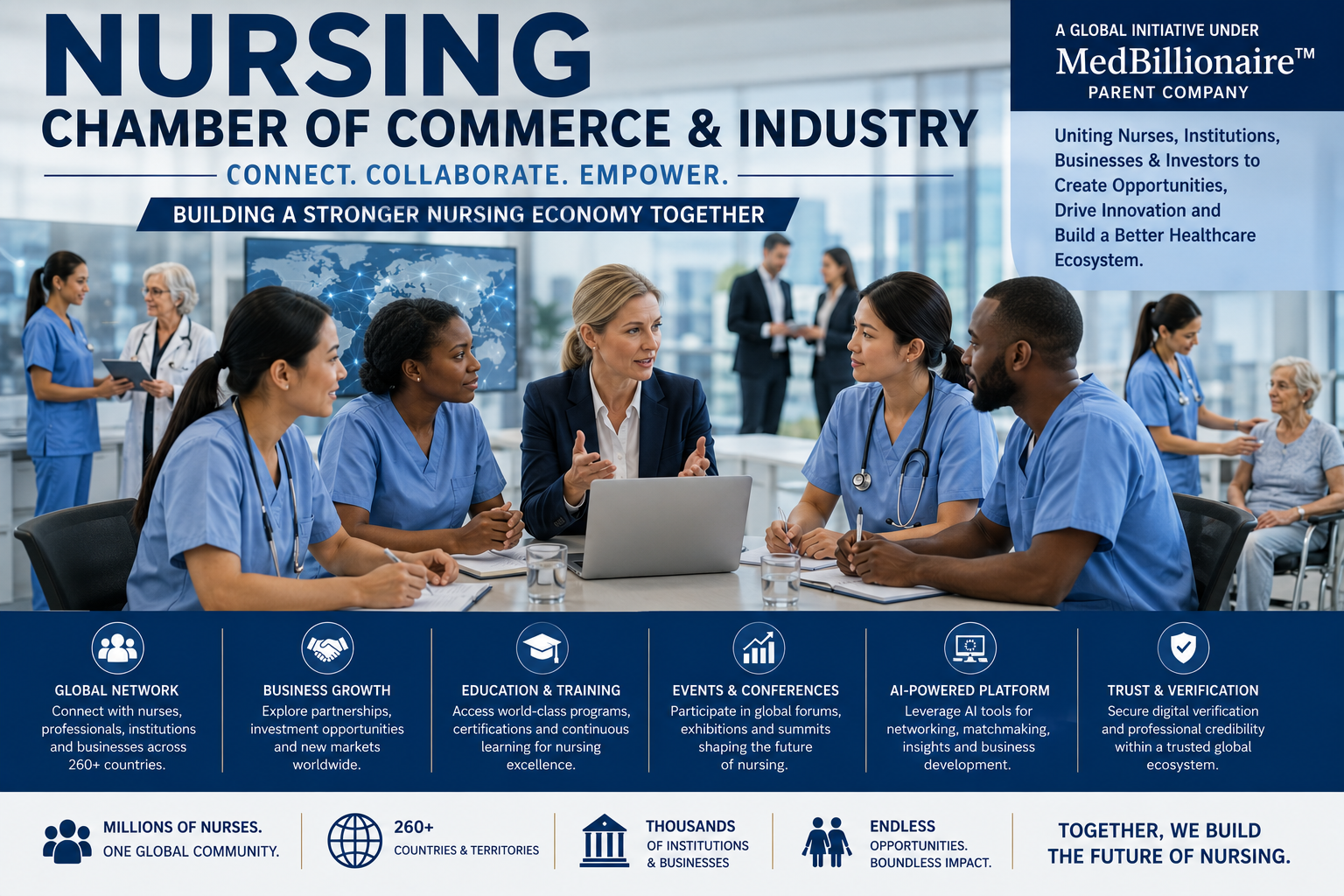
Nursing is one of the most important
components of the global healthcare system, yet the commercial infrastructure surrounding
the profession remains fragmented. Nurses work across hospitals, clinics,
universities, home healthcare, rehabilitation, long-term care, digital health,
research, medical technology, education, staffing, and countless other areas.
At the same time, businesses serving nurses and nursing organizations often
operate independently, with limited access to international commercial
networks.
A Nursing Chamber
of Commerce & Industry can provide a structured environment for
bringing these professional and commercial interests together.
Within the MedBillionaire™
ecosystem, the concept of a Nursing Chamber is connected to the broader Federation
of Medical Chambers of Commerce & Industry (FMCCI). FMCCI is
described as a United States-incorporated global federation being developed to
establish and connect Medical Chambers across countries, territories, regions,
and cities.
The nursing-focused chamber concept
takes that infrastructure and applies it specifically to the nursing economy.
Rather than functioning solely as a
professional association, the proposed model treats a Nursing Chamber as a commercial
healthcare enterprise capable of connecting nurses, nursing businesses,
educational institutions, healthcare employers, technology companies,
investors, and strategic partners.
The objective is not to replace
professional nursing regulators, licensing authorities, nursing unions,
accreditation organizations, or governmental healthcare bodies. Instead, the
commercial chamber concept is intended to create an additional business and
economic-development layer around the nursing sector.
What
Is a Nursing Chamber of Commerce & Industry?
A Nursing Chamber of Commerce &
Industry can be understood as a specialized commercial organization focused on
the economic, entrepreneurial, educational, technological, and business
interests surrounding nursing.
A conventional chamber of commerce
generally connects businesses within a geographic area. A nursing-focused
chamber applies a similar concept to a particular healthcare vertical.
Its potential community could
include:
- Registered nurses
- Nurse practitioners
- Nurse educators
- Nursing researchers
- Nursing entrepreneurs
- Home healthcare companies
- Nursing staffing businesses
- Nursing schools
- Universities
- Hospitals
- Rehabilitation organizations
- Long-term care providers
- Digital health companies
- Medical technology companies
- Nursing software providers
- Pharmaceutical companies
- Medical-device manufacturers
- Healthcare investors
- Insurance organizations
- Healthcare consultants
- Training companies
- Recruitment agencies
- Medical publishers
The resulting organization could
become a meeting point between the professional nursing community and the
broader healthcare economy.
Under the FMCCI concept, the chamber
would also have access to shared technology, international networking
infrastructure, digital directories, business matchmaking, events, educational
resources, verification systems, and commercial opportunities.
Why Nursing Needs Commercial Infrastructure
Nursing is not limited to bedside
care.
The profession interacts with almost
every part of the healthcare economy.
A nurse may become a healthcare
entrepreneur, establish a home-care company, develop a nursing education
platform, create healthcare software, build a staffing agency, participate in medical
research, launch a wellness business, develop a medical-device company, or
establish a consulting practice.
However, these activities frequently
exist in separate commercial ecosystems.
A Nursing Chamber could create a
central platform where these interests can interact.
For example, a nurse entrepreneur
developing a home healthcare business could potentially connect with:
- A technology company providing scheduling software
- A healthcare investor looking for opportunities
- A nursing school seeking clinical partnerships
- A medical-device manufacturer
- A hospital seeking external services
- A staffing company
- An insurance provider
- A healthcare consultant
- International partners
This is the fundamental
economic-development opportunity behind a specialized nursing chamber.
The Nursing Chamber Within the FMCCI Ecosystem
The Federation
of Medical Chambers of Commerce & Industry (FMCCI) is positioned
within the MedBillionaire™ ecosystem as a specialized global medical commercial
infrastructure.
Its broader objective is to create
interconnected Medical Chambers rather than isolated organizations.
A Nursing Chamber could therefore
operate as a specialized chamber or vertical within that larger network.
The relationship can be understood
conceptually as:
MedBillionaire™ → FMCCI → Medical
Chamber Network → Nursing Chamber → Local Nursing Business Community
The Nursing Chamber would focus
specifically on nursing while benefiting from access to the broader healthcare
network.
This creates opportunities for
nurses and nursing companies to interact with other medical sectors rather than
operating in isolation.
MedBillionaire™ as the Parent Platform
According to the supplied
MedBillionaire™ business framework, MedBillionaire™ serves as the parent
economic platform for a portfolio of specialized healthcare organizations
and companies.
The ecosystem is intended to
combine:
- Healthcare
- MedTech
- AI
- FinTech
- Corporate governance
- Entrepreneurship
- Education
- Digital infrastructure
- International business development
FMCCI is positioned as one of its
flagship organizations.
The Nursing Chamber concept fits
into this architecture by creating a specialized commercial community around
nursing.
This distinction is important.
The chamber is not intended to be
simply another nursing website or online directory. Its proposed purpose is to
develop a structured business organization with territorial operations,
membership, events, partnerships, technology, educational activities, and
commercial services.
The Core Purpose of a Nursing Chamber
A Nursing Chamber can have several
interconnected objectives.
1.
Professional Networking
The chamber can create opportunities
for nurses and nursing organizations to connect with each other.
2.
Entrepreneurship
Nurses interested in starting
businesses can gain access to business-development resources and networks.
3.
Healthcare Commerce
Companies selling products and
services to the nursing sector can connect with potential customers and
partners.
4.
Education
The chamber can facilitate business,
leadership, technology, and entrepreneurship education.
5.
International Collaboration
Nursing organizations in different
countries can potentially identify opportunities for collaboration.
6.
Technology Adoption
Digital health and AI companies can
introduce solutions designed for nursing organizations.
7.
Investment Connections
Qualified investors and nursing
entrepreneurs can potentially discover relevant business opportunities, subject
to applicable laws.
8.
Industry Representation
The chamber can provide a commercial
forum where nursing businesses discuss economic and operational priorities.
A Global Nursing Business Network
One of the most significant aspects
of the FMCCI model is its proposed international structure.
FMCCI intends to establish Medical
Chambers across approximately 260 countries and territories, with
additional opportunities for regional, provincial, state, and city-level
chambers where commercially appropriate.
A Nursing Chamber could therefore
become part of a much larger geographic network.
Consider the potential structure:
Global FMCCI
↓
National Medical Chamber
↓
Nursing Chamber
↓
Regional Nursing Network
↓
City-Level Nursing Business
Community
This structure could allow local
nursing organizations to participate in international healthcare commerce while
retaining a local operating focus.
Who Could Join a Nursing Chamber?
A specialized chamber should not
necessarily be restricted exclusively to individual nurses.
The nursing economy extends across
numerous organizations.
Nurses
and Nursing Professionals
Potential members could include:
- Registered nurses
- Nurse practitioners
- Nurse educators
- Nurse administrators
- Nursing researchers
- Nursing consultants
- Nursing entrepreneurs
- Clinical specialists
- Nursing executives
Membership requirements would depend
on the applicable chamber structure and local laws.
Nursing
Businesses
Businesses could include:
- Home healthcare agencies
- Nursing staffing companies
- Nurse recruitment firms
- Nursing consulting businesses
- Training providers
- Healthcare technology companies
- Nursing software companies
- Medical equipment suppliers
Educational
Institutions
The chamber could connect:
- Nursing schools
- Universities
- Colleges
- Training institutions
- Simulation centers
- Research institutions
Healthcare
Employers
Potential institutional participants
could include:
- Hospitals
- Clinics
- Rehabilitation centers
- Long-term care facilities
- Home healthcare organizations
- Community healthcare organizations
Strategic
Companies
Other participants could include:
- Pharmaceutical companies
- Medical-device companies
- Insurance organizations
- Digital health companies
- AI companies
- Healthcare financial services
- Healthcare logistics companies
This broad structure creates a
complete commercial ecosystem rather than a narrow professional directory.
The Commercial Model
The Nursing Chamber concept is
fundamentally different from a traditional nonprofit membership organization.
Under the supplied FMCCI framework,
territorial chambers are intended to operate as commercial companies.
Revenue opportunities could include:
- Membership programs
- Chamber licensing
- Conferences
- Nursing exhibitions
- Corporate sponsorship
- Advertising
- Education
- Certification
- Consulting
- AI services
- Business matchmaking
- Recruitment services
- Market intelligence
- Investment facilitation
- Digital services
- Strategic partnerships
The precise revenue model would
depend on the territory, operating agreements, applicable regulations, and
services actually offered.
Membership as a Revenue Stream
Membership could form the foundation
of the chamber's community.
Possible categories could include:
Individual
Membership
Designed for individual nursing
professionals.
Professional
Membership
For specialized nursing
professionals and independent practitioners.
Corporate
Membership
For companies operating in the
nursing and healthcare industries.
Institutional
Membership
For hospitals, universities, nursing
schools, and healthcare organizations.
Strategic
Membership
For investors, technology companies,
consultants, and strategic partners.
International
Membership
For organizations seeking
cross-border healthcare relationships.
Different membership levels could
provide different services, directories, event access, educational resources,
networking opportunities, and commercial visibility.
Nursing Conferences and Exhibitions
Events could become an important
part of the chamber's commercial model.
A Nursing Chamber could organize:
- Nursing leadership conferences
- Nursing entrepreneurship summits
- Healthcare technology exhibitions
- Nursing education forums
- Home healthcare conferences
- Nurse staffing conferences
- AI-in-nursing events
- Healthcare investment forums
- International nursing trade delegations
- Nursing innovation exhibitions
Such events could bring together
professionals who normally operate in separate sectors.
For example, a nursing technology
exhibition could connect nurses with software companies, AI developers,
medical-device manufacturers, hospital administrators, investors, and
educational institutions.
Nursing Entrepreneurship
One of the strongest commercial
applications of the chamber model is nursing entrepreneurship.
Nurses possess extensive practical
knowledge of healthcare workflows.
That experience can sometimes lead
to entrepreneurial ideas involving:
- Home healthcare
- Telehealth
- Patient education
- Elder care
- Healthcare staffing
- Clinical software
- Nursing education
- Medical transportation
- Healthcare consulting
- Medical supplies
- Wellness services
- Healthcare content
- Workforce technology
A Nursing Chamber could provide an
environment where these ideas are connected to commercial resources.
The chamber itself would not
necessarily build every business.
Instead, its role could be to
facilitate connections among entrepreneurs, investors, technology companies,
educators, and healthcare institutions.
AI Infrastructure for the Nursing Chamber
AI is another major component of the
proposed FMCCI infrastructure.
A nursing-focused chamber could use
AI for operational and commercial functions such as:
- Member onboarding
- CRM management
- Directory organization
- Business matchmaking
- Event recommendations
- Content generation
- Market research
- Lead identification
- Translation
- Education
- Customer support
- Analytics
- Report generation
- Opportunity discovery
For example, a nursing entrepreneur
looking for a technology partner could potentially use an AI-powered matching
system to identify relevant companies within the chamber network.
Similarly, a nursing school could
potentially identify hospitals, educators, technology providers, or
international institutions relevant to a particular program.
AI would therefore function as an
infrastructure layer rather than simply a marketing feature.
Digital Nursing Directory
A major feature of a Nursing Chamber
could be its digital directory.
A chamber directory could contain
verified or appropriately documented profiles for:
- Nursing professionals
- Nursing companies
- Hospitals
- Educational institutions
- Technology providers
- Healthcare suppliers
- Consultants
- Investors
- Strategic partners
Depending on applicable privacy,
professional licensing, and data-protection requirements, profiles could
display relevant business information without exposing inappropriate personal
data.
The directory could become a
discovery engine for the nursing economy.
FMCCI.org and the Digital Headquarters
The supplied FMCCI framework
identifies FMCCI.org as the intended global digital headquarters of the
federation.
Within that infrastructure, a
Nursing Chamber could have a dedicated digital presence.
Possible functions could include:
- Chamber applications
- Membership enrollment
- Business directories
- Events
- Training
- Business opportunities
- Partnerships
- Digital verification
- News
- Market reports
- Educational resources
- Investor connections
This means the chamber's digital
infrastructure could extend beyond a basic informational website.
It could become the operational
interface connecting the chamber's physical activities with the wider
international network.
Business Matchmaking
Business matchmaking can become an
important service.
Imagine a nursing company seeking to
expand into another country.
It may need:
- Local distributors
- Recruitment partners
- Healthcare facilities
- Legal and regulatory advisors
- Technology providers
- Investors
- Insurance partners
- Educational institutions
A global chamber network could help
identify potential contacts.
Similarly, a hospital seeking a
nursing technology solution could potentially discover vendors through the
chamber's business network.
The chamber becomes a connection
infrastructure between supply and demand.
Nursing Education and Training
Education can extend beyond clinical
education.
The chamber could support
business-oriented learning in areas such as:
- Healthcare entrepreneurship
- Business planning
- Financial management
- Leadership
- Corporate governance
- AI adoption
- Digital health
- Marketing
- International expansion
- Healthcare compliance
- Human-resource management
- Strategic planning
These programs could complement,
rather than replace, formal nursing education and legally required professional
training.
Corporate Governance
Because the FMCCI framework proposes
independently incorporated chamber companies, governance becomes an important
part of the model.
A chamber company may need
appropriate systems for:
- Directors
- Shareholders
- Financial reporting
- Internal controls
- Contracts
- Risk management
- Compliance
- Performance reporting
- Corporate records
- Strategic planning
The exact requirements would depend
on the company's structure and applicable jurisdiction.
Within the MedBillionaire™ concept,
chamber leadership may also receive training designed around the discipline
associated with institutional businesses.
The 51% / 49% Ownership Structure
According to the supplied
MedBillionaire™ and FMCCI framework, each approved territorial chamber would
ordinarily operate through a separately incorporated U.S. C-corporation.
The proposed standard structure is:
MedBillionaire™ or its designated
holding company — 51%
Strategic operating partner or
investor group — up to 49%
This means a territorial partner
would potentially participate in the ownership of the chamber company rather
than simply paying for a membership.
The partner would be expected to
help develop the territory while benefiting from access to the broader FMCCI
infrastructure.
Actual ownership terms, shareholder
rights, pricing, governance, transfer restrictions, and responsibilities would
be established through the applicable legal agreements.
How a Nursing Chamber Could Be Valued?
Not every territory has identical
commercial potential.
The proposed FMCCI framework
therefore contemplates territory-based valuation.
Factors could include:
- Population
- GDP
- Healthcare spending
- Nursing workforce
- Number of hospitals
- Number of nursing schools
- Healthcare business density
- Pharmaceutical activity
- Medical technology activity
- Insurance penetration
- Investment activity
- Medical tourism
- Purchasing power
- Geographic importance
- Digital adoption
A major global healthcare center
could therefore have different commercial characteristics from a smaller
regional market.
This approach provides a framework
for evaluating a chamber based on its underlying market rather than treating
every territory as identical.
Licensing a Nursing Chamber
Under the FMCCI framework, the
opportunity is not simply to purchase a membership.
A qualified operating partner may
seek the right to develop a Medical Chamber within a particular territory.
The general process may involve:
- Submitting an application
- Identifying proposed shareholders and management
- Completing identity and background verification
- Reviewing the proposed territory
- Assessing commercial potential
- Determining applicable equity and licensing terms
- Incorporating the operating company where appropriate
- Signing shareholder and operating agreements
- Completing payment obligations
- Training chamber leadership
- Activating the chamber's digital infrastructure
- Launching membership and commercial activities
The final process would depend on
the applicable legal and commercial documentation.
Public-Company Discipline Without Automatic Public
Listing
An important distinction should be
maintained between a privately held chamber company and a publicly traded
corporation.
Under the supplied MedBillionaire™
concept, chamber companies may be developed using principles associated with Pre-Public
Companies™.
This means the company can be
structured with an emphasis on:
- Governance
- Financial reporting
- KPI management
- Internal controls
- Corporate strategy
- Shareholder relations
- Risk management
- Institutional planning
However, being a C-corporation with
shareholders does not automatically make a company publicly listed.
Any future securities offering or
stock-exchange listing would require appropriate legal, financial, disclosure,
regulatory, and exchange processes.
Nursing Industry Intelligence
A sophisticated chamber can also
function as a source of industry intelligence.
Potential publications could
include:
- Nursing workforce reports
- Nursing business trends
- Healthcare technology reports
- Staffing market analysis
- Home healthcare trends
- Nursing entrepreneurship reports
- Education market reports
- Investment trends
- Regional healthcare reports
- AI adoption studies
Such reports could be available to
members, corporate partners, institutions, or other authorized users depending
on the business model.
Nursing Recruitment and Workforce Development
Healthcare workforce shortages and
workforce mobility make recruitment another potentially important commercial
area.
A Nursing Chamber could facilitate
relationships among:
- Nurses
- Hospitals
- Staffing companies
- Recruitment agencies
- Educational institutions
- International healthcare organizations
However, recruitment and
professional placement must comply with applicable licensing, immigration,
employment, privacy, and healthcare laws.
The chamber's role would therefore
be commercial networking and infrastructure rather than bypassing professional
or governmental requirements.
International Medical Commerce
A Nursing Chamber would not operate
in isolation from the rest of healthcare.
Nursing depends on:
- Medical devices
- Pharmaceuticals
- Diagnostics
- Digital health
- Hospital infrastructure
- Insurance
- Education
- Workforce services
- Medical software
- Patient-care technologies
The FMCCI network can therefore
connect nursing organizations with other healthcare industries.
This is where the broader federation
becomes commercially relevant.
A nursing company could potentially
find a pharmaceutical partner through the pharmaceutical chamber, a technology
provider through a digital-health network, or an international healthcare
partner through another territorial chamber.
Performance Measurement
A chamber must ultimately
demonstrate whether it is creating economic activity.
Potential KPIs include:
- Active members
- Membership retention
- Membership revenue
- Corporate partnerships
- Event attendance
- Sponsorship revenue
- Business introductions
- Completed partnerships
- Educational participation
- Website engagement
- Digital directory growth
- International connections
- Published reports
- Commercial opportunities generated
- Financial performance
- Governance compliance
These metrics can help management
distinguish between a chamber that merely has a large directory and one that is
actively generating economic activity.
Exclusive Limited-Edition Healthcare Companies
The Nursing Chamber concept also
fits within the wider limited-edition healthcare company philosophy
described by MedBillionaire™.
MedBillionaire™ states that it
offers a curated portfolio of healthcare companies across medical and wellness
sectors.
The stated objective is to develop
businesses with frameworks intended to support:
- Scalability
- Innovation
- Operational development
- Strategic partnerships
- Long-term enterprise growth
A nursing-focused business can
therefore represent one specialized component within a larger healthcare
portfolio.
Built in the United States
According to the supplied
MedBillionaire™ framework, healthcare companies within the ecosystem are
incorporated, or intended to be incorporated, in the United States.
For FMCCI, the supplied structure
similarly contemplates territorial chamber companies being established as U.S.
C-corporations.
The U.S. corporate structure is
intended to provide standardization across the wider network while allowing
each chamber to develop a local commercial presence.
Local operations would still need to
comply with the laws and professional requirements applicable to the territory
in which the chamber operates.
A Limited-Availability Business Opportunity
The FMCCI concept uses a
limited-territory approach.
Instead of creating an unlimited
number of identical operating companies in the same territory, the framework
contemplates specific territorial rights.
This creates a defined operating
environment for each chamber.
For example, a specific city or
region could have an authorized chamber operator while other territories remain
available for future development.
The actual availability of any
particular territory would need to be confirmed through FMCCI's applicable
licensing process.
MedBillionaire™ and the Private Equity Stock Exchange
Concept
The MedBillionaire™ framework also
describes a future Private Equity Stock Exchange concept.
This should be understood as part of
the company's stated long-term vision rather than an assumption that every
chamber is automatically publicly traded.
Any future exchange participation,
securities transaction, private placement, public offering, or listing would be
subject to applicable securities laws, regulatory requirements, exchange rules,
corporate readiness, and the circumstances of the individual company.
For a Nursing Chamber, the immediate
focus remains the development of a viable operating company, membership community,
commercial services, and governance infrastructure.
Why a Nursing Chamber Could Matter to Healthcare
Entrepreneurs
The commercial value of a Nursing
Chamber ultimately depends on whether it solves meaningful problems.
Its potential value comes from
bringing fragmented groups into one environment.
A nursing entrepreneur may need
customers.
A hospital may need qualified
partners.
A technology company may need
healthcare users.
An investor may need opportunities.
A university may need industry
relationships.
A medical supplier may need
distribution.
A recruitment organization may need
employers.
A Nursing Chamber can potentially
connect these participants.
Its economic purpose is therefore network
creation, commercial facilitation, and sector development.
The Future of the Nursing Economy
The nursing profession is
increasingly intersecting with technology, entrepreneurship, education, home
healthcare, digital platforms, workforce management, and healthcare innovation.
This creates a broader nursing economy
beyond conventional clinical employment.
The next generation of nursing
businesses may involve:
- AI-enabled care coordination
- Remote monitoring
- Digital education
- Home healthcare
- Healthcare workforce technology
- Nursing analytics
- Patient engagement
- Clinical workflow systems
- Elder-care platforms
- Nursing entrepreneurship
- International education
- Healthcare consulting
A commercial chamber can provide an
infrastructure through which these businesses interact.
Frequently Asked Questions
What
is a Nursing Chamber of Commerce & Industry?
It is a specialized commercial
organization designed to connect nurses, nursing businesses, healthcare
institutions, educational organizations, technology companies, investors, and
strategic partners.
Is
a Nursing Chamber the same as a nursing regulator?
No. A commercial chamber should not
be confused with a government licensing authority or professional nursing
regulator. Its proposed role is business networking, economic development,
education, and commercial collaboration.
Who
can participate?
Depending on the chamber's
membership rules, participants may include nurses, nursing companies,
hospitals, universities, healthcare technology companies, suppliers, investors,
consultants, and other healthcare organizations.
Is
the Nursing Chamber part of MedBillionaire™?
Under the supplied framework, FMCCI
is positioned as an organization within the MedBillionaire™ ecosystem,
with specialized Medical Chambers potentially operating under the federation.
How
does FMCCI relate to a Nursing Chamber?
FMCCI is intended to provide the
broader international federation and infrastructure through which specialized
Medical Chambers can operate and connect.
Is
the chamber a nonprofit organization?
The supplied FMCCI commercial brief
describes FMCCI as a for-profit federation and its territorial chamber
companies as commercial enterprises.
Can
a chamber generate revenue?
Yes. The proposed model includes
potential revenue from membership, licensing, conferences, sponsorship,
education, certification, AI services, consulting, advertising, digital
services, business matchmaking, and strategic partnerships.
What
is the proposed ownership model?
According to the supplied framework,
MedBillionaire™ or its designated holding company retains 51%, while an approved
strategic operating partner or investor group may acquire up to 49%, subject to
the relevant agreements.
Does
owning shares automatically mean the chamber is publicly listed?
No. A privately held corporation
with shareholders is not automatically publicly traded. Any future public
offering or exchange listing would require the applicable regulatory and legal
processes.
What
is FMCCI.org?
FMCCI.org is described in the
supplied framework as the intended global digital headquarters for FMCCI,
supporting chamber licensing, directories, applications, events, digital
verification, business opportunities, education, and international
collaboration.
Can
a Nursing Chamber operate internationally?
The proposed FMCCI structure is
specifically designed for international networking. Actual operations in each
country would remain subject to local corporate, professional, commercial, tax,
privacy, employment, healthcare, and regulatory requirements.
What
makes the Nursing Chamber different from a nursing association?
A professional association may
primarily focus on professional development, advocacy, education, or member
interests. The proposed Nursing Chamber has a stronger commercial orientation,
emphasizing business development, networking, investment connections, trade,
technology, and entrepreneurship.
Conclusion, Creating an Economic Platform Around
Nursing
A Nursing Chamber of Commerce
& Industry can be viewed as more than a professional directory. Within
the proposed FMCCI and MedBillionaire™ structure, it represents a potential
commercial infrastructure for connecting the many businesses, professionals,
institutions, technologies, and investment interests surrounding nursing.
The underlying idea is
straightforward: nursing is a profession, but it is also part of a substantial
economic ecosystem.
Nurses work with hospitals.
Hospitals purchase technology. Technology companies require customers.
Universities educate the workforce. Staffing organizations connect
professionals with employers. Investors finance healthcare businesses.
Pharmaceutical and medical-device companies supply healthcare institutions.
Home healthcare organizations provide services directly to patients.
These relationships already exist,
but they are often fragmented.
A specialized chamber can create a
structured environment in which these participants discover one another and
develop commercial relationships.
Within the supplied MedBillionaire™
prospectus, FMCCI provides the broader federation, while specialized
chambers can create territorial and sector-specific commercial communities. AI,
digital directories, events, education, business matchmaking, verification,
market intelligence, and international networking can then become shared
infrastructure.
The long-term proposition is
therefore not simply to create another nursing organization.
It is to develop a business
network around the nursing economy, connecting local entrepreneurship with
an international healthcare ecosystem while allowing individual chambers to
retain local commercial focus.
The success of such a model would
ultimately depend on execution: strong governance, credible membership, useful
services, regulatory compliance, capable local leadership, sustainable revenue,
effective technology, and genuine value for participating healthcare
businesses.
That is what turns a chamber from a
name and directory into an operating economic institution.