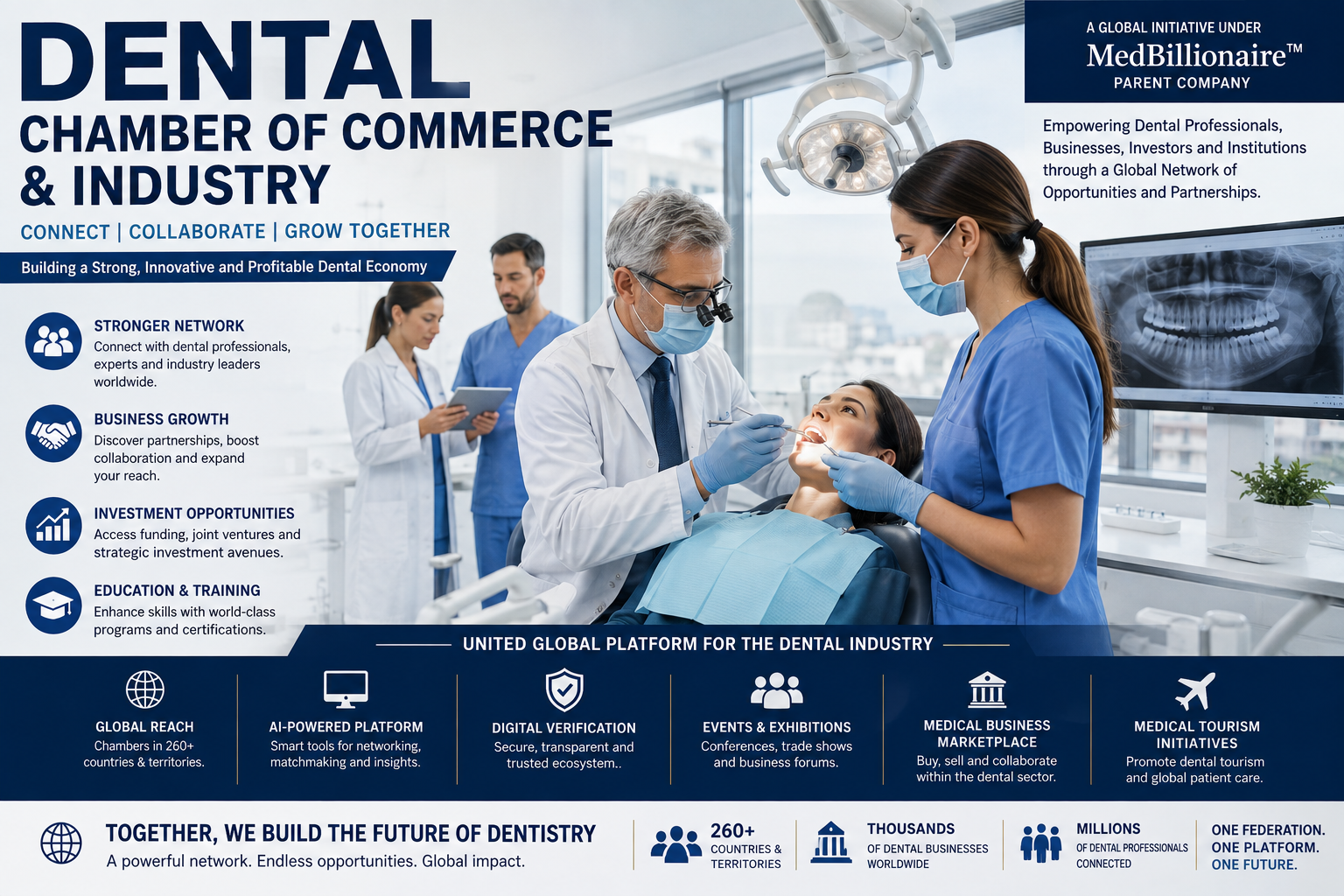
The dental industry is no longer
limited to dentists, dental clinics, and traditional practice management. It
has developed into a complex global economy involving dental technology,
laboratories, manufacturers, distributors, insurance providers, education
institutions, investors, software companies, medical tourism operators,
researchers, and thousands of specialized service providers.
As this industry becomes
increasingly interconnected, there is a growing need for commercial
infrastructure that can bring these different participants together.
The Dental Chamber of Commerce
& Industry concept developed within the MedBillionaire™ ecosystem
is designed around this opportunity.
Rather than treating a chamber
simply as a membership association, the concept positions a dental chamber as a
commercial, technology-enabled business organization capable of
connecting dental professionals, companies, institutions, investors, and
strategic partners within a defined territory while also linking that territory
to an international network.
At the broader level, the
Federation of Medical Chambers of Commerce & Industry (FMCCI) is
being developed as a United States-incorporated global organization within the
MedBillionaire™ ecosystem. Its proposed network is intended to connect
specialized medical chambers across countries, territories, regions, and
cities.
A Dental Chamber can therefore represent
a specialized commercial vertical within this larger healthcare infrastructure.
The objective is not simply to
create another directory of dentists. The objective is to develop a structured
business environment in which dental-sector participants can network, trade,
learn, form partnerships, discover investment opportunities, participate in
events, access technology, and expand internationally.
What
Is a Dental Chamber
of Commerce & Industry?
A Dental Chamber of Commerce &
Industry can be understood as a business organization focused specifically on
the economic and commercial interests of the dental sector.
A conventional chamber of commerce
generally connects businesses operating within a geographical area. A
specialized dental chamber adds an industry-specific dimension.
Its potential community could
include:
- Dentists
- Dental surgeons
- Orthodontists
- Prosthodontists
- Dental clinics
- Dental hospitals
- Dental laboratories
- Dental universities
- Dental schools
- Dental educators
- Dental equipment manufacturers
- Dental-material companies
- Implant companies
- Orthodontic companies
- Dental software providers
- Dental AI companies
- Dental insurance organizations
- Dental distributors
- Pharmaceutical companies
- Investors
- Private-equity firms
- Healthcare entrepreneurs
- Researchers
- Medical-tourism companies
- Professional-service providers
This creates an ecosystem that
extends beyond clinical dentistry.
A dental practice may need
equipment. A manufacturer needs distributors. A laboratory needs dentists. A
technology company needs customers. An investor may seek dental businesses. A
university may need industry relationships. A dental entrepreneur may need
international partners.
The chamber can provide an organized
environment where these relationships can develop.
Why the Dental Industry Needs Commercial Infrastructure?
Dentistry represents a highly
specialized portion of healthcare, but it also operates as a significant
commercial industry.
A modern dental practice may depend
on dozens of external businesses.
For example, a single clinic can
require:
- Dental chairs
- Imaging equipment
- Sterilization equipment
- Dental materials
- Implants
- Orthodontic products
- Laboratory services
- Practice-management software
- Appointment systems
- Payment technology
- Marketing services
- Insurance relationships
- Professional recruitment
- Continuing education
- Legal services
- Accounting
- Financing
The result is an extensive supply
chain.
A dental chamber can potentially
become a central business network connecting these participants.
Instead of each organization
searching independently for suppliers, partners, investors, educational
programs, and commercial opportunities, a specialized chamber can create
structured channels for those interactions.
This is particularly relevant as
dentistry becomes increasingly influenced by digital technology, artificial
intelligence, 3D printing, robotics, imaging, digital laboratories, clear
aligners, implantology, tele-dentistry, and data-driven practice management.
The commercial ecosystem around
dentistry is becoming more sophisticated.
A specialized chamber can evolve
alongside it.
The Dental Chamber Within the FMCCI Ecosystem
The Federation of Medical
Chambers of Commerce & Industry (FMCCI) is intended to provide the
broader infrastructure connecting medical chambers around the world.
Within that model, a Dental Chamber
can function as a specialized industry chamber.
The broader FMCCI network may
include chambers serving different healthcare sectors and professional
communities, while the dental vertical focuses specifically on the dental
economy.
This creates two layers.
The
Local Layer
The local Dental Chamber develops
relationships with:
- Dentists
- Clinics
- Laboratories
- Universities
- Manufacturers
- Suppliers
- Investors
- Healthcare businesses
The
International Layer
The Dental Chamber connects into the
broader FMCCI network, potentially allowing members to discover opportunities
beyond their immediate geographical market.
For example, a dental manufacturer
in one country could potentially identify distributors in another.
A dental laboratory could explore
international partnerships.
A dental technology company could
seek healthcare investors.
A dental education institution could
establish relationships with organizations abroad.
This creates a bridge between local
dental commerce and international healthcare commerce.
MedBillionaire™ as the Parent Ecosystem
The Dental Chamber concept is
positioned within the broader MedBillionaire™ ecosystem.
MedBillionaire™ serves as the parent
platform described in the supplied project framework, bringing together
healthcare businesses, technology, corporate development, investment concepts,
AI infrastructure, and specialized organizations.
Within this structure, FMCCI
represents a proposed global medical chamber network.
A Dental Chamber represents a more
specialized business community within that network.
This distinction is important.
The Dental Chamber is not intended
to replace professional dental regulators, licensing boards, government health
authorities, accreditation organizations, or professional associations whose
functions are established by law.
Instead, its proposed role is
commercial and economic.
Its activities can focus on:
- Business networking
- Commercial development
- Education
- Events
- Trade
- Investment connections
- Technology adoption
- International collaboration
- Business matchmaking
- Entrepreneurship
- Market intelligence
Professional licensing and clinical
regulation would remain matters for the applicable authorities in each
jurisdiction.
A New Model for Dental Business Networking
Traditional professional networking
can be fragmented.
A dentist may belong to a
professional association.
A dental laboratory may belong to a
local business association.
A manufacturer may participate in
trade exhibitions.
An investor may operate through
financial networks.
A technology company may attend
technology conferences.
A university may have its own
industry partnerships.
These communities can exist
independently.
The Dental Chamber concept seeks to
bring these different groups into one commercial environment.
The result could be a network where
a dental professional does not only meet other dental professionals but can
also discover:
Technology → Suppliers → Investors →
Laboratories → Education → Partners → International Markets
That broader connectivity is one of
the central ideas behind the chamber model.
Who Could Become a Member?
A Dental Chamber can potentially
create multiple membership categories.
Dental
Professionals
Membership may be available to
qualified dental professionals and other appropriately eligible healthcare
professionals, subject to local requirements.
Possible categories could include:
- Dentists
- Dental surgeons
- Orthodontists
- Prosthodontists
- Periodontists
- Endodontists
- Oral surgeons
- Dental hygienists
- Dental technicians
- Dental educators
- Researchers
Dental
Businesses
Corporate members could include:
- Dental clinics
- Dental groups
- Dental laboratories
- Dental manufacturers
- Dental distributors
- Dental software companies
- Dental technology businesses
- Dental implant companies
- Orthodontic companies
- Dental supply companies
Institutions
Institutional participation could
include:
- Dental universities
- Dental colleges
- Research institutions
- Training centers
- Healthcare organizations
- Professional education organizations
Strategic
and Financial Partners
The network could also include:
- Investors
- Banks
- Private-equity organizations
- Insurance companies
- Technology investors
- Healthcare consultants
- Legal firms
- Accounting firms
- Business-development organizations
The objective is to create a broad
economic network rather than a narrowly defined professional directory.
What Can a Dental Chamber Actually Do?
A successful chamber needs
activities beyond membership collection.
The proposed model can generate
value through multiple programs.
Dental
Business Conferences
The chamber could organize
conferences bringing together dentists, manufacturers, technology companies,
investors, educators, and entrepreneurs.
Topics could include:
- Digital dentistry
- AI in dentistry
- Dental entrepreneurship
- Practice expansion
- Dental technology
- Dental laboratories
- Investment
- Healthcare financing
- International dental markets
These events could create sponsorship
and exhibition opportunities.
Dental Exhibitions and Trade Shows
Dental exhibitions are already an
important part of the global dental economy.
A chamber could organize specialized
exhibitions where companies demonstrate:
- Dental equipment
- Imaging systems
- Digital scanners
- Dental software
- Laboratory technology
- Orthodontic products
- Dental materials
- Implant systems
- AI solutions
The chamber could function as a
commercial bridge between manufacturers and buyers.
Dental Business Matchmaking
One of the potentially valuable
services of a Dental Chamber is structured business matchmaking.
Consider a dental manufacturer
seeking distribution partners.
Instead of relying solely on cold
outreach, the manufacturer could use the chamber network to identify relevant
businesses.
Similarly:
A clinic looking for a laboratory
could search the network.
A dental software company could
identify clinics interested in digital transformation.
An investor could discover dental
businesses seeking capital.
A dental entrepreneur could identify
potential acquisition or partnership opportunities.
The chamber therefore becomes a business-discovery
platform.
International Dental Trade
Dental commerce increasingly crosses
borders.
Manufacturers may produce products
in one country and distribute them in another.
Dental laboratories may provide
services internationally.
Patients may travel for dental
treatment.
Technology companies may sell
software globally.
Universities may collaborate
internationally.
A global Dental Chamber network can
potentially support these relationships by providing a structured commercial
environment.
The chamber does not eliminate the
need for import rules, licensing, product approvals, customs requirements,
professional regulations, or other legal obligations.
Instead, it can help businesses
identify opportunities while encouraging them to obtain the appropriate
approvals before conducting regulated activities.
Dental Investment Opportunities
Another potential function is
investment facilitation.
Dental businesses can include:
- Clinics
- Multi-location practices
- Dental laboratories
- Technology companies
- Software companies
- Manufacturing companies
- Medical-tourism businesses
- Education platforms
Some may seek capital for expansion.
A Dental Chamber can provide a
platform for companies to present legitimate business opportunities to
qualified investors, subject to securities laws and applicable financial
regulations.
The chamber itself would not
automatically make an investment opportunity legitimate or guarantee investment
returns.
Its role would be to create a
structured environment for introductions and commercial discussions.
AI-Powered Dental Chamber Infrastructure
Artificial intelligence is an
important part of the proposed FMCCI model.
A large international chamber
network could potentially generate enormous quantities of information.
AI can help organize this
information.
Potential applications include:
Intelligent
Member Matching
AI could identify businesses with
complementary needs.
Automated
Onboarding
Applications and documentation could
be organized through digital workflows.
Business
Discovery
Members could search for companies,
products, professionals, events, and opportunities using natural-language
queries.
Event
Management
AI can assist with:
- Event scheduling
- Speaker discovery
- Attendee communication
- Registration
- Follow-up
- Reporting
Market
Intelligence
AI systems could help organize
information relating to dental markets, technologies, business trends, and
commercial opportunities.
Multilingual
Communication
Because FMCCI is intended to operate
internationally, AI-powered translation could help participants communicate
across language barriers.
The purpose is not to replace
professional judgment.
AI functions should support human
operators while maintaining appropriate privacy, cybersecurity, compliance, and
data-governance controls.
FMCCI.org as the Digital Headquarters
The proposed FMCCI.org platform
is intended to serve as the digital headquarters of the federation.
For a Dental Chamber, the platform
could provide a centralized digital presence.
Potential functions include:
- Chamber licensing
- Partner applications
- Member registration
- Digital verification
- Member directories
- Dental company directories
- Events
- Conferences
- Business opportunities
- Educational resources
- Investor connections
- International collaboration
- News
- Market information
A local Dental Chamber could
therefore have a physical business presence while maintaining an integrated
digital presence within the global FMCCI infrastructure.
The Dental Chamber as a Commercial Enterprise
An important feature of the
MedBillionaire™ model is that territorial chambers are envisioned as commercial
companies rather than merely local associations.
According to the supplied project
brief, each FMCCI Chamber is intended to be incorporated as an independent U.S.
C-Corporation.
The proposed ownership structure is:
- MedBillionaire™: 51%
- Strategic operating partner: up to 49%
The local operating partner would be
responsible for developing the chamber within the approved territory, while the
wider FMCCI infrastructure could provide technology, branding, AI systems,
international networking, and strategic support.
The exact structure, valuation,
agreements, and regulatory arrangements would depend on the specific transaction
and applicable law.
Why a Dental Entrepreneur Might Consider a Chamber
Business?
The opportunity is different from
simply opening another dental clinic.
A clinic primarily generates revenue
from patient services.
A Dental Chamber could potentially
generate revenue from an entire business community.
Its revenue model could include:
- Memberships
- Corporate memberships
- Conferences
- Exhibitions
- Sponsorships
- Advertising
- Education
- Training
- Certification
- AI services
- Business matchmaking
- Consulting
- Market intelligence
- Digital services
- Strategic partnerships
This means the business model is
based on ecosystem participation rather than exclusively on clinical treatment.
For an entrepreneur with
business-development capabilities, this distinction can be significant.
Building Enterprise Value Over Time
A chamber's long-term commercial
value could depend on the strength of its network.
Important indicators could include:
- Number of active members
- Corporate membership
- Revenue
- Member retention
- Events
- Sponsorships
- Digital traffic
- Business introductions
- International partnerships
- Educational activity
- Market presence
- Operating margins
- Governance
- Brand reputation
A chamber with a strong membership
community and recurring commercial activity can become more valuable than a
chamber that simply possesses a large contact database.
The objective is therefore not
merely to collect members.
It is to create an active
economic network.
Dental Entrepreneurship and the Future of the Industry
The dental sector is undergoing
significant technological change.
Digital impressions, CAD/CAM
systems, 3D printing, artificial intelligence, remote consultations, digital
imaging, practice-management platforms, robotics, and advanced laboratory
technologies are changing how dental businesses operate.
This creates opportunities for
entrepreneurs beyond conventional clinical practice.
A dentist may become a clinic
operator.
A technology entrepreneur may
develop dental software.
An investor may finance dental
expansion.
A manufacturer may build a
distribution network.
A laboratory may develop
international services.
A chamber can provide the common
commercial infrastructure connecting these participants.
This is why the Dental Chamber
concept fits within a broader healthcare-business ecosystem.
Healthcare
Company Buying Requirements Under the MedBillionaire™ Ecosystem
Participation in a MedBillionaire™
healthcare company or chamber opportunity should be approached as a corporate
transaction rather than simply as a membership purchase.
Potential buyers and operating
partners may need to satisfy requirements relating to:
Identity
Verification
Applicants should be prepared to
provide appropriate identification and corporate information.
Source
of Funds
Where required, applicants may need
to demonstrate that funds used for an investment or acquisition come from
lawful sources.
Professional
Background
Relevant healthcare, business,
investment, management, technology, or commercial experience may be considered
depending on the opportunity.
Corporate
Due Diligence
Potential partners may undergo
background and corporate checks before entering agreements.
Governance
Shareholders and directors may need
to comply with corporate governance requirements.
Regulatory
Compliance
Healthcare-related activities must
comply with the laws and regulations applicable to the territory in which they
operate.
Shareholder
Agreements
Ownership rights, responsibilities,
voting rights, transfers, distributions, and other matters should be governed
by formal legal documentation.
Operating
Capability
A territorial chamber requires
people capable of developing membership, partnerships, events, sales,
communications, and local relationships.
The specific requirements should
always be confirmed through the applicable FMCCI and MedBillionaire™
agreements.
Exclusive Limited-Edition Healthcare Companies
The Dental Chamber concept also fits
into MedBillionaire™'s broader strategy of developing exclusive,
limited-edition healthcare companies.
Rather than creating unlimited
businesses under the same structure, the ecosystem is designed around a
selective portfolio of healthcare enterprises.
These companies can operate across
different healthcare and wellness sectors.
The limited-availability approach is
intended to support distinct territorial and business opportunities while
creating a structured portfolio of companies.
Built in the United States
According to the supplied
MedBillionaire™ framework, healthcare companies within the ecosystem are
incorporated, or intended to be incorporated, in the United States.
For FMCCI, the proposed model
specifically uses independent U.S. C-Corporations for territorial chambers.
This creates a standardized
corporate framework while allowing individual chambers to develop local
commercial operations.
The fact that a company is
U.S.-incorporated does not eliminate the requirement to comply with the laws of
the countries and territories where it conducts business.
A Limited-Availability Business Opportunity
The FMCCI model is based on
territorial allocation.
The intention is to develop a
limited number of chambers rather than create an unlimited number of identical
operating companies.
A territory could therefore
represent a defined commercial opportunity.
The practical value of that
territory would depend on factors such as market size, healthcare activity,
management capability, revenue development, and the terms of the relevant
agreement.
Limited availability should not be
interpreted as a guarantee of profitability or enterprise value.
Ownership Structure and Local Entrepreneurship
The proposed 51/49 structure creates
a relationship between the parent ecosystem and the local operating partner.
MedBillionaire™ retains the majority
interest.
The approved partner can hold up to
49%, subject to the applicable agreements.
This arrangement is designed to
combine:
Centralized infrastructure + local
entrepreneurship
The local operator understands the
market.
The federation provides the broader
network.
The parent company provides
strategic infrastructure.
The result is intended to create a
scalable model in which local chambers can develop while remaining connected to
the international organization.
Vision for Long-Term Growth
According to the MedBillionaire™
framework, the long-term objective is to develop healthcare companies that
focus on:
- Innovation
- Operational excellence
- Scalability
- Technology
- Corporate governance
- International expansion
- Enterprise development
The broader ecosystem also describes
a future Private Equity Stock Exchange concept.
Any future participation, securities
offering, exchange activity, or listing would remain dependent on the
applicable legal structure, regulatory approvals, securities laws, financial
requirements, and the circumstances of each individual company.
Ownership in a private company
should not be understood as an automatic public-market listing or guaranteed
increase in value.
What Makes the Dental Chamber Concept Different?
The central difference is the scope
of the business model.
A conventional dental association
may primarily focus on professional activities.
A conventional chamber may focus on
general business networking.
A Dental Chamber of Commerce &
Industry combines the two commercial dimensions around a specific healthcare
sector.
Its potential ecosystem includes:
Professionals + Clinics +
Laboratories + Manufacturers + Technology + Investors + Education +
International Trade
This creates a much broader
commercial network.
The Long-Term Opportunity for Dental Businesses
The future dental economy is likely
to become increasingly interconnected.
Dental practices will interact with
technology companies.
Laboratories will become
increasingly digital.
Manufacturers will require
sophisticated distribution systems.
Investors will evaluate healthcare
businesses using more complex financial and operational data.
Patients will increasingly encounter
digital healthcare journeys.
Education will become more
technology-driven.
International healthcare commerce
will continue to create new relationships.
A Dental Chamber can provide
infrastructure for these interactions.
Its purpose is therefore not simply
to create another professional organization.
It is to create a commercial operating
layer around the dental economy.
Frequently Asked Questions
What
is a Dental Chamber of Commerce & Industry?
A Dental Chamber of Commerce &
Industry is a specialized business organization focused on connecting dental
professionals, dental companies, institutions, investors, technology providers,
and strategic partners.
Is
the Dental Chamber a dental licensing authority?
No. A commercial chamber should not
be confused with a government dental board or professional licensing authority.
Licensing and clinical regulation remain matters for the appropriate
authorities.
What
is FMCCI?
The Federation
of Medical Chambers of Commerce & Industry (FMCCI) is being
developed within the MedBillionaire™ ecosystem as a proposed international
federation connecting Medical Chambers and specialized healthcare business
communities.
What
is the role of MedBillionaire™?
MedBillionaire™ serves as the parent
ecosystem described in the supplied framework. It provides the broader
corporate, strategic, technological, and business-development infrastructure
around specialized healthcare enterprises.
Can
a Dental Chamber generate revenue?
Under the proposed model, revenue
could come from memberships, conferences, exhibitions, sponsorships, education,
AI services, advertising, certification, consulting, digital services, and
strategic partnerships.
Who
can participate?
Potential participants can include
dental professionals, clinics, laboratories, manufacturers, distributors,
universities, technology companies, investors, insurers, researchers, and other
appropriately qualified healthcare businesses.
How
does the proposed ownership structure work?
According to the supplied project
brief, MedBillionaire™ retains 51% while up to 49% may be made available to a
qualified strategic operating partner, subject to the applicable agreements and
legal requirements.
Is
the Dental Chamber limited to one country?
The broader FMCCI concept is
intended to create Medical Chambers across approximately 260 countries and
territories, with additional regional and city-level opportunities where
commercially appropriate.
What
is FMCCI.org?
FMCCI.org is intended to function as
the digital headquarters of the federation, supporting chamber licensing,
directories, applications, events, digital verification, education, business
opportunities, and international collaboration.
How
can AI be used by a Dental Chamber?
AI may support member onboarding,
CRM, business matching, marketing, event management, research, content,
education, translation, reporting, and other administrative processes.
Does
becoming a shareholder guarantee profitability?
No. Ownership in a company does not
guarantee profits, appreciation, dividends, liquidity, or a future public
listing. Commercial outcomes depend on execution, market conditions,
governance, financial performance, regulation, and other factors.
Does
owning a chamber automatically mean it will be publicly listed?
No. Any future listing or securities
activity would require the applicable legal, financial, disclosure, regulatory,
and exchange requirements to be satisfied.
Conclusion: Creating a Commercial Network for the
Dental Economy
The Dental Chamber of Commerce
& Industry represents a proposed new layer of commercial infrastructure
for the global dental sector.
Instead of limiting the concept to
professional networking, the model brings together dental professionals,
businesses, manufacturers, laboratories, technology companies, universities,
investors, educators, and strategic partners.
Within the broader FMCCI
network, a Dental Chamber can provide a local gateway into an international
healthcare business ecosystem.
Within the MedBillionaire™
ecosystem, it represents a specialized commercial enterprise designed around
membership, business development, technology, education, trade, investment
connections, and international collaboration.
The proposed model combines local
autonomy with centralized infrastructure: an independently incorporated
territorial company can develop its own market while accessing shared
technology, branding, AI infrastructure, digital platforms, and international
relationships.
The most important consideration is
that the Dental Chamber should be viewed as a business infrastructure
platform, not merely as a membership badge.
Its potential strength comes from
the network it creates.
A successful chamber could connect
the dentist with the laboratory, the laboratory with the manufacturer, the
manufacturer with the distributor, the technology company with the clinic, the
entrepreneur with the investor, and the local dental market with international
opportunities.
That is the underlying commercial
idea behind the Dental Chamber of Commerce & Industry within the FMCCI and
MedBillionaire™ framework: build the network, connect the participants,
create commercial activity, and develop a scalable healthcare business
ecosystem while maintaining appropriate corporate, professional, financial, and
regulatory standards.