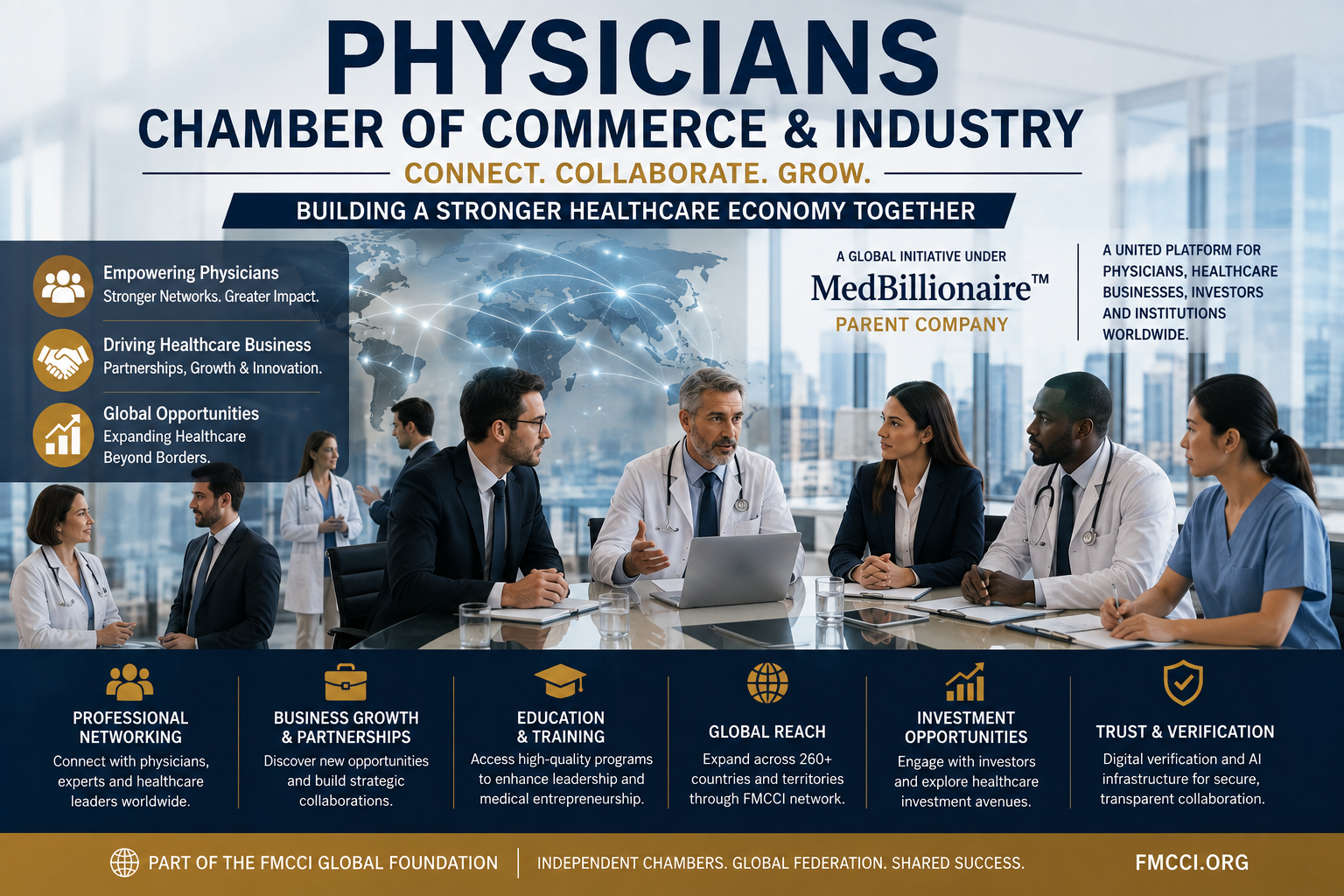
The healthcare industry is becoming
increasingly interconnected. Physicians, hospitals, clinics, pharmaceutical
companies, medical-technology businesses, investors, universities, insurers,
researchers, and healthcare entrepreneurs increasingly operate across
organizational and geographic boundaries. As healthcare becomes more digital
and commercially integrated, there is growing importance in creating structured
networks through which these participants can communicate, collaborate,
exchange knowledge, develop partnerships, and explore new markets.
Within this changing environment,
the concept of a Physicians Chamber of Commerce & Industry can
provide a specialized business platform focused specifically on the medical
profession and the wider healthcare economy.
Within the MedBillionaire™
ecosystem, this concept is connected to the proposed Federation of
Medical Chambers of Commerce & Industry (FMCCI). According to the
supplied project brief, FMCCI is envisioned as a global, for-profit federation
developing and connecting Medical Chambers across countries, territories,
states, provinces, regions, and major cities.
The purpose is not simply to create
another professional directory. The proposed model combines chamber operations
with business networking, AI infrastructure, healthcare commerce, education,
investment facilitation, digital verification, events, media, and international
collaboration.
This article explores what a
Physicians Chamber of Commerce & Industry could mean, how such an
organization can operate, the proposed FMCCI structure, and how the concept
fits within MedBillionaire™.
What
Is a Physicians Chamber
of Commerce & Industry?
A Physicians Chamber of Commerce
& Industry can be understood as a specialized commercial and professional
network focused on physicians and businesses connected to healthcare.
Traditional chambers of commerce
generally bring together businesses from multiple industries. A
physician-focused chamber takes a narrower approach by concentrating on the
medical ecosystem.
Potential participants could
include:
- Physicians
- Surgeons
- Dentists
- Pharmacists
- Nurses
- Medical researchers
- Hospitals
- Clinics
- Diagnostic laboratories
- Pharmaceutical companies
- Medical-device companies
- Health-technology businesses
- Healthcare software companies
- Medical universities
- Investors
- Insurers
- Medical distributors
- Medical tourism businesses
- Healthcare consultants
The supplied FMCCI brief describes a
substantially broader network, including medical professionals, healthcare
institutions, healthcare businesses, investors, financial organizations, and
strategic partners.
The idea is to create a business
environment where physicians are not isolated from the commercial
infrastructure surrounding modern healthcare.
Why a Specialized Physicians Chamber Matters
Medicine is both a professional
discipline and a major economic sector.
A physician may operate a private
practice, participate in a hospital, establish a medical technology company,
invest in healthcare businesses, conduct research, teach at a university, or
become involved in medical entrepreneurship.
Each activity creates different
relationships.
For example, a physician developing
a healthcare software product may need technology partners and investors. A
hospital may require medical-device suppliers. A pharmaceutical company may
need physician networks and distribution relationships. A medical university
may seek international research partnerships.
A specialized chamber can
potentially provide a structured environment where these relationships can
develop.
The purpose is therefore broader
than networking.
It can include:
Professional connection — bringing physicians and healthcare professionals
together.
Commercial connection — connecting healthcare businesses with buyers, suppliers,
and partners.
Investment connection — facilitating introductions between qualified businesses
and investors where legally permitted.
Educational connection — creating programs around leadership, management,
technology, governance, and entrepreneurship.
International connection — connecting healthcare organizations across markets.
The Physicians Chamber Concept Within MedBillionaire™
The proposed Physicians Chamber
model forms part of the broader Federation of Medical Chambers of Commerce
& Industry (FMCCI) concept under MedBillionaire™.
According to the supplied brief,
FMCCI is intended to establish a network of independent Medical Chambers while
connecting them through shared technology, branding, governance standards,
commercial infrastructure, and international relationships.
MedBillionaire™ is described in the
source document as the parent economic platform supporting specialized
organizations within its ecosystem.
The proposed structure can therefore
be viewed as:
MedBillionaire™ → FMCCI →
Territorial Medical Chambers → Physicians, Healthcare Businesses &
Institutions
This structure is designed to
combine centralized infrastructure with local market development.
A Global Federation of Medical Chambers
The FMCCI concept is intended to
operate internationally rather than as a single-city organization.
The supplied project brief proposes
coverage of approximately 260 countries and territories, approximately 1,000
major cities, and potential expansion into additional states, provinces,
regions, commercial zones, and potentially 2,000 cities or more.
The practical objective is to create
a network in which a physician, hospital, healthcare company, or investor can
potentially participate locally while having access to an international
network.
For example, a physician-led
healthcare company in one market could potentially discover:
- A technology partner in another country
- A medical distributor in another region
- An investor in another financial center
- A research institution overseas
- A hospital seeking a strategic partner
- A medical tourism opportunity
- A healthcare acquisition opportunity
The value of the model therefore
depends substantially on the strength and activity of the network.
How the Proposed Chamber Companies Are Structured
One of the distinctive elements of
the supplied FMCCI proposal is its commercial corporate structure.
According to the brief, each
approved territorial chamber would ordinarily operate through a separately
incorporated United States C-Corporation. The proposed standard
ownership model provides for MedBillionaire™ or its designated holding
company to retain 51%, while an approved territorial partner or investor
group may acquire up to 49%, subject to the applicable agreements.
This means the proposed opportunity
is different from simply purchasing a membership.
A territorial partner would
participate in an operating company responsible for developing the Medical
Chamber within a designated territory.
The precise:
- Equity price
- Shareholder rights
- Governance provisions
- Responsibilities
- Licensing terms
- Transfer restrictions
- Financial obligations
would need to be established through
the relevant legal and commercial documentation.
Territory-Based Business Development
Not every healthcare market has the
same economic characteristics.
A major international financial
center may have a larger healthcare investment ecosystem than a smaller city.
Similarly, countries can differ considerably in healthcare expenditure,
physician populations, pharmaceutical markets, medical tourism, insurance
coverage, and purchasing power.
The FMCCI project brief proposes
evaluating chamber opportunities according to territory-specific factors
including GDP, population, healthcare expenditure, number of hospitals and
physicians, pharmaceutical and medical-device markets, insurance penetration,
medical tourism, investment activity, universities, purchasing power, geographic
importance, and digital growth potential.
This creates a territory-based
commercial approach.
Potential categories described in
the brief include:
- Global financial and medical capitals
- Major national capitals
- High-growth healthcare markets
- Regional commercial centers
- Emerging medical markets
- Developing city chambers
- Strategic frontier territories
Such a framework recognizes that the
commercial potential of a chamber depends partly on the environment in which it
operates.
What Would a Physicians Chamber Actually Do?
A Physicians Chamber should provide
tangible activities rather than functioning solely as a name or online
directory.
Potential activities include
professional networking, conferences, business matchmaking, healthcare
investment forums, education, medical exhibitions, trade delegations,
sponsorship opportunities, and healthcare business development.
The FMCCI brief identifies a broad
range of proposed commercial activities, including membership programs,
conferences, medical exhibitions, trade delegations, AI services,
certification, business matchmaking, professional networking, investment
forums, medical tourism initiatives, education, sponsorships, and corporate
partnerships.
For a physician-centered chamber, these
activities could be organized around the specific needs of doctors and medical
businesses.
Physicians as Entrepreneurs
The traditional image of a physician
is primarily associated with clinical practice.
However, physicians can also become:
- Practice owners
- Healthcare executives
- Researchers
- Medical-technology founders
- Investors
- Educators
- Consultants
- Hospital partners
- Healthcare advisors
- Digital-health entrepreneurs
A Physicians Chamber can therefore
create a professional environment that recognizes both sides of modern medical
leadership: clinical expertise and business participation.
Educational programs could address
subjects such as:
- Healthcare entrepreneurship
- Practice management
- Financial management
- Leadership
- AI adoption
- Digital transformation
- Corporate governance
- Healthcare marketing
- International expansion
- Risk management
The FMCCI proposal specifically
identifies corporate training in areas such as leadership, finance, governance,
medical entrepreneurship, AI adoption, hospital management, sales and
marketing, compliance, and international expansion.
A Digital Headquarters for the Medical Business
Network
The proposed FMCCI.org
platform is intended to serve as the global digital headquarters of the
federation.
According to the project brief, the
platform is designed to support chamber licensing, partner applications, AI
onboarding, chamber management, global member directories, healthcare company
directories, events, digital verification, a medical business marketplace,
international collaboration, educational resources, and investor connections.
Each territorial chamber could
receive its own digital operating interface.
Such a page could include:
- Chamber information
- Leadership
- Membership
- Physicians
- Hospitals
- Healthcare businesses
- Events
- Business opportunities
- Investment opportunities
- Medical trade listings
- News
- Research
- Training programs
- Employment opportunities
- Procurement opportunities
- Local healthcare information
- Partnership opportunities
This transforms the chamber website
from a static brochure into a potentially active business platform.
AI-Powered Chamber Operations
Artificial intelligence is another
major component of the proposed FMCCI model.
A global network containing hundreds
or thousands of chambers could generate a significant amount of information and
administrative work.
The supplied brief proposes using AI
to assist with:
- Member onboarding
- Identity and document verification
- CRM
- Business matching
- Medical company discovery
- Investor matching
- Marketing
- Reports
- Educational content
- Event management
- Knowledge management
- International collaboration
The purpose is operational
scalability.
AI can potentially automate
repetitive administrative tasks while allowing human chamber leadership to
concentrate on relationship-building and strategic decisions.
AI should therefore be treated as an
operating tool rather than a replacement for professional judgment, regulatory
oversight, or physician expertise.
International Medical Business Matchmaking
One of the strongest potential
applications of a global physician and healthcare chamber network is business
matchmaking.
Consider a few hypothetical
examples.
A pharmaceutical company in one
country may need an authorized distributor in another.
A hospital group may be looking for
medical equipment.
A physician entrepreneur may be
searching for an investor.
A healthcare software company may
need pilot hospitals.
A medical university may want
international research collaboration.
A medical-device manufacturer may
need local commercial partners.
A chamber network can potentially
make these relationships easier to discover.
The FMCCI proposal specifically
describes examples such as pharmaceutical companies connecting with overseas
distributors, hospital groups identifying medical-technology partners, dental
companies developing international joint ventures, universities recruiting
internationally, hospitals finding investors and suppliers, and entrepreneurs
discovering acquisition opportunities.
Membership Categories for a Physicians Chamber
A physician-focused chamber could
maintain several classes of participation.
Individual
Physician Membership
Designed for doctors and other
healthcare professionals seeking networking, education, professional
visibility, and business relationships.
Corporate
Membership
Designed for healthcare companies
such as pharmaceutical businesses, medical-device manufacturers, software
companies, and healthcare service providers.
Institutional
Membership
Hospitals, universities,
laboratories, research institutions, and training organizations could
participate as institutional members.
Investor
Membership
Investors and financial
organizations could participate to discover healthcare businesses and
commercial opportunities, subject to applicable laws and regulations.
Strategic
Partnership Membership
Professional-service firms,
technology companies, logistics providers, insurers, and other organizations
supporting healthcare could participate.
The supplied FMCCI brief similarly
proposes participation by individuals, companies, institutions, investors, and
professional groups.
Commercial Activities and Revenue Opportunities
A chamber requires a sustainable
economic model to operate effectively.
Potential revenue sources include:
- Membership fees
- Chamber licensing
- Annual renewals
- Conferences
- Exhibitions
- Sponsorship
- Advertising
- Education
- Certification
- Consulting
- Digital services
- AI subscriptions
- Investment facilitation
- Corporate partnerships
The FMCCI brief identifies these and
additional potential revenue sources for the federation and its chambers.
However, individual revenue
performance would depend on market demand, execution, local regulations,
operating costs, membership acquisition, and the chamber's ability to create
services that businesses consider valuable.
Physicians Chamber
of Commerce & Industry and Healthcare Businesses for Sale
A Physicians Chamber can also become
a useful business-development environment for entrepreneurs evaluating
healthcare companies.
For example, members may be
interested in:
- Acquiring an existing healthcare business
- Developing a new healthcare company
- Finding a strategic partner
- Entering a new geographic market
- Expanding an existing practice
- Investing in healthcare technology
This is particularly relevant to the
broader MedBillionaire™ ecosystem, which describes a portfolio of
limited-edition healthcare companies.
According to the supplied
MedBillionaire™ prospectus information, the ecosystem offers a curated
portfolio of healthcare companies across medical and wellness sectors, with
companies developed around strategic frameworks intended to support scalability
and long-term development.
Telemedicine
Franchise for Sale
Telemedicine represents one of the
areas where physician expertise and digital infrastructure increasingly
intersect.
A physician-led telemedicine
business may involve:
- Virtual consultations
- Digital patient engagement
- Remote monitoring
- Healthcare software
- Scheduling systems
- Digital records
- Clinical support
- Remote specialist access
Within a Physicians Chamber,
telemedicine businesses could potentially connect with physicians, technology
providers, investors, hospitals, and international partners.
The commercial opportunity should
nevertheless be evaluated independently, including licensing requirements,
professional rules, technology costs, reimbursement structures, privacy
requirements, and market demand.
Digital
Health Care Franchise for Sale
Digital healthcare is broader than
telemedicine.
It can include:
- AI-enabled healthcare
- Patient-management software
- Remote monitoring
- Health applications
- Digital diagnostics
- Healthcare analytics
- Medical platforms
- Wearable technology
- Digital therapeutics
- Healthcare automation
A Physicians Chamber can provide an
environment where digital-health companies connect with physicians and
institutions capable of evaluating or adopting their solutions.
The FMCCI model's proposed AI
infrastructure is particularly relevant to this area because the platform
itself is envisioned as an AI-supported digital network.
Walk-In
Medical Clinic Franchise for Sale
Walk-in medical clinics represent
another healthcare business category that can participate in a
physician-centered commercial network.
A chamber could potentially connect
walk-in clinic operators with:
- Physicians
- Nurses
- Medical suppliers
- Diagnostic laboratories
- Healthcare software providers
- Insurance organizations
- Investors
- Training providers
The chamber itself would not replace
the clinical or regulatory requirements of operating a healthcare facility.
Instead, its potential role would be to create relationships and commercial
infrastructure around participating businesses.
Governance and Public-Company Development
The proposed FMCCI model also places
significant emphasis on corporate governance.
Although territorial chambers may
initially operate as private C-Corporations, the supplied brief proposes
training owners and executives in public-company disciplines such as:
- Corporate governance
- Board structures
- Financial statements
- Internal controls
- Compliance
- Risk management
- Shareholder relations
- Management reporting
- Valuation
- Audit preparation
- KPIs
- Succession planning
This is consistent with the
MedBillionaire™ concept of developing Pre-Public Companies™—private
enterprises designed with institutional structures from an early stage.
Importantly, the document states
that shareholder ownership does not automatically make a chamber
publicly listed. Any securities offering or stock-exchange listing would
require the applicable legal, regulatory, financial, and disclosure processes.
Physicians Chamber Performance Measurement
A business network needs measurable
objectives.
The proposed FMCCI framework
identifies potential KPIs such as:
- Active members
- Membership revenue
- Sponsorship income
- Events
- Member retention
- Commercial introductions
- Partnerships
- Investment opportunities
- Training participation
- Website traffic
- Content production
- Engagement
- Geographic reach
- Financial reporting
- Governance compliance
- Brand reputation
- Enterprise-value growth
These measurements can help
determine whether a chamber is creating meaningful economic activity.
A chamber should not be evaluated
simply by how many people register. The quality of its relationships,
commercial activity, member retention, financial performance, and professional
reputation may be equally important.
Local Independence With Federation-Level
Infrastructure
A central feature of the proposed
model is the balance between local operations and centralized infrastructure.
Territorial teams may be responsible
for:
- Membership
- Events
- Partnerships
- Staff
- Revenue
- Local business development
- Market-specific programs
FMCCI and MedBillionaire™ are
proposed to retain control over:
- Brand
- Intellectual property
- Technology
- Licensing standards
- Governance
- Equity rights
- Territory allocation
- Chamber approval
- Platform architecture
- Strategic policies
This structure attempts to combine
entrepreneurial flexibility with institutional consistency.
MedBillionaire™ as the Parent Company
The Physicians Chamber concept
should be understood within the wider MedBillionaire™ business model.
The supplied prospectus describes
MedBillionaire™ as the parent company responsible for developing, managing, and
supporting a portfolio of limited-edition healthcare businesses. It states that
the ecosystem combines healthcare innovation, AI, MedTech, FinTech, governance,
and strategic business development.
The model is based on limited availability
rather than creating unlimited businesses.
According to the supplied
information, MedBillionaire™ retains a 51% ownership interest in each
applicable healthcare company, while up to 49% may be made available to
qualified buyers, subject to applicable agreements and transaction terms.
This ownership model is important
for anyone evaluating participation because prospective partners should
understand the corporate structure, shareholder rights, obligations, valuation,
governance, and applicable legal documentation before entering any transaction.
Healthcare Company Buying Requirements Under the
MedBillionaire™ Ecosystem
Anyone considering participation in
a healthcare company or chamber opportunity should approach the process as a
business and legal transaction rather than simply purchasing a brand name.
Potential requirements may include:
- Identity verification
Applicants should provide appropriate identification and corporate information. - Background review
Professional and business backgrounds may be evaluated. - Source-of-funds verification
Where required, applicants may need to demonstrate lawful sources of investment funds. - Territory assessment
The proposed market may be evaluated for commercial and healthcare potential. - Corporate documentation
Shareholder, licensing, operating, and brand-use agreements should be reviewed. - Equity assessment
The applicable equity position and valuation should be clearly established. - Governance requirements
Directors and managers may need to follow prescribed governance standards. - Regulatory compliance
Healthcare activities must comply with the laws and professional regulations applicable to the relevant jurisdiction. - Operational capability
A buyer or operating partner should have the capacity to develop the business. - Financial due diligence
Prospective participants should independently evaluate costs, projected revenues, liabilities, ownership rights, and risks.
The FMCCI source describes a formal
partnership process involving application, shareholder identification,
verification, territory assessment, equity valuation, incorporation,
contractual agreements, payment, leadership training, and activation of the
chamber's digital presence.
What Makes a Physicians Chamber Valuable?
The value of a Physicians Chamber
ultimately depends on the value it creates for its members.
A successful chamber should answer
practical questions:
Does it create useful relationships?
Does it help businesses discover
opportunities?
Does it provide meaningful
education?
Does it improve access to
international markets?
Does it provide reliable
information?
Does it create opportunities for
collaboration?
Does it help healthcare businesses
become more visible?
Does it maintain professional
credibility?
Technology alone cannot answer these
questions.
The strength of a chamber depends on
the people, businesses, institutions, leadership, governance, and commercial
relationships that participate in it.
The Long-Term Opportunity
The supplied FMCCI brief describes
an ambitious long-term objective: developing thousands of interconnected
Medical Chambers under one federation.
Each chamber is envisioned as more
than a membership organization.
It could simultaneously represent:
- A territorial medical business community
- A U.S.-incorporated operating company
- A MedBillionaire™ portfolio company
- A membership organization
- A media platform
- A training center
- A healthcare investment interface
- A trade-development platform
- A gateway into the international FMCCI network
If successfully developed, such an
ecosystem could connect a substantial number of healthcare companies and
professionals through shared digital and commercial infrastructure.
However, the scale described is a
strategic objective, not a guaranteed outcome. Actual development would depend
on market adoption, regulatory compliance, capital, technology, leadership,
execution, and the performance of individual chambers.
Frequently Asked Questions
What
is a Physicians Chamber of Commerce & Industry?
It is a proposed specialized
business network focused on physicians, healthcare professionals, healthcare
companies, institutions, investors, and organizations supporting the medical
economy.
Is
the Physicians Chamber only for doctors?
No. The proposed FMCCI ecosystem is
broader than physicians and can include healthcare institutions, businesses,
investors, technology companies, researchers, and strategic partners.
What
is FMCCI?
FMCCI stands for Federation of
Medical Chambers of Commerce & Industry. It is proposed as the
international federation connecting territorial Medical Chambers.
What
is the relationship between FMCCI and MedBillionaire™?
The supplied project brief positions
FMCCI as one of the organizations within the MedBillionaire™ ecosystem, with
MedBillionaire™ serving as the parent economic platform.
How
can a territorial chamber generate revenue?
Potential revenue sources include
memberships, conferences, exhibitions, sponsorships, education, certification,
advertising, AI services, consulting, digital services, business matchmaking,
and strategic partnerships.
Does
FMCCI guarantee profits?
No. The existence of a chamber,
business opportunity, or proposed revenue model does not guarantee
profitability, investment returns, valuation increases, or commercial success.
Can
a chamber become publicly listed?
The source material states that
public offerings and stock-exchange listings would require applicable legal,
regulatory, disclosure, and financial processes. Share ownership of the
business or chamber by itself does not create a public listing.
What
is FMCCI.org?
FMCCI.org is proposed as the global
digital headquarters for chamber licensing, member directories, events,
business opportunities, verification, education, international collaboration,
and investor connections.
Conclusion
The Physicians Chamber of
Commerce & Industry represents a specialized approach to organizing the
business side of the medical profession.
Instead of viewing physicians solely
as clinical professionals around the world, the model recognizes that doctors
increasingly participate in entrepreneurship, investment, research, education, healthcare
technology, medical business ownership, and directly international healthcare
development.
Within the proposed MedBillionaire™
ecosystem, the Physicians Chamber concept connects to the broader Federation
of Medical Chambers of Commerce & Industry (FMCCI). The proposed
federation combines territorial Medical Chambers with shared technology, AI
infrastructure, digital platforms, education, networking, business development,
investment facilitation, media, and international collaboration.
The fundamental idea is
straightforward:
Build strong local medical business
communities and connect them through a global healthcare commercial network.
The proposed structure provides
opportunities for physicians, healthcare entrepreneurs, institutions,
investors, technology companies, and strategic partners to participate in a
specialized environment centered on healthcare commerce.
At the same time, anyone considering
participation should conduct appropriate legal, financial, regulatory, and
commercial due diligence. Ownership structures, licensing arrangements, costs,
revenue expectations, territorial rights, regulatory obligations, and potential
future transactions should be evaluated through the applicable documentation
rather than assumed from promotional descriptions.
For MedBillionaire™, the Physicians
Chamber concept is ultimately part of a larger objective: developing an
interconnected healthcare business ecosystem in which medical professionals and
healthcare organizations can participate not only in medicine, but also in the
broader commercial, technological, educational, and entrepreneurial
infrastructure surrounding the global healthcare economy.