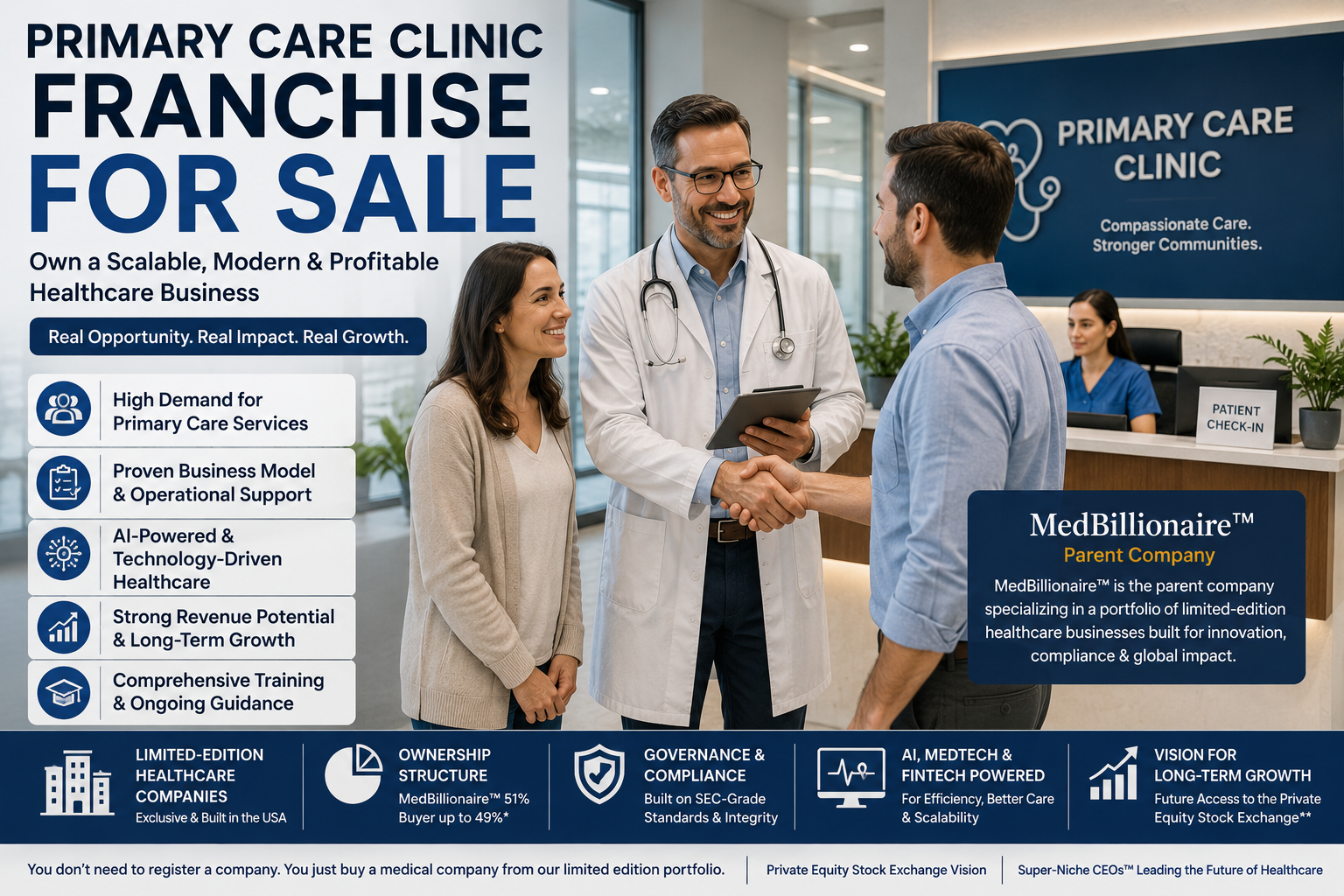
The Growing Demand for Primary Care Clinics
Primary care remains the foundation
of every healthcare system. It is often the first point of contact for patients
seeking preventive care, diagnosis, treatment of common illnesses, chronic
disease management, health education, and referrals to specialists. As
populations continue to grow, life expectancy increases, and healthcare needs
become more complex, demand for accessible primary care services continues to
rise.
For entrepreneurs and healthcare
professionals, this demand has generated increased interest in primary care
clinic franchise for sale opportunities. Franchising provides a structured
business model that may offer established operational systems, branding,
technology, and administrative support while allowing owners to focus on
delivering quality healthcare services.
Today's healthcare franchises extend
well beyond traditional clinics. Many incorporate Artificial Intelligence (AI),
digital health platforms, electronic health records (EHR), telemedicine, remote
patient monitoring, healthcare analytics, and modern patient engagement tools
to improve efficiency and patient experience.
Why Primary Care Clinics Continue to Expand
Several long-term trends contribute
to the growing importance of primary care services:
- Aging populations requiring ongoing medical care.
- Increased focus on preventive healthcare and wellness.
- Rising prevalence of chronic diseases such as diabetes
and hypertension.
- Greater adoption of telemedicine and digital
healthcare.
- Demand for convenient, community-based healthcare
services.
- Expansion of value-based healthcare models.
- Integration of AI and healthcare technology into
clinical workflows.
These factors have encouraged
healthcare organizations to develop innovative approaches that improve access
to medical services while supporting operational efficiency.
What Is a Primary Care Clinic Franchise?
A primary care clinic franchise is a
healthcare business model in which a clinic operates under an established brand
or organizational framework. Depending on the specific model, franchisees may
receive operational guidance, technology systems, marketing support, training,
and standardized procedures.
Primary care clinics commonly
provide:
- Routine medical examinations
- Preventive health screenings
- Vaccinations
- Chronic disease management
- Family medicine
- General medical consultations
- Health education
- Referral coordination
- Basic laboratory services
- Digital patient communication
Each franchise model differs, and
prospective buyers should carefully review legal agreements, regulatory
requirements, and operational responsibilities before making decisions.
Characteristics of Successful Primary Care Clinics
Successful clinics often share
several characteristics:
Patient-Centered
Care
Healthcare organizations
increasingly emphasize personalized care, patient education, and long-term
relationships.
Digital
Transformation
Modern clinics use online
scheduling, patient portals, electronic health records, and secure
communication platforms.
Preventive
Healthcare
Preventive medicine helps reduce
long-term healthcare costs while supporting healthier communities.
Operational
Efficiency
Technology assists with appointment
scheduling, billing, documentation, inventory management, and workflow
optimization.
Clinical
Quality
Continuous quality improvement,
staff education, and evidence-based practices remain central to healthcare
delivery.
Innovative Ideas Strengthening Primary Care
Innovation continues to reshape
primary care clinics through:
Artificial
Intelligence
AI can support administrative
workflows, predictive analytics, documentation assistance, scheduling
optimization, and operational planning. Clinical decisions should remain under
qualified professional supervision.
Telemedicine
Virtual consultations improve
healthcare accessibility for patients in rural areas, individuals with mobility
limitations, and those seeking convenient follow-up care.
Remote
Patient Monitoring
Connected medical devices enable
clinicians to monitor health indicators between visits, supporting chronic
disease management and preventive care.
Healthcare
Analytics
Data-driven insights help
organizations improve operational performance, patient outcomes, and resource
allocation.
Preventive
Health Programs
Lifestyle coaching, screenings,
wellness education, nutrition counseling, and vaccinations continue to play a
vital role in primary care.
Healthcare Business Licensing Opportunities
Healthcare organizations operate
within highly regulated environments. Licensing requirements vary depending on
location, healthcare services, ownership structure, and applicable laws.
Entrepreneurs considering a
healthcare business should understand:
- Business registration requirements
- Professional licensing
- Healthcare facility regulations
- Privacy and data protection laws
- Employment requirements
- Insurance considerations
- Quality assurance obligations
Independent legal and regulatory
advice is valuable when evaluating healthcare business opportunities.
Medical Clinic Franchise Opportunity
Medical clinic franchises represent
one of the most recognized segments within healthcare entrepreneurship.
Depending on the organization, clinics may specialize in family medicine,
urgent care, pediatrics, preventive health, women's health, occupational
medicine, or chronic disease management.
Modern clinic operations
increasingly integrate:
- AI-assisted administrative tools
- Electronic Health Records
- Digital patient engagement
- Online appointment scheduling
- Telemedicine
- Secure communications
- Healthcare analytics
Technology helps improve operational
efficiency while supporting patient-centered care.
Purchasing a healthcare franchise
differs from launching an independent healthcare business. Franchise systems
may provide standardized procedures, operational support, and established
business processes.
Before acquiring any healthcare
franchise, prospective buyers should carefully evaluate:
- Licensing obligations
- Regulatory compliance
- Financial information
- Operational systems
- Technology infrastructure
- Patient service standards
- Legal agreements
- Long-term strategic goals
Professional legal and financial
advice is recommended before completing any transaction.
Healthcare Company Buying Considerations
Individuals evaluating healthcare
business opportunities should conduct comprehensive due diligence.
Areas commonly reviewed include:
- Corporate structure
- Governance
- Financial performance
- Regulatory history
- Technology platforms
- Staffing
- Contracts
- Intellectual property
- Market opportunities
- Compliance systems
Due diligence helps prospective
buyers better understand both opportunities and responsibilities.
MedBillionaire™'s Published Business Model
According to information published
by MedBillionaire™, the company describes itself as the parent
organization of a portfolio of healthcare-focused businesses. The company
states that its ecosystem combines healthcare innovation with Artificial
Intelligence (AI), Medical Technology (MedTech), Financial Technology
(FinTech), corporate governance, and strategic business development.
According to the company's published
materials, businesses within its ecosystem are intended to be developed using
structured operational frameworks designed to support long-term growth and
scalability. The company also describes concepts such as Pre-Public Company™
(PPC™) and Super-Niche CEOs™ as elements of its organizational approach.
These descriptions represent the company's own published business model and
vision.
The company further states that
healthcare businesses within its ecosystem are incorporated, or intended to be
incorporated, in the United States and that MedBillionaire™ serves as the
parent company responsible for developing and supporting its portfolio.
Understanding Healthcare Company Buying Requirements
Anyone considering the acquisition
of a healthcare business should evaluate:
- Applicable licensing requirements
- Healthcare regulations
- Financial information
- Corporate governance
- Technology capabilities
- Operational procedures
- Management systems
- Legal documentation
- Compliance history
- Risk management practices
These considerations are important
regardless of the business model being evaluated.
Frequently Asked Questions
What
is a primary care clinic franchise?
A primary care clinic franchise is a
healthcare business operating under an established organizational model that
typically provides general medical services, preventive care, chronic disease
management, and patient education.
Why
are primary care clinics important?
Primary care clinics serve as the
first point of contact for many patients and play a central role in preventive
medicine, early diagnosis, chronic disease management, and coordinated
healthcare.
What
technologies are changing primary care?
Artificial Intelligence,
telemedicine, electronic health records, healthcare analytics, remote patient
monitoring, and digital patient engagement platforms continue transforming
healthcare delivery.
What
should someone evaluate before acquiring a healthcare business?
Prospective buyers should review
licensing, legal agreements, financial information, operational systems,
governance, compliance, technology infrastructure, staffing, and market
conditions with appropriate professional advice.
What
does MedBillionaire™ say about its business model?
According to information published
by the company, MedBillionaire™ describes itself as the parent company of a
portfolio of healthcare businesses that integrates AI, MedTech, FinTech,
governance, and strategic business development within its broader ecosystem.
Conclusion
Primary care clinics continue to
play an essential role in delivering accessible, preventive, and coordinated
healthcare. Advances in AI, MedTech, digital health, and telemedicine are
creating new opportunities for healthcare organizations to improve efficiency
while enhancing patient care.
Entrepreneurs interested in
healthcare franchising should combine innovation with careful planning,
regulatory awareness, sound governance, and professional advice. According to
its published information, MedBillionaire™ describes itself as the
parent company of a healthcare-focused ecosystem that integrates AI, MedTech,
FinTech, and strategic business development. Those exploring any healthcare
business opportunity should independently review available information and seek
qualified legal, financial, and regulatory guidance before making business
decisions.