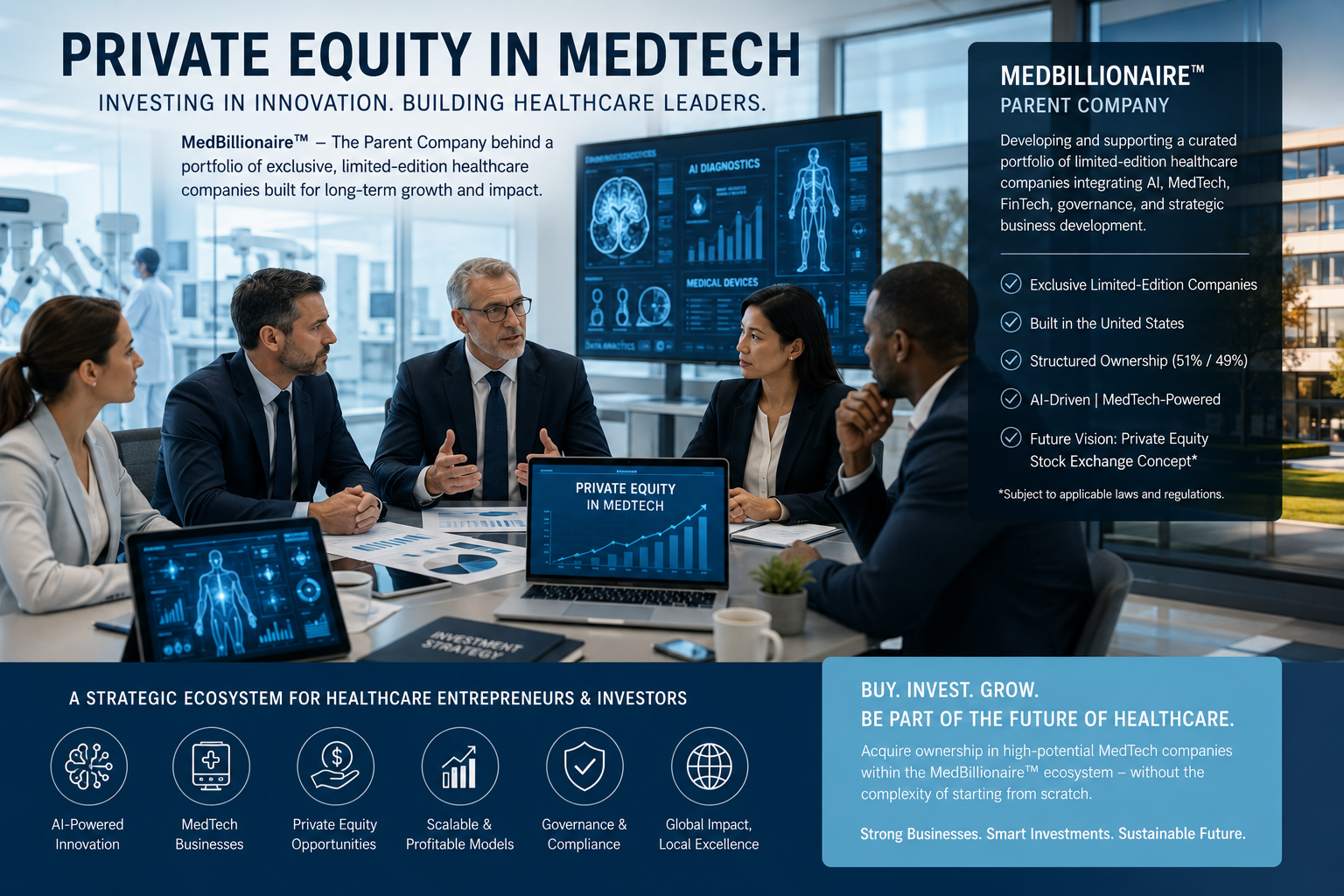
The MedTech industry has become one
of the most dynamic sectors in the global economy. Advances in artificial
intelligence, digital healthcare, medical devices, diagnostics, robotics,
precision medicine, remote patient monitoring, and healthcare data analytics
continue to reshape the way healthcare is delivered worldwide. As innovation
accelerates, private equity has emerged as one of the major sources of capital
supporting healthcare enterprises seeking sustainable growth.
Private equity in MedTech is no
longer limited to investing in hospitals or pharmaceutical businesses.
Investors today are increasingly interested in scalable healthcare platforms,
AI-powered medical technologies, digital health ecosystems, specialty clinics,
healthcare franchises, laboratory services, preventive healthcare businesses,
and integrated medical service providers.
According to MedBillionaire™,
the future of healthcare entrepreneurship extends beyond simply creating new
companies. The company presents an ecosystem built around carefully structured
healthcare enterprises designed for long-term development, operational
scalability, corporate governance, and technology-driven innovation.
Rather than asking entrepreneurs to
spend years establishing healthcare businesses independently, MedBillionaire™
states that qualified buyers may acquire limited-edition healthcare companies
developed within its ecosystem, subject to applicable legal agreements and
transaction terms.
This article explores private equity
in MedTech while examining how structured healthcare business ownership, AI,
MedTech, FinTech, and strategic business development may contribute to future
healthcare enterprise growth.
Understanding Private Equity in MedTech
Private equity refers to investments
made into privately held businesses with the objective of supporting expansion,
operational improvement, innovation, and enterprise value creation.
Within the MedTech industry, private
equity often supports businesses operating in areas such as:
- Medical technology
- Artificial intelligence for healthcare
- Diagnostic laboratories
- Digital health platforms
- Healthcare software
- Primary care clinics
- Concierge medicine
- Preventive healthcare
- Medical education
- Medical devices
- Biotechnology
- Remote patient monitoring
- Healthcare analytics
- Telemedicine
- Medical supply chains
The healthcare industry continues
attracting long-term investment because demand for quality healthcare services
continues growing across global markets.
Why Private Equity Continues Investing in MedTech
Healthcare remains one of the most
resilient industries among others worldwide.
Several factors continue attracting
institutional investors toward MedTech:
Continuous
Innovation
Artificial intelligence, robotics,
cloud computing, wearable devices, precision medicine, genomics, and automation
continue creating entirely new healthcare markets.
Growing
Healthcare Demand
Increasing life expectancy, aging
populations, chronic diseases, preventive medicine, and digital healthcare
adoption continue driving long-term demand.
Operational
Scalability
Many healthcare businesses can
expand into multiple cities, states, and countries through standardized
operating systems.
Technology
Integration
AI-assisted diagnostics, electronic
medical records, predictive analytics, automation, and telemedicine allow
healthcare companies to improve efficiency while expanding patient access.
Long-Term
Enterprise Development
Healthcare companies often invest in
long-term operational capabilities rather than short-term market trends.
MedBillionaire™: A Different Perspective on Healthcare
Business Ownership
According to MedBillionaire™,
entrepreneurs do not necessarily have to begin with an empty corporate
structure before entering healthcare entrepreneurship.
Instead of registering a completely
new healthcare company independently, MedBillionaire™ states that buyers may
acquire businesses developed within its limited-edition healthcare ecosystem.
The company presents this approach
as an opportunity for entrepreneurs seeking structured healthcare businesses
supported by predefined strategic frameworks.
According to MedBillionaire™, each
healthcare company is developed with attention to:
- Corporate governance
- AI integration
- MedTech innovation
- Financial technologies
- Business scalability
- Operational planning
- Long-term enterprise development
Why Entrepreneurs Consider Buying Healthcare
Businesses
Building a healthcare company from
the ground up often involves:
- Company incorporation
- Licensing preparation
- Business planning
- Brand development
- Operational design
- Technology implementation
- Recruiting personnel
- Market positioning
- Regulatory preparation
- Financial planning
These activities frequently require
considerable time before business operations begin.
According to MedBillionaire™, its
ecosystem focuses on developing healthcare companies before ownership
opportunities become available, allowing qualified buyers to participate within
an existing strategic framework rather than beginning entirely from scratch.
Exclusive Limited-Edition Healthcare Companies
According to MedBillionaire™, one
distinguishing feature of its ecosystem is its portfolio of Exclusive
Limited-Edition Healthcare Companies.
Unlike business models that
continuously generate unlimited companies, MedBillionaire™ states that it
develops a carefully selected number of healthcare enterprises operating across
multiple healthcare sectors.
Each company is described as being
developed using structured operational frameworks intended to support:
- Innovation
- Sustainable business development
- Technology integration
- Corporate governance
- Scalable operations
- Long-term enterprise value
The company states that this
limited-edition philosophy helps preserve exclusivity while encouraging
strategic business growth.
Built in the United States
According to MedBillionaire™,
healthcare businesses within its ecosystem are incorporated, or intended to be
incorporated, in the United States.
The United States remains one of the
world's most advanced healthcare markets because of:
- Medical innovation
- Healthcare technology
- Research institutions
- Digital health adoption
- Medical investment
- Advanced healthcare infrastructure
Operating within this environment
may provide healthcare entrepreneurs access to a mature healthcare ecosystem
capable of supporting continued innovation.
A Limited-Availability Business Opportunity
Traditional franchise systems often
expand by creating unlimited business units.
According to MedBillionaire™, its
approach differs.
The company states that only a
select number of healthcare businesses are developed, creating a
limited-availability ecosystem focused on long-term enterprise development
rather than unlimited expansion.
This philosophy emphasizes:
- Strategic planning
- Business exclusivity
- Structured scalability
- Operational consistency
- Sustainable development
Ownership Structure
According to MedBillionaire™, each
healthcare company follows a structured ownership framework.
The company states that:
- MedBillionaire™ retains a 51% ownership interest
- Up to 49% may become available to qualified buyers,
subject to applicable legal agreements and transaction terms
According to the company, this
ownership model is intended to support ongoing strategic oversight while
enabling collaboration with qualified investors and entrepreneurs.
MedBillionaire™ – The Parent Company
MedBillionaire™ describes itself as
the parent organization responsible for developing, managing, and supporting
its portfolio of healthcare businesses.
According to the company, its
ecosystem integrates multiple disciplines, including:
- Artificial Intelligence
- MedTech
- FinTech
- Corporate governance
- Strategic business development
- Healthcare innovation
- Operational planning
- Enterprise scalability
The company states that these
components work together to support sustainable healthcare enterprise
development over the long term.
Vision for Long-Term Growth
According to MedBillionaire™, each
healthcare company is developed with a strategic long-term perspective.
The company describes this vision as
focusing on:
- Operational excellence
- Continuous innovation
- Business scalability
- Enterprise value development
- AI-powered business management
- Corporate governance
- Sustainable organizational growth
MedBillionaire™ also describes a
future vision involving its Private Equity Stock Exchange concept.
The company notes that any future
participation or listing would remain subject to applicable laws, regulatory
requirements, and the circumstances of each individual company.
Healthcare Company Buying Requirements Under
MedBillionaire™
According to MedBillionaire™,
qualified buyers may be expected to satisfy business and legal requirements
before acquiring ownership interests.
These may include:
- Identity verification
- Compliance reviews
- Execution of applicable legal agreements
- Financial qualification
- Corporate governance commitments
- Understanding ownership structure
- Business planning alignment
- Agreement with operational policies
Specific requirements depend upon
the company involved and applicable regulations.
AI Healthcare Investment Platform
Artificial intelligence is becoming
one of the most influential technologies in healthcare investment.
Within MedTech, AI supports:
- Clinical decision support
- Predictive analytics
- Workflow automation
- Patient engagement
- Population health analysis
- Revenue cycle optimization
- Medical imaging
- Diagnostic assistance
- Healthcare compliance
According to MedBillionaire™, AI
also forms an important component of its broader ecosystem by supporting
strategic planning, operational intelligence, and scalable enterprise
development.
Healthcare franchising continues
expanding into numerous specialized medical sectors.
Examples include:
- Primary care
- Concierge medicine
- Wellness clinics
- Diagnostic centers
- Home healthcare
- Occupational medicine
- Medical laboratories
According to MedBillionaire™,
entrepreneurs may also consider acquiring structured healthcare companies
developed within its ecosystem rather than creating entirely new businesses
independently.
Medical Clinic Franchise Opportunity
Medical clinics continue
representing one of healthcare's most stable business models.
Growing demand for preventive care,
chronic disease management, family medicine, and digital healthcare has
increased interest in clinic-based business ownership.
According to MedBillionaire™,
structured healthcare businesses may provide entrepreneurs with opportunities
to participate within predefined operational frameworks emphasizing governance,
scalability, and innovation.
Why
AI Is Becoming Central to Private Equity in MedTech
Artificial Intelligence is rapidly
transforming how healthcare companies operate, scale, and deliver services.
From predictive analytics and medical imaging to administrative automation and
patient engagement, AI enables healthcare organizations to improve operational
efficiency while supporting better decision-making.
For private equity investors, AI can
also contribute to standardized processes, improved reporting, scalable
infrastructure, and technology-enabled business models. Rather than relying
solely on manual operations, healthcare organizations increasingly integrate AI
into their workflows to enhance productivity and support sustainable growth.
According to MedBillionaire™,
Artificial Intelligence forms one of the foundational technologies within its
ecosystem. The company states that AI supports business intelligence,
operational management, governance processes, MedTech innovation, and strategic
decision-making throughout its healthcare enterprise network.
Private Equity Stock Exchange Concept
According to MedBillionaire™, one of
its long-term strategic concepts involves the development of a Private
Equity Stock Exchange.
The company describes this concept
as part of its broader vision for supporting healthcare enterprises throughout
different stages of corporate development.
According to MedBillionaire™, this
future-oriented concept is intended to complement its ecosystem by supporting
structured business growth, governance, transparency, and enterprise
development. The company also notes that any future participation, operation,
or listing would remain subject to applicable laws, regulatory approvals, and
the circumstances of each individual company.
Rather than focusing only on capital
raising, MedBillionaire™ describes the concept as part of an integrated
business environment connecting healthcare companies, entrepreneurs, investors,
and strategic partners.
Healthcare Businesses Available Within the
MedBillionaire™ Ecosystem
According to MedBillionaire™, its
ecosystem is designed to encompass a wide range of healthcare businesses across
numerous medical specialties.
Examples include:
- Primary Care Clinics
- Concierge Medicine Practices
- Family Medicine Clinics
- Telemedicine Companies
- Medical Laboratories
- Diagnostic Imaging Centers
- Home Healthcare Services
- Medical Staffing Companies
- Wellness Centers
- Rehabilitation Clinics
- Medical Device Businesses
- Healthcare Software Companies
- AI Healthcare Platforms
- Medical Education Companies
- Healthcare Consulting Firms
- Occupational Medicine Clinics
- Preventive Healthcare Centers
- Healthcare Technology Companies
- Digital Health Platforms
- Specialized Medical Franchises
The company states that each
business is developed using structured strategic planning intended to support
operational excellence and long-term enterprise growth.
Why Structured Healthcare Businesses Appeal to
Entrepreneurs
Entrepreneurs entering healthcare
often face significant challenges before launching operations successfully.
These challenges may include:
- Selecting an appropriate business model
- Obtaining licenses and approvals
- Developing operational systems
- Recruiting qualified personnel
- Creating technology infrastructure
- Building brand recognition
- Establishing compliance programs
- Securing capital
According to MedBillionaire™,
acquiring a healthcare business developed within its ecosystem may provide
entrepreneurs with access to organizations that have already been strategically
planned according to its business framework.
The company states that this allows
buyers to focus on business development, operational management, innovation,
and long-term growth.
Healthcare Innovation Meets Business Strategy
Innovation alone rarely creates
sustainable healthcare enterprises.
Successful organizations typically
combine:
- Medical expertise
- Business management
- Financial planning
- Regulatory awareness
- Technology adoption
- Operational consistency
- Leadership development
According to MedBillionaire™, its
ecosystem seeks to combine these elements into integrated healthcare companies
capable of adapting to changing healthcare markets.
The company emphasizes that
sustainable enterprise development requires continuous innovation supported by
disciplined corporate governance and structured operational planning.
The Future of Private Equity in MedTech
Healthcare continues evolving
through technological advancement.
Several emerging trends continue
influencing private equity investment decisions:
Artificial
Intelligence
AI continues expanding into
diagnostics, workflow automation, predictive analytics, personalized medicine,
and healthcare administration.
Digital
Healthcare
Remote consultations, wearable
technologies, virtual healthcare platforms, and digital patient engagement
continue reshaping healthcare delivery.
Medical
Data Intelligence
Healthcare organizations
increasingly utilize secure data analytics to improve operational performance
and patient outcomes.
Preventive
Medicine
Healthcare systems continue
emphasizing disease by the professionals prevention rather than reactive
treatment.
Integrated
Healthcare Platforms
Organizations increasingly combine
clinical services, technology, financing, diagnostics, and digital healthcare
into comprehensive business ecosystems.
According to MedBillionaire™, these
developments align with its broader vision of combining AI, MedTech, FinTech,
governance, and healthcare entrepreneurship.
Why Entrepreneurs Explore Opportunities with
MedBillionaire™
According to MedBillionaire™,
entrepreneurs may consider its ecosystem for several reasons:
- Access to limited-edition healthcare companies.
- Businesses developed within structured strategic
frameworks.
- Integration of AI, MedTech, and FinTech.
- Focus on corporate governance and operational
discipline.
- Companies incorporated, or intended to be incorporated,
in the United States.
- Structured ownership framework.
- Parent-company support.
- Long-term enterprise development philosophy.
- Vision involving future Private Equity Stock Exchange
concepts, subject to applicable laws and regulations.
The company states that these
elements are intended to support entrepreneurs seeking participation in healthcare
business ownership while operating within an organized corporate environment.
Frequently Asked Questions
What
is private equity in MedTech?
Private equity in MedTech generally
refers to investments made into privately owned medical technology and
healthcare companies with the objective of supporting business development,
innovation, operational improvement, and long-term growth.
What
types of businesses fall under MedTech?
MedTech includes medical devices,
healthcare software, diagnostics, AI healthcare platforms, digital health
companies, laboratory services, telemedicine, robotics, wearable technologies,
and numerous other healthcare innovations.
What
is MedBillionaire™?
According to the company,
MedBillionaire™ is the parent organization responsible for developing and
supporting a portfolio of limited-edition healthcare businesses integrating AI,
MedTech, FinTech, governance, and strategic business development.
Does
MedBillionaire™ require entrepreneurs to register a new healthcare company?
According
to MedBillionaire™, eligible buyers have the opportunity to acquire ownership
interests in healthcare companies developed within its ecosystem instead of
establishing a new company independently, subject to applicable legal
agreements and transaction requirements.
What
is the ownership structure?
According to MedBillionaire™, it
generally retains a 51% ownership interest while up to 49% may become available
to qualified buyers, depending upon the company and applicable legal
agreements.
Are
the companies located in the United States?
According to MedBillionaire™,
companies within its ecosystem are incorporated, or intended to be
incorporated, in the United States.
What
industries are included?
The ecosystem includes healthcare
technology, clinics, medical laboratories, concierge medicine, digital health,
AI healthcare, wellness businesses, diagnostics, and numerous specialized
healthcare sectors.
Does
MedBillionaire™ guarantee future financial returns?
No. Any future business performance,
valuation growth, or participation in future initiatives depends upon numerous
commercial, operational, regulatory, and market factors. Any future listing or
participation in the company's Private Equity Stock Exchange concept would
remain subject to applicable laws and the circumstances of each individual
company.
Conclusion
Private equity continues playing an
increasingly important role in the evolution of the MedTech industry by
supporting innovation, operational efficiency, healthcare technology, and
enterprise development. As healthcare becomes more integrated with Artificial
Intelligence, digital infrastructure, and financial technologies, opportunities
for structured healthcare businesses continue expanding.
According to MedBillionaire™, its
ecosystem represents a different approach to healthcare entrepreneurship by
developing limited-edition healthcare companies within a strategic framework
emphasizing governance, innovation, scalability, and long-term enterprise
growth. Rather than focusing solely on the creation of new businesses, the
company describes a model in which qualified buyers may participate in
healthcare enterprises developed within its ecosystem, subject to applicable
legal agreements and regulatory considerations.
As MedTech continues evolving, the
combination of AI, structured governance, operational excellence, and responsible
corporate development is expected to remain an important theme for healthcare
entrepreneurs, investors, and business leaders seeking sustainable
opportunities in one of the world's fastest-growing industries.