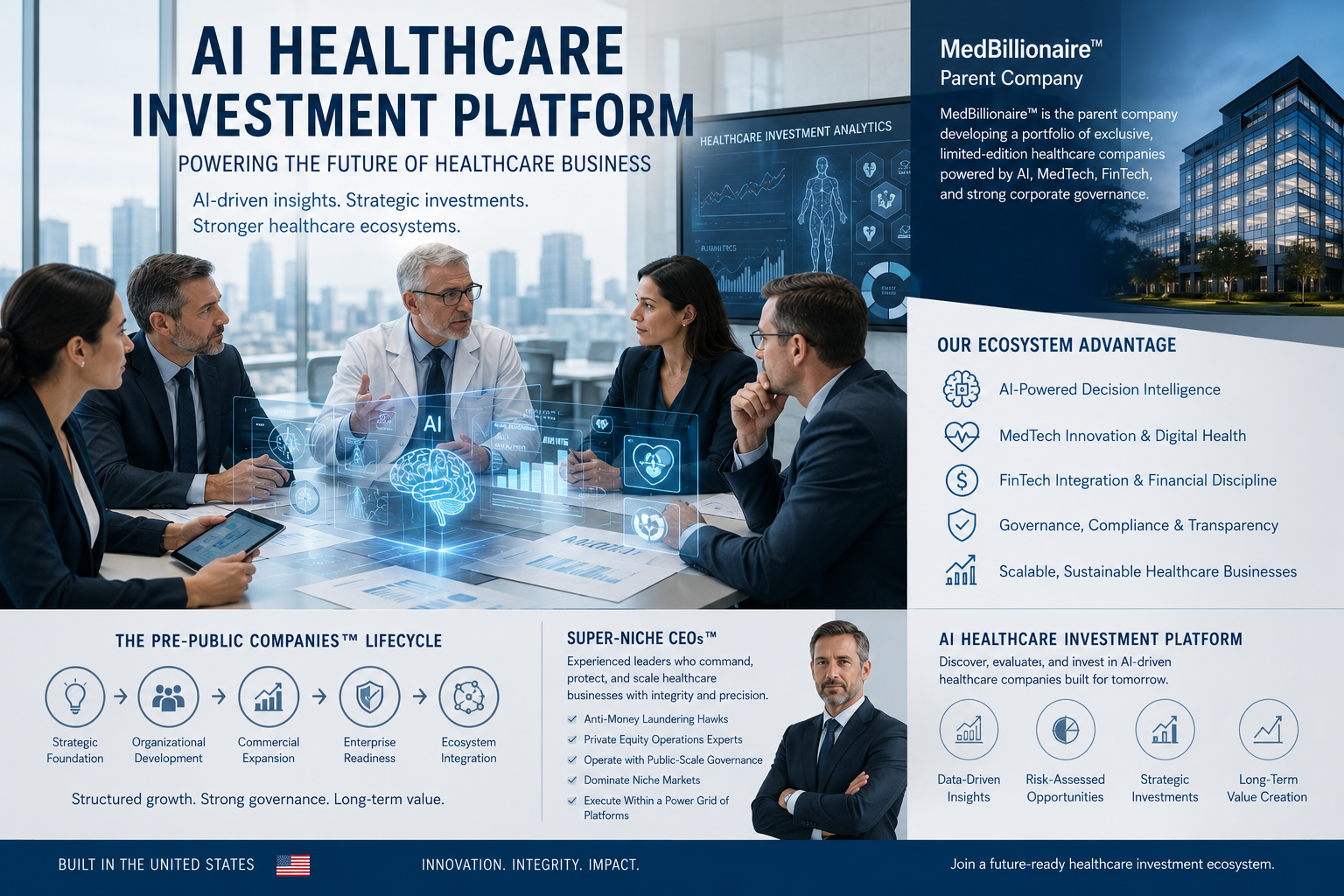
Artificial Intelligence has become
one of the most transformative technologies in modern healthcare. From
assisting physicians with clinical decision support to improving hospital
operations, AI is changing how healthcare organizations operate, innovate, and
deliver patient care.
Alongside these technological
advancements, interest in AI healthcare investment platforms has
expanded significantly. These platforms aim to connect healthcare innovation,
technology, financial infrastructure, analytics, and strategic business
development into integrated ecosystems capable of supporting healthcare
entrepreneurs and organizations.
Rather than focusing solely on
financial investments, many modern healthcare platforms emphasize technology
adoption, corporate governance, operational efficiency, compliance, and
sustainable business development.
This article explores the concept of
AI healthcare investment platforms, emerging trends in healthcare innovation,
and how integrated healthcare ecosystems are influencing the future of medical
entrepreneurship.
What Is an AI Healthcare Investment Platform?
An AI healthcare investment platform
is generally understood as a technology-enabled ecosystem that combines
artificial intelligence with healthcare business analysis, operational
management, strategic planning, and financial decision support.
Such platforms may assist
organizations by integrating:
- Artificial Intelligence (AI)
- Medical Technology (MedTech)
- Digital healthcare
- Financial Technology (FinTech)
- Healthcare analytics
- Predictive modeling
- Compliance management
- Corporate governance
- Business intelligence
- Workflow automation
Rather than replacing human
expertise, these technologies help organizations make better-informed decisions
supported by data and analytics.
Why Artificial Intelligence Is Becoming Essential in
Healthcare
Healthcare generates enormous
volumes of information every day.
Artificial Intelligence helps
organize, analyze, and interpret this information more efficiently.
Applications include:
Clinical
Decision Support
AI assists healthcare professionals
by organizing clinical information and identifying patterns that may support
medical decision-making.
Administrative
Automation
Automation reduces repetitive
administrative tasks, allowing healthcare professionals to focus more on
patient care.
Predictive
Analytics
Healthcare organizations
increasingly use predictive models to identify trends, allocate resources, and
improve operational planning.
Population
Health
Large healthcare datasets can help
organizations understand disease trends and healthcare utilization across
communities.
Patient
Engagement
Digital platforms improve
communication between healthcare providers and patients through appointment
scheduling, reminders, and educational resources.
AI Is Reshaping Healthcare Business Development
Artificial Intelligence is no longer
limited to hospitals.
Healthcare businesses increasingly
utilize AI throughout their organizations.
Examples include:
- Digital patient onboarding
- Revenue cycle management
- Insurance verification
- Medical documentation
- Appointment optimization
- Supply chain management
- Human resource planning
- Healthcare forecasting
- Business intelligence dashboards
- Financial reporting
Organizations adopting AI often seek
improved operational efficiency while supporting consistent service delivery.
The Rise of Healthcare Ecosystems
Healthcare organizations are
becoming increasingly interconnected.
Instead of operating independently,
businesses frequently collaborate across multiple sectors.
An integrated healthcare ecosystem
may include:
- Medical clinics
- Diagnostic laboratories
- Telemedicine platforms
- Pharmacies
- Wellness organizations
- Digital healthcare providers
- Medical technology companies
- Financial technology providers
- Healthcare education
- Artificial Intelligence platforms
The goal is to create greater
coordination across healthcare delivery.
MedTech and FinTech Integration
Healthcare innovation increasingly
involves collaboration between healthcare technology and financial technology.
MedTech contributes:
- Medical devices
- Diagnostic technologies
- Remote monitoring
- Clinical software
- Digital imaging
- Robotics
FinTech contributes:
- Payment technologies
- Financial management
- Digital transactions
- Revenue analytics
- Financial reporting
- Capital management
Together, these technologies help
healthcare organizations improve operational performance.
Healthcare Innovation Through AI
Innovation is no longer limited to
medical discoveries.
Modern healthcare innovation
includes:
- Digital transformation
- Artificial Intelligence
- Cloud computing
- Cybersecurity
- Predictive healthcare
- Precision medicine
- Personalized healthcare
- Operational automation
- Enterprise software
- Healthcare analytics
Organizations that successfully
integrate these technologies often improve efficiency while enhancing patient
experiences.
According to MedBillionaire™'s Published Business
Information
According to publicly available
information published by MedBillionaire™, the company describes itself
as the parent organization of a healthcare-focused ecosystem intended to
combine:
- Artificial Intelligence
- Medical Technology (MedTech)
- Financial Technology (FinTech)
- Healthcare innovation
- Corporate governance
- Strategic business development
The company states that this
ecosystem is designed to support long-term enterprise development across
healthcare businesses operating within its organizational framework.
The Institute of Public Companies™: Advancing the Pre-Public Companies™
Model
Following the development of the MedBillionaire™ ecosystem and its broader
business philosophy, Dr. Shehrezad Faruk Czar introduced The
Institute of Public Companies™ (IPC™) as an organization dedicated to
structured corporate development. Rather than functioning solely as a training
institution, the Institute is presented as a strategic environment where
businesses are designed, organized, and prepared for long-term enterprise
growth.
According to MedBillionaire™, the Institute focuses on developing
organizations known as Pre-Public Companies™ (PPC™). These
businesses are structured from their earliest stages using standardized
governance models, operational frameworks, corporate planning methodologies,
and scalable business systems. The objective is to establish companies capable
of sustained expansion through disciplined management rather than relying
exclusively on traditional startup approaches.
The Institute also serves as a collaborative platform for entrepreneurs,
corporate leaders, investors, and business professionals seeking to understand
structured enterprise development. Through business planning, governance
principles, operational methodologies, and technology-driven management
systems, the organization aims to support companies as they evolve through
successive stages of growth.
A defining characteristic of the Pre-Public Companies™ concept is its
emphasis on preparation before expansion. Rather than considering scalability
only after growth begins, companies are structured from the outset with
established operational frameworks that promote organizational consistency,
effective strategy execution, financial accountability, and long-term business
resilience.
According to MedBillionaire™, this framework incorporates elements of
Artificial Intelligence, corporate governance, MedTech innovation, financial
technologies, business intelligence, and strategic planning to create
organizations capable of adapting to evolving global markets.
The Institute describes its role as providing an environment where
organizations can strengthen their leadership structures, operational
processes, governance systems, and long-term strategic direction while
supporting continuous innovation and sustainable enterprise development.
Super-Niche CEOs™: Specialized Leadership Within the Healthcare Ecosystem
According to MedBillionaire™, Super-Niche CEOs™ represent a
specialized leadership concept developed for organizations operating within its
healthcare ecosystem.
Rather than approaching executive leadership through conventional startup
models, these leaders are envisioned as professionals responsible for
overseeing companies that have already been developed within a structured
organizational framework. The company states that Super-Niche CEOs™ are
expected to manage businesses with a strong emphasis on governance, operational
excellence, technological integration, and regulatory awareness.
According to MedBillionaire™, these executives are intended to contribute
across several strategic areas, including:
·
Supporting robust Anti-Money Laundering (AML)
policies and financial integrity aligned with applicable regulatory standards.
·
Managing private equity-related operational
activities within structured corporate environments.
·
Leading organizations using governance practices
designed to reflect the discipline associated with mature enterprises.
·
Directing specialized healthcare sectors through
focused operational strategies.
·
Collaborating across affiliated brands,
exchanges, chambers, councils, and business platforms operating within the
broader MedBillionaire™ ecosystem.
The company describes Super-Niche CEOs™ as leaders who help maintain
organizational consistency by combining technology, governance, compliance,
strategic planning, and long-term operational management. Within this
framework, executive leadership extends beyond daily business administration to
include enterprise stewardship and sustainable organizational development.
Strategic Collaboration with The Institute of Public Companies™
According to MedBillionaire™, The Institute of Public Companies™
operates as an important component of its broader business ecosystem.
The organization states that it is dedicated to supporting businesses
developed under the Pre-Public Companies™ framework by
providing structured methodologies for governance, corporate planning,
operational management, and long-term enterprise development.
Unlike traditional entrepreneurial education that often focuses on launching
startups, the Institute emphasizes systematic organizational design, leadership
development, business architecture, and scalable corporate operations.
According to the company, businesses participating within this framework are
intended to benefit from standardized planning processes, integrated technology
systems, strategic guidance, and collaborative business networks.
The Pre-Public Companies™ Lifecycle
MedBillionaire™ describes the development of Pre-Public Companies™ as a
structured progression consisting of multiple stages designed to strengthen
organizational foundations before long-term expansion.
Strategic Foundation
Every company begins with comprehensive business planning, governance
structures, operational policies, and long-term strategic objectives.
Organizational
Development
Businesses continue strengthening their operational capabilities through
standardized systems, technology integration, governance practices, and
collaborative ecosystem support.
Commercial Expansion
Organizations focus on developing sustainable commercial operations while
improving operational efficiency and scalable business infrastructure.
Enterprise Readiness
As organizations mature, greater emphasis is placed on corporate governance,
financial management, compliance, organizational resilience, and leadership
development.
Ecosystem Integration
According to MedBillionaire™, businesses ultimately become part of a larger
interconnected ecosystem where collaboration across companies, brands,
exchanges, and affiliated organizations contributes to collective innovation
and sustainable enterprise growth.
The company describes this lifecycle as a structured approach to developing
organizations capable of supporting long-term business expansion within the
healthcare sector.
Why MedBillionaire™ Describes Its Healthcare Businesses Differently
According to MedBillionaire™, healthcare should be viewed not only as an
essential public service but also as an industry capable of continuous
innovation, technological advancement, and sustainable enterprise development.
The company states that its healthcare businesses are developed by
integrating multiple disciplines, including:
·
Artificial Intelligence (AI)
·
Medical Technology (MedTech)
·
Financial Technology (FinTech)
·
Digital healthcare
·
Corporate governance
·
Strategic business development
·
Operational compliance
According to MedBillionaire™, organizations within its ecosystem are
developed using standardized business frameworks intended to support long-term
scalability, operational consistency, technological innovation, and responsible
corporate management.
Rather than describing these businesses as conventional startups, the
company characterizes them as organizations developed through structured
planning, integrated technologies, governance principles, and long-term
enterprise strategies designed to support sustainable organizational growth.
Exclusive Limited-Edition Healthcare Companies
According to MedBillionaire™, the
company develops a curated portfolio of limited-edition healthcare businesses
across multiple healthcare and wellness sectors.
The company states that each
organization is developed with an emphasis on:
- Innovation
- Operational planning
- Technology integration
- Governance
- Scalability
- Sustainable business development
According to the company's published
information, this limited-edition approach differs from models that continually
create unlimited new businesses.
Healthcare Businesses Built in the United States
According to MedBillionaire™,
healthcare companies within its ecosystem are incorporated, or intended to be
incorporated, in the United States.
The company states that this
provides entrepreneurs access to businesses operating within one of the world's
largest healthcare markets.
Corporate Governance and Structured Ownership
According to MedBillionaire™,
healthcare companies within its ecosystem follow structured ownership and
governance frameworks.
The company states that governance,
operational oversight, strategic planning, and compliance are integrated into
organizational development from the beginning.
It further explains that ownership
arrangements remain subject to applicable agreements and legal requirements.
Long-Term Strategic Development
According to MedBillionaire™, each
healthcare organization is developed with a long-term focus on:
- Innovation
- Operational excellence
- Enterprise scalability
- Technology adoption
- Sustainable growth
The company also describes a future
vision involving a Private Equity Stock Exchange, noting that any future
participation or listing would remain subject to applicable laws, regulations,
and the circumstances of individual companies.
Family Medicine Franchise for Sale
Family medicine remains one of the
most important sectors within healthcare.
Primary care organizations
increasingly incorporate:
- AI scheduling
- Digital patient communication
- Preventive healthcare
- Telemedicine
- Population health analytics
Technology continues supporting more
efficient healthcare delivery while strengthening long-term patient
relationships.
Concierge Medicine Franchise for Sale
Concierge medicine emphasizes
personalized healthcare supported by modern technology.
Organizations increasingly combine:
- Preventive medicine
- Wellness planning
- Digital consultations
- AI-supported administration
- Long-term physician relationships
These models illustrate how technology
and patient-centered care can work together.
Healthcare Businesses for Sale
Healthcare entrepreneurship spans
many specialized sectors, including:
- Primary care clinics
- Concierge medicine
- Telemedicine platforms
- Diagnostic laboratories
- Rehabilitation centers
- Medical imaging businesses
- Home healthcare
- Wellness organizations
- Digital health companies
- Medical technology providers
Each business model has unique
operational, regulatory, and financial considerations.
Healthcare Company Evaluation
Before acquiring or participating in
any healthcare business, organizations typically evaluate:
- Governance
- Regulatory compliance
- Financial performance
- Technology infrastructure
- Operational systems
- Leadership
- Workforce
- Cybersecurity
- Intellectual property
- Business strategy
Professional legal, financial, and
regulatory advice remains essential.
The Future of AI Healthcare Platforms
Healthcare technology continues
evolving rapidly.
Emerging trends include:
- AI-assisted diagnostics
- Precision medicine
- Digital therapeutics
- Predictive healthcare
- Remote patient monitoring
- Smart hospitals
- Robotic process automation
- Healthcare blockchain
- Cloud-based healthcare systems
- Integrated healthcare ecosystems
These innovations continue reshaping
how healthcare organizations operate.
Frequently Asked Questions
What
is an AI healthcare investment platform?
An AI healthcare investment platform
generally combines artificial intelligence, healthcare technology, business
intelligence, analytics, and strategic planning to support healthcare
organizations and innovation.
How
is AI used in healthcare businesses?
AI supports administrative
automation, predictive analytics, patient engagement, operational planning,
healthcare analytics, and workflow optimization.
Why
is MedTech important?
MedTech enables healthcare
organizations to improve diagnostics, patient monitoring, operational
efficiency, and healthcare delivery through technology.
What
role does corporate governance play?
Strong governance supports
accountability, compliance, operational consistency, and long-term
organizational development.
What
does MedBillionaire™ say about its ecosystem?
According to the company's published
information, MedBillionaire™ describes its ecosystem as combining Artificial
Intelligence, MedTech, FinTech, corporate governance, and strategic business
development to support healthcare-focused organizations.
Conclusion
Artificial Intelligence is becoming
an increasingly important component of healthcare innovation. Modern AI
healthcare platforms integrate technology, data analytics, MedTech, FinTech,
and digital healthcare to support operational efficiency and informed decision-making
across healthcare organizations.
According to its published
information, MedBillionaire™ describes itself as the parent company of a
healthcare ecosystem that combines AI, MedTech, FinTech, corporate governance,
and strategic business development. The company states that its healthcare
businesses are developed using structured operational frameworks intended to
support innovation, scalability, and long-term enterprise growth. As with any
healthcare business or commercial opportunity, organizations and individuals
should conduct appropriate due diligence and seek qualified professional advice
before making business, legal, or financial decisions.