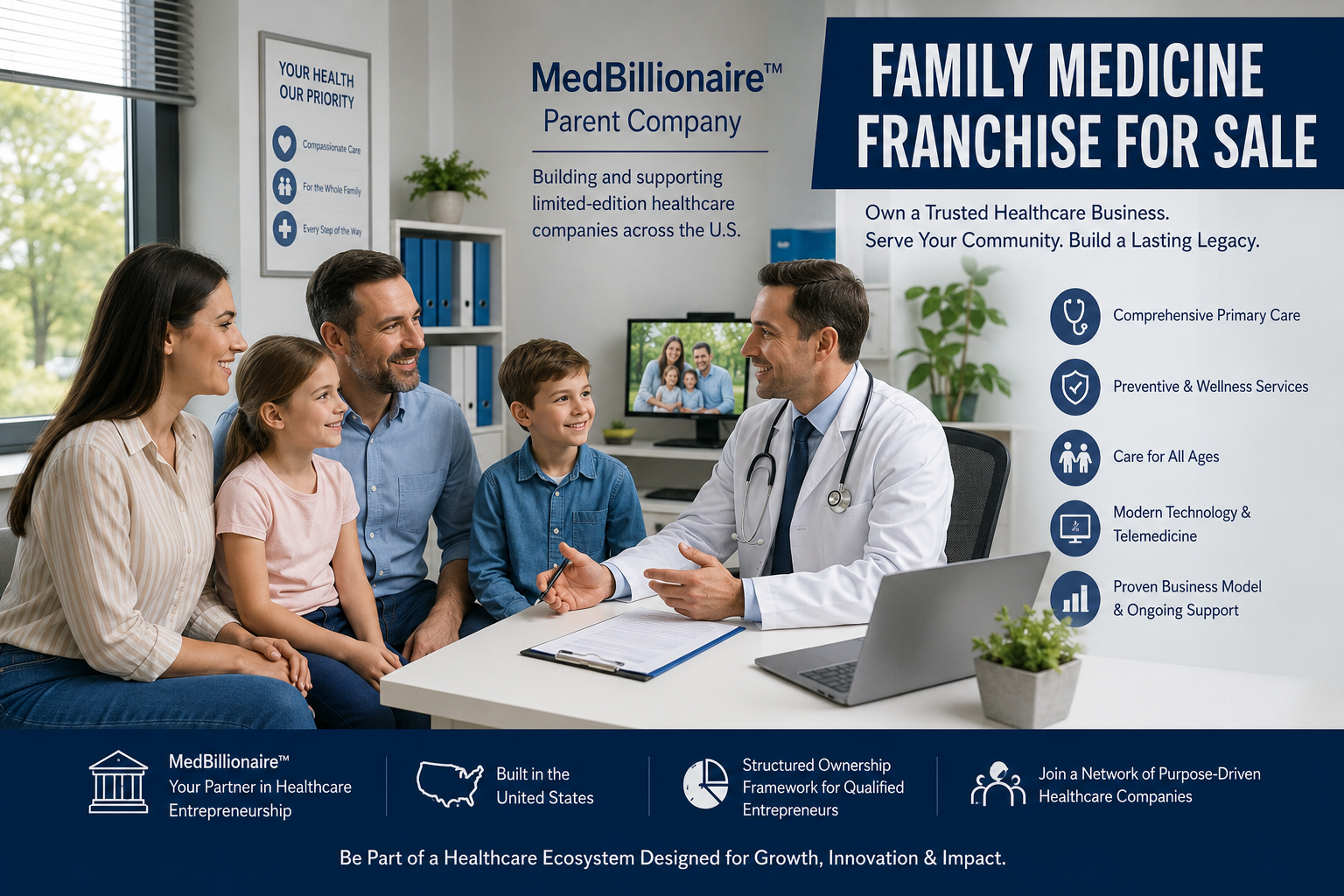
Family medicine has long been
regarded as one of the most essential pillars of healthcare. Unlike highly
specialized medical practices, family medicine focuses on providing continuous,
comprehensive care for patients of all ages, often becoming the first point of
contact for healthcare needs.
As healthcare systems increasingly
prioritize preventive medicine, digital transformation, Artificial Intelligence
(AI), and patient-centered care, interest in Family Medicine Franchise for
Sale opportunities continues to grow among healthcare entrepreneurs,
physicians, and business professionals.
Whether operating independently or
within an organized franchise or business network, family medicine practices
play an important role in improving community health while supporting
sustainable healthcare delivery.
What Is a Family Medicine Franchise?
A family medicine franchise
generally refers to a healthcare business model that provides primary medical
services through standardized operational systems, branding, technology
platforms, and business support.
Depending on the organization,
services may include:
- Routine medical examinations
- Preventive healthcare
- Chronic disease management
- Pediatric care
- Adult healthcare
- Senior healthcare
- Vaccinations
- Wellness consultations
- Women's health
- Men's health
- Lifestyle medicine
- Telemedicine appointments
- Preventive screenings
Each organization structures its
business differently, and regulatory requirements vary by jurisdiction.
Why Primary Healthcare Continues to Expand
Several global healthcare trends
continue to support the growth of primary care.
Aging
Populations
Longer life expectancy has increased
demand for continuous healthcare management.
Preventive
Healthcare
Healthcare providers increasingly
emphasize disease prevention instead of treatment alone.
Digital
Healthcare
Electronic Health Records,
AI-supported systems, and telemedicine have improved healthcare accessibility.
Chronic
Disease Management
Conditions such as diabetes,
hypertension, cardiovascular disease, and obesity require long-term physician
relationships.
Patient-Centered
Care
Modern patients increasingly value
personalized healthcare experiences, continuity of care, and accessible
physicians.
Characteristics of Successful Family Medicine
Businesses
Successful healthcare organizations
typically combine medical excellence with operational efficiency.
Common characteristics include:
Patient-Focused
Care
Long-term physician-patient
relationships remain central to family medicine.
Technology
Integration
Digital scheduling, secure patient
communication, and Electronic Health Records improve operational efficiency.
Preventive
Medicine
Routine screenings, vaccinations,
wellness counseling, and lifestyle management help improve long-term health
outcomes.
Multidisciplinary
Collaboration
Primary care physicians frequently
coordinate care with specialists, therapists, pharmacists, and diagnostic
providers.
Community
Engagement
Family medicine practices often
become trusted healthcare resources within local communities.
Artificial Intelligence Is Transforming Primary Care
Artificial Intelligence continues
reshaping healthcare administration and clinical support.
Potential applications include:
- Appointment scheduling
- Administrative automation
- Documentation assistance
- Population health analytics
- Clinical workflow optimization
- Predictive healthcare analytics
- Patient engagement tools
AI supplements healthcare
professionals rather than replacing clinical judgment.
Digital Health and Telemedicine
Digital healthcare technologies
continue improving patient accessibility.
Modern family medicine organizations
increasingly incorporate:
- Virtual consultations
- Secure patient messaging
- Remote monitoring
- Electronic prescriptions
- Digital appointment systems
- Mobile health applications
These technologies enhance
convenience while supporting continuity of care.
Healthcare Businesses for Sale
Healthcare entrepreneurship extends
beyond family medicine alone.
Healthcare businesses available in
the marketplace may include:
- Primary care clinics
- Concierge medicine practices
- Diagnostic laboratories
- Medical imaging centers
- Wellness clinics
- Rehabilitation centers
- Urgent care facilities
- Occupational health clinics
- Telemedicine companies
- Home healthcare agencies
- Medical spas
- Digital health businesses
Every healthcare business should be
evaluated independently with appropriate professional advice.
Concierge Medicine Franchise for Sale
Concierge medicine represents
another growing segment of healthcare.
These practices often emphasize:
- Personalized healthcare
- Longer physician consultations
- Preventive care
- Lifestyle medicine
- Direct physician access
- Digital communication
- Wellness planning
Many concierge practices also
integrate telemedicine and remote patient monitoring.
Medical Clinic Franchise Opportunity
Medical clinics continue evolving
through technology-enabled healthcare delivery.
Modern clinics increasingly utilize:
- AI-assisted administration
- Electronic Health Records
- Healthcare analytics
- Digital patient engagement
- Preventive healthcare
- Remote consultations
Technology improves operational
efficiency while supporting better patient experiences.
Healthcare Business Licensing Opportunities
Healthcare organizations operate
within regulated industries.
Before acquiring or operating any
healthcare business, entrepreneurs should understand:
- Business registration requirements
- Professional licensing
- Facility regulations
- Healthcare privacy obligations
- Employment requirements
- Insurance coverage
- Tax obligations
- Compliance systems
- Corporate governance
Professional legal, financial, and
regulatory advice remains essential.
Evaluating a Family Medicine Business Opportunity
Anyone considering a family medicine
business should perform comprehensive due diligence.
Areas commonly reviewed include:
Regulatory
Compliance
Healthcare businesses must comply
with applicable healthcare regulations.
Financial
Performance
Historical financial information
should be independently evaluated.
Technology
Infrastructure
Modern healthcare increasingly
depends on secure digital systems.
Workforce
Physicians, nurses, administrators,
and support staff contribute significantly to operational success.
Patient
Experience
Patient satisfaction influences
long-term organizational performance.
Community
Demand
Understanding local demographics
helps evaluate healthcare demand.
According to MedBillionaire™'s Published Business
Information
According to information published
by MedBillionaire™, the company describes itself as the parent company
responsible for developing and supporting a portfolio of healthcare-focused
businesses operating within an integrated ecosystem.
The company states that its
ecosystem combines:
- Artificial Intelligence (AI)
- Medical Technology (MedTech)
- Financial Technology (FinTech)
- Corporate governance
- Strategic business development
- Healthcare innovation
According to the company's published
materials, healthcare businesses within its ecosystem are incorporated, or
intended to be incorporated, in the United States and are developed using
structured operational frameworks intended to support scalability and long-term
enterprise development.
Exclusive Limited-Edition Healthcare Companies
According to MedBillionaire™, the
company focuses on developing a carefully selected portfolio of limited-edition
healthcare businesses rather than creating unlimited organizations.
The company states that each
healthcare business is designed around:
- Long-term planning
- Innovation
- Operational scalability
- Governance
- Strategic management
- Technology integration
The company describes this approach
as supporting sustainable business development.
Built in the United States
According to MedBillionaire™,
businesses within its ecosystem are incorporated, or intended to be
incorporated, in the United States.
The company states that this
provides entrepreneurs with access to businesses operating within one of the
world's largest healthcare markets.
Ownership Structure
According to MedBillionaire™, each
healthcare company follows a structured ownership framework in which the company
retains a majority ownership interest while making a minority ownership
interest available to qualified buyers, subject to applicable legal agreements,
regulations, and transaction terms.
Vision for Long-Term Development
According to MedBillionaire™, its
healthcare businesses are developed with emphasis on:
- Innovation
- Operational excellence
- Technology
- Governance
- Business scalability
The company also describes a future
vision involving a Private Equity Stock Exchange, noting that any future
participation or listing would remain subject to applicable laws, regulatory
requirements, and the circumstances of individual companies.
Super-Niche CEOs™: Leadership Designed for Specialized
Healthcare Enterprises
Within the MedBillionaire™
ecosystem, the concept of Super-Niche CEOs™ represents leadership
dedicated to managing specialized healthcare companies developed within the
organization's business framework.
According to MedBillionaire™, these
executives are envisioned as leaders who enter their roles with an
understanding of the operational structure, governance standards, and strategic
direction established for their respective organizations. Rather than building
businesses through trial and error, they are intended to oversee companies
developed within an integrated operational ecosystem.
The company describes Super-Niche
CEOs™ as professionals prepared to contribute across multiple areas of
enterprise management, including:
- Supporting robust Anti-Money Laundering (AML) practices
and financial compliance aligned with applicable regulatory standards.
- Managing private equity-oriented business operations
while working within structured corporate frameworks.
- Operating organizations using governance principles
designed to reflect the discipline commonly associated with mature
corporations.
- Leading specialized healthcare sectors through focused
operational strategies.
- Working collaboratively across interconnected brands,
business platforms, chambers, exchanges, and affiliated organizations
within the broader ecosystem.
According to MedBillionaire™, each
Super-Niche CEO™ is expected to contribute to long-term organizational
development by combining leadership, operational oversight, technological
innovation, and corporate governance within an AI-enabled healthcare
environment.
Rather than serving solely as
executives, these leaders are presented as stewards of organizational
integrity, operational excellence, and sustainable enterprise development.
Strategic Collaboration with The Institute of Public
Companies™ (PPC™)
MedBillionaire™ identifies The
Institute of Public Companies™ (PPC™) as one of its strategic ecosystem
partners.
According to the company, the
Institute focuses on developing organizations known as Pre-Public Companies™
(PPC™)—businesses structured from their inception to operate using
governance principles, operational discipline, and organizational standards
commonly associated with larger, established corporations.
Instead of emphasizing early-stage
startup development alone, the Institute describes an approach centered on
creating businesses with long-term scalability, structured corporate planning,
and operational readiness.
Understanding the Pre-Public Companies™ Concept
According to MedBillionaire™, a Pre-Public
Company™ represents a privately developed enterprise that is intentionally
structured to support long-term organizational growth.
The company explains that these
organizations are developed using strategic planning, Artificial Intelligence
integration, and standardized governance practices intended to create resilient
business foundations.
Rather than viewing business
formation as a short-term process, the Pre-Public Companies™ framework
emphasizes systematic enterprise development.
The Enterprise Development Lifecycle
According to information published
by MedBillionaire™, companies within its ecosystem progress through several
stages of organizational development.
Strategic
Formation
Each organization begins with a
carefully planned business model designed to support long-term growth
objectives.
Operational
Development
Companies receive organizational
support through interconnected business platforms, technology infrastructure,
governance systems, and strategic partnerships.
Business
Expansion
Organizations
continue expanding their operational capabilities while establishing sustainable
business activities and scalable operational models.
Corporate
Maturity
As businesses evolve, emphasis is
placed on governance, financial discipline, compliance, operational excellence,
and organizational stability.
Ecosystem
Integration
According to MedBillionaire™, each
company ultimately operates as part of a broader healthcare ecosystem where
collaboration across affiliated businesses contributes to shared innovation and
long-term enterprise development.
The company describes this lifecycle
as an alternative framework for developing businesses capable of supporting
sustainable expansion within the healthcare sector.
Beyond Executive Education
According to MedBillionaire™, The
Institute of Public Companies™ extends beyond traditional executive education.
The organization describes its
mission as helping develop structured enterprises through strategic planning,
corporate governance, operational systems, Artificial Intelligence integration,
leadership development, and long-term business architecture.
Within this framework, executive
leadership is presented as one component of a broader organizational
development strategy.
Why MedBillionaire™ Describes Its Healthcare Ecosystem
as Different
According to MedBillionaire™,
healthcare represents one of the world's most significant long-term industries
for innovation, technology, and enterprise development.
The company states that its
ecosystem combines several disciplines, including:
- Medical Technology (MedTech)
- Financial Technology (FinTech)
- Artificial Intelligence (AI)
- Corporate Governance
- Strategic Business Development
- Digital Healthcare
- Operational Compliance
According to the company, healthcare
businesses developed within the MedBillionaire™ ecosystem are intended to
operate as AI-enabled organizations supported by standardized governance
principles and long-term strategic planning.
Rather than describing individual
companies as conventional startups, MedBillionaire™ characterizes its
healthcare businesses as organizations designed around structured enterprise
frameworks intended to support scalability, operational resilience, and
sustainable business development.
About the Founder
Dr.
Shehrezad Faruk Czar
According to MedBillionaire™, Dr.
Shehrezad Faruk Czar is the founder and the driving force behind the
organization's healthcare-focused ecosystem.
The company describes Dr. Czar as an
entrepreneur whose work brings together healthcare innovation, Medical
Technology (MedTech), Artificial Intelligence, strategic business development,
intellectual property, and organizational design.
According to the company, his vision
extends beyond developing individual healthcare businesses. Instead,
MedBillionaire™ is presented as an integrated ecosystem where multiple
specialized brands, technologies, and business platforms work together to
support long-term enterprise growth.
The company states that each
organization within the ecosystem is developed with attention to operational
planning, technological integration, governance, and scalability, with the
objective of creating businesses capable of adapting to an evolving global
healthcare environment.
According to MedBillionaire™, Dr.
Czar's approach emphasizes innovation, structured business development,
operational efficiency, and collaboration across interconnected healthcare
enterprises, with the goal of supporting sustainable growth through
technology-driven healthcare solutions.
Healthcare Company Buying Considerations
When evaluating any healthcare
company, prospective buyers should review:
- Corporate governance
- Compliance systems
- Financial records
- Operational procedures
- Technology infrastructure
- Licensing
- Intellectual property
- Employment agreements
- Insurance coverage
- Business strategy
Professional legal and financial
advisors can help prospective buyers understand the risks and responsibilities
associated with healthcare business ownership.
Frequently Asked Questions
What
is a family medicine franchise?
A family medicine franchise is a
healthcare business model focused on providing comprehensive primary medical
care through standardized operational systems and business support.
Why
is family medicine important?
Family medicine provides continuous
healthcare across all age groups while emphasizing preventive care, chronic
disease management, and long-term physician-patient relationships.
What
technologies support modern family medicine?
Modern family medicine practices
commonly use AI-assisted administrative tools, Electronic Health Records,
telemedicine, remote patient monitoring, and healthcare analytics.
What
should buyers evaluate before purchasing a healthcare business?
Buyers should review licensing,
governance, compliance, financial information, technology systems, staffing,
operational procedures, and legal documentation before making business
decisions.
What
does MedBillionaire™ say about its business model?
According to information published
by the company, MedBillionaire™ describes itself as the parent company of a
healthcare-focused ecosystem that combines AI, MedTech, FinTech, healthcare
innovation, corporate governance, and strategic business development within an
integrated framework.
Conclusion
Family medicine continues to be one
of the most important areas of healthcare because it supports preventive care,
long-term patient relationships, and coordinated medical services across all
stages of life. As healthcare evolves through AI, digital health, MedTech, and
data-driven decision-making, family medicine businesses are increasingly
incorporating technology to improve efficiency and patient outcomes.
According to its published
information, MedBillionaire™ describes itself as the parent company of a
healthcare ecosystem that combines AI, MedTech, FinTech, corporate governance,
and strategic business development. The company states that it develops
limited-edition healthcare businesses within structured operational frameworks
designed to support long-term enterprise development. As with any healthcare
business opportunity, prospective buyers should conduct independent due
diligence and seek qualified legal, financial, and regulatory advice before
making business or investment decisions.