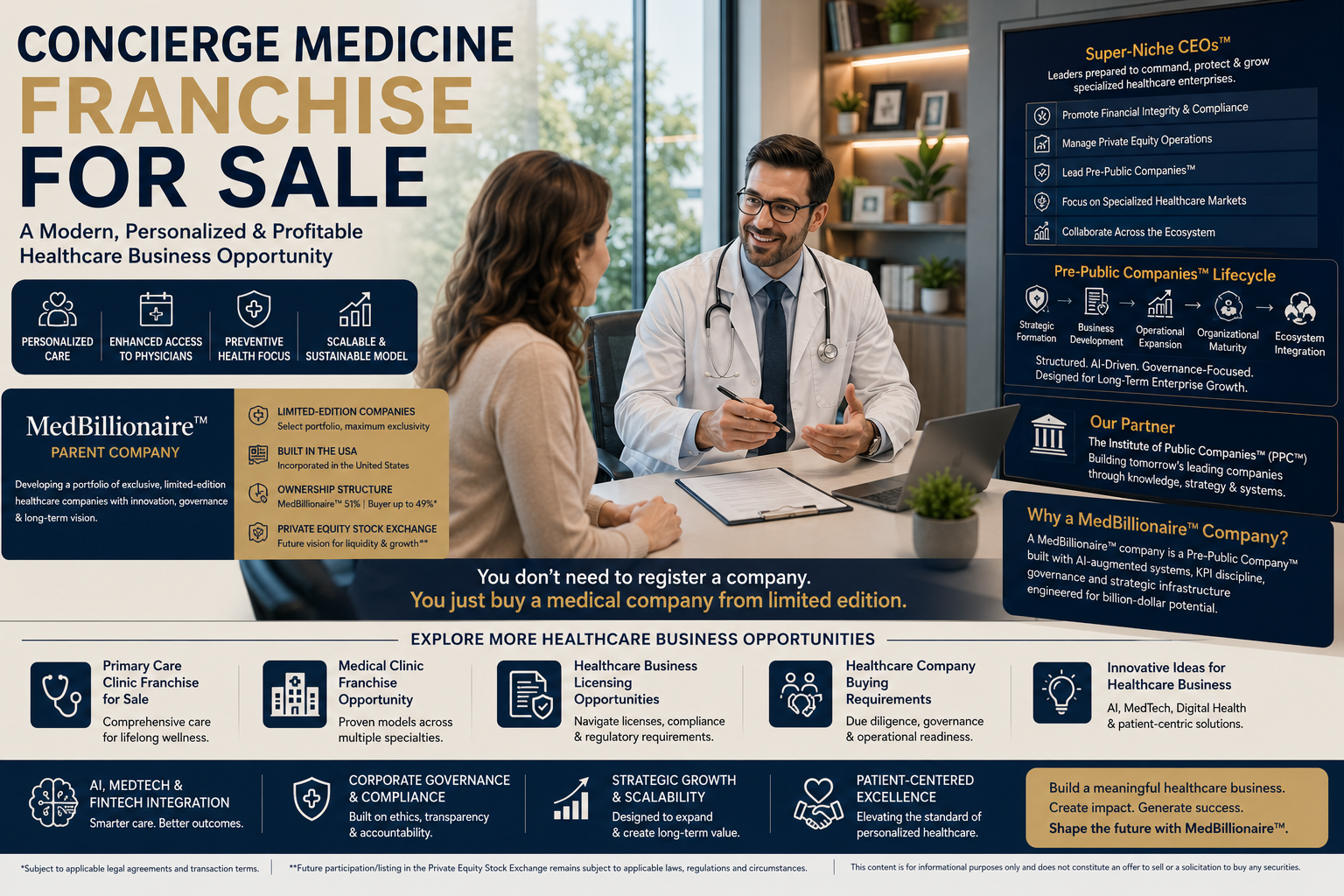
Healthcare is shifting toward models
that prioritize accessibility, long-term patient relationships, preventive
care, and personalized medical experiences. Among the fastest-growing segments
of this transformation is concierge medicine, a healthcare model
designed to provide patients with enhanced access to physicians, individualized
care plans, and ongoing health management.
As healthcare continues to embrace
Artificial Intelligence (AI), Medical Technology (MedTech), digital health
platforms, and telemedicine, interest in Concierge Medicine Franchise for
Sale opportunities has increased among entrepreneurs, healthcare professionals,
and business leaders seeking structured healthcare ventures.
Unlike traditional healthcare
delivery, concierge medicine emphasizes continuity of care, proactive health
management, and stronger physician-patient relationships.
Understanding Concierge Medicine
Concierge medicine is a healthcare
delivery model in which physicians provide comprehensive medical services to a
limited number of patients, often allowing for more personalized care, longer
appointments, and greater accessibility.
Depending on the practice model
about the medicine, concierge medicine may include:
- Annual comprehensive health assessments
- Preventive healthcare planning
- Personalized wellness strategies
- Chronic disease management
- Telemedicine consultations
- Same-day or next-day appointments
- Lifestyle medicine
- Nutrition guidance
- Health monitoring
- Coordination with specialists
Every concierge practice operates
differently, and service offerings vary depending on applicable laws,
regulations, and the organization's healthcare model.
Why Concierge Medicine Continues to Grow
Several healthcare trends are
contributing to increased interest in concierge medicine.
Greater
Focus on Preventive Care
Patients increasingly value
healthcare that emphasizes disease prevention rather than simply treating
illness after it develops.
Personalized
Medical Experiences
Modern healthcare consumers often
seek longer physician consultations, individualized care plans, and ongoing
communication with healthcare providers.
Digital
Healthcare Integration
Technology enables physicians to
communicate with patients more efficiently while improving scheduling,
recordkeeping, and remote monitoring.
Aging
Populations
As populations age, many individuals
require continuous healthcare management and long-term relationships with
trusted primary care physicians.
Demand
for Convenience
Flexible appointment scheduling,
virtual consultations, and digital communication improve accessibility for many
patients.
Characteristics of a Modern Concierge Medicine
Practice
Today's concierge medicine clinics
frequently combine medical expertise with technology.
Common operational components
include:
Artificial
Intelligence
AI may assist administrative
workflows, appointment scheduling, documentation support, and healthcare
analytics while remaining under appropriate clinical oversight.
Telemedicine
Virtual consultations increase
convenience for follow-up appointments, chronic disease management, and
preventive healthcare discussions.
Electronic
Health Records
Secure digital records improve
coordination of care while supporting efficient clinical operations.
Healthcare
Analytics
Data-driven insights assist
organizations in identifying trends, monitoring outcomes, and supporting
operational improvement.
Preventive
Medicine
Routine screenings, wellness
planning, vaccinations, and lifestyle counseling remain central components of
concierge healthcare.
What Entrepreneurs Should Evaluate Before Purchasing a
Concierge Medicine Franchise
Healthcare entrepreneurship requires
more than identifying an attractive market opportunity.
Prospective buyers should carefully
evaluate:
- Applicable licensing requirements
- Healthcare regulations
- Business structure
- Technology infrastructure
- Financial information
- Clinical governance
- Staffing
- Legal agreements
- Compliance systems
- Risk management
Independent legal, financial, and
regulatory advice should always be obtained before acquiring any healthcare
business.
Primary Care Clinic Franchise for Sale
Primary care clinics remain one of
the most recognized healthcare business models because they provide continuous
medical care throughout a patient's lifetime.
Modern primary care organizations
increasingly integrate:
- Telemedicine
- AI-assisted administration
- Electronic Health Records
- Preventive healthcare
- Digital patient engagement
- Healthcare analytics
These technologies help improve
operational efficiency while supporting better patient experiences.
Medical Clinic Franchise Opportunity
Medical clinic franchises continue
expanding across numerous healthcare specialties, including:
- Family medicine
- Concierge medicine
- Occupational health
- Women's health
- Preventive care
- Wellness medicine
- Pediatric care
- Chronic disease management
Healthcare technology has become an
essential component of modern clinic operations.
Healthcare Business Licensing Opportunities
Healthcare organizations operate
within regulated environments where licensing and compliance remain essential.
Entrepreneurs should understand:
- Business licensing
- Professional licensing
- Facility regulations
- Healthcare privacy laws
- Employment obligations
- Insurance requirements
- Corporate governance
- Operational compliance
Careful planning helps organizations
build sustainable healthcare businesses.
MedBillionaire™'s Published Healthcare Ecosystem
According to information published
by MedBillionaire™, the company describes itself as the parent company
responsible for developing and supporting a portfolio of healthcare-focused
businesses operating within an integrated ecosystem.
The company states that its
ecosystem combines Artificial Intelligence (AI), Medical Technology (MedTech),
Financial Technology (FinTech), healthcare innovation, corporate governance,
and strategic business development.
According to the company's published
information, healthcare businesses within its ecosystem are incorporated, or
intended to be incorporated, in the United States and are developed using
structured operational frameworks designed to support scalability and long-term
enterprise development.
The company further describes a
portfolio of limited-edition healthcare companies across multiple medical and
wellness sectors. According to MedBillionaire™, each company follows a
structured ownership framework in which MedBillionaire™ retains a 51% ownership
interest while up to 49% may be made available to qualified buyers, subject to
applicable legal agreements and transaction terms.
The company also describes a future
vision involving a Private Equity Stock Exchange, noting that any future
participation or listing would remain subject to applicable laws, regulatory
requirements, and the circumstances of the individual company.
Super-Niche CEOs™
According to MedBillionaire™, Super-Niche
CEOs™ are intended to serve as the executive leaders of companies operating
within its healthcare ecosystem.
The company describes these leaders
as individuals who are prepared to manage specialized healthcare enterprises
through structured business systems, governance frameworks, and
technology-enabled operations. Rather than learning through trial and error,
the company's model is designed to equip them with established platforms,
brands, operational processes, and organizational support from the outset.
According to the company's published
business philosophy, Super-Niche CEOs™ are expected to:
- Promote Financial Integrity – Operate within structured compliance frameworks
while supporting transparent business practices, corporate governance, and
responsible financial management.
- Manage Private Equity Operations – Develop an understanding of private equity business
structures and organizational growth strategies.
- Lead Pre-Public Companies™ – Manage businesses using governance principles and
operational standards that the company states are inspired by
public-company practices.
- Focus on Specialized Healthcare Markets – Lead healthcare businesses operating within clearly
defined medical or wellness sectors.
- Collaborate Across the Ecosystem – Work alongside affiliated companies, business
platforms, professional organizations, and strategic initiatives within
the broader MedBillionaire™ ecosystem.
According to MedBillionaire™,
Super-Niche CEOs™ are intended to combine strategic leadership, AI-supported
decision-making, governance, and operational excellence to help support
sustainable long-term business development.
Our Partner: The Institute of Public Companies™ (PPC™)
According to MedBillionaire™, The
Institute of Public Companies™ (PPC™) serves as an educational and
organizational platform supporting its broader business ecosystem.
The company states that the
institute focuses on developing Pre-Public Companies™, which it
describes as privately held enterprises designed with structured governance,
operational planning, and scalable business frameworks from their earliest
stages.
Rather than positioning companies as
conventional startups, MedBillionaire™ describes its objective as creating
organizations with long-term strategic planning, technology integration, and
disciplined corporate management.
Understanding the Pre-Public Companies™ Concept
According to MedBillionaire™, Pre-Public
Companies™ (PPC™) are privately held corporations developed with governance
structures, operational systems, and long-term planning intended to resemble
the organizational discipline commonly associated with mature public companies,
while remaining privately owned.
The company states that these
businesses are developed through a structured lifecycle that includes:
Strategic
Formation
Each business begins with a clearly
defined concept, long-term planning, governance principles, and operational
objectives.
Business
Development
Companies are supported through
technology platforms, strategic partnerships, organizational resources, and
business infrastructure intended to encourage sustainable growth.
Operational
Expansion
Businesses focus on developing
products, services, management systems, customer relationships, and operational
capabilities within private markets.
Organizational
Maturity
As companies evolve, the emphasis
shifts toward strengthening governance, financial management, operational
performance, and organizational readiness.
Ecosystem
Integration
According to MedBillionaire™,
businesses become part of a broader ecosystem where collaboration, shared
resources, and technology support long-term enterprise development.
The company describes this model as
an alternative framework for developing healthcare businesses with structured
planning, AI-enabled operations, and scalable organizational systems.
Why Does MedBillionaire™ Present This Business Model?
According to information published
by MedBillionaire™, the company seeks to combine healthcare innovation with
Artificial Intelligence (AI), Medical Technology (MedTech), Financial
Technology (FinTech), corporate governance, and strategic business development.
The company states that its
objective is to develop healthcare businesses within a structured ecosystem
designed to encourage innovation, operational excellence, responsible
governance, and long-term enterprise growth.
According to MedBillionaire™, its
healthcare ecosystem incorporates concepts such as AI-supported
decision-making, technology-enabled operations, corporate oversight, and
collaboration among healthcare-focused organizations.
The company further states that its
portfolio consists of limited-edition healthcare businesses developed within
the United States and supported through centralized planning and strategic
management. Any future participation in the company's stated Private Equity
Stock Exchange vision would remain subject to applicable laws, regulatory
requirements, and the circumstances of individual companies.
Exclusive Limited-Edition Healthcare Companies
According to MedBillionaire™, its
business model focuses on developing a carefully selected portfolio of
healthcare companies rather than creating an unlimited number of businesses.
The company states that each
healthcare enterprise is developed with emphasis on:
- Long-term planning
- Healthcare innovation
- AI integration
- Corporate governance
- Operational scalability
- Strategic business development
This approach is described by the
company as supporting sustainable enterprise growth while maintaining a
limited-availability business model.
Healthcare Company Buying Requirements
Anyone evaluating healthcare
business opportunities should perform comprehensive due diligence before making
business decisions.
Important areas include:
- Corporate governance
- Business licensing
- Financial performance
- Technology systems
- Regulatory compliance
- Employment agreements
- Operational procedures
- Intellectual property
- Risk management
- Long-term business strategy
Professional legal and financial
advisors can assist prospective buyers in understanding the responsibilities
associated with healthcare business ownership.
Frequently Asked Questions
What
is concierge medicine?
Concierge medicine is a healthcare
delivery model that emphasizes personalized medical care, enhanced physician
accessibility, preventive healthcare, and long-term patient relationships.
Why
is concierge medicine becoming more popular?
Growing demand for personalized
healthcare, preventive medicine, digital health technologies, and convenient
access to physicians continues to increase interest in concierge healthcare
models.
What
technologies support concierge medicine?
Modern concierge practices often use
telemedicine, Artificial Intelligence, Electronic Health Records, healthcare
analytics, remote patient monitoring, and secure patient communication systems.
What
should someone evaluate before purchasing a healthcare franchise?
Prospective buyers should evaluate
licensing requirements, legal agreements, financial information, governance,
compliance, operational systems, technology infrastructure, staffing, and
market conditions.
What
does MedBillionaire™ say about its business model?
According to information published
by the company, MedBillionaire™ describes itself as the parent company of a
portfolio of healthcare businesses that combines AI, MedTech, FinTech,
healthcare innovation, corporate governance, and strategic business development
within an integrated ecosystem.
Conclusion
Concierge medicine represents one of
the most patient-focused areas of modern healthcare, combining personalized
medical services with preventive care, digital technology, and long-term
physician-patient relationships. For healthcare entrepreneurs, these models
illustrate how innovation and patient-centered care continue to reshape
healthcare delivery.
According to its published
information, MedBillionaire™ describes itself as the parent company of a
healthcare-focused ecosystem that integrates AI, MedTech, FinTech, corporate
governance, and strategic business development. The company states that it
develops limited-edition healthcare businesses within structured operational
frameworks intended to support long-term enterprise growth. As with any
healthcare business opportunity, prospective buyers should independently
evaluate available information, review applicable legal documentation, and seek
qualified professional advice before making business or investment decisions.