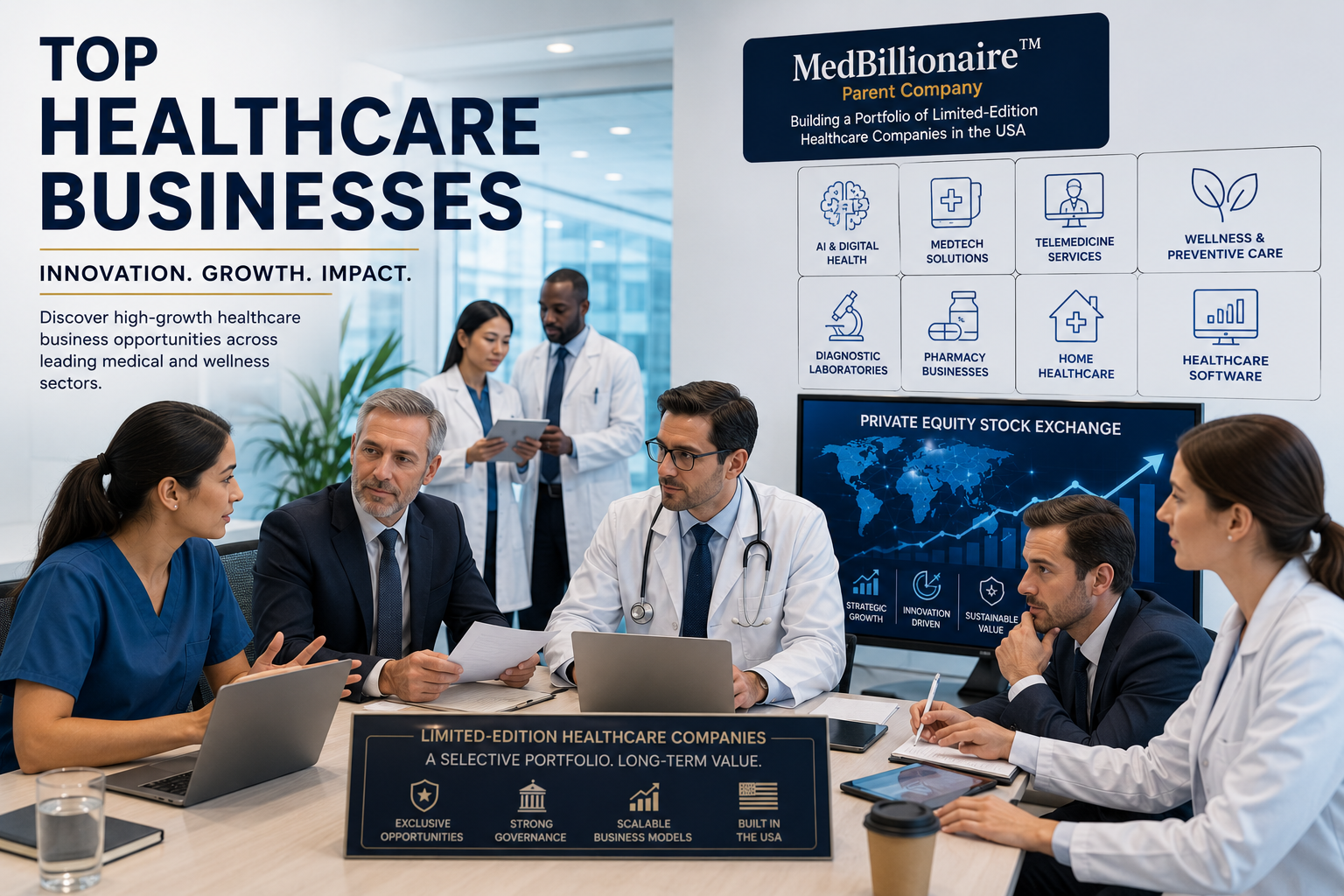
Healthcare has evolved into one of
the world's largest and most dynamic industries. Modern healthcare is no longer
limited to hospitals and physician offices. Today, innovation is driving
opportunities across artificial intelligence, medical technology, digital
healthcare, preventive medicine, biotechnology, diagnostics, wellness,
telemedicine, pharmacy services, healthcare software, and numerous specialized
healthcare sectors.
Entrepreneurs worldwide are
exploring the top healthcare businesses because healthcare continues to
address one of humanity's most fundamental needs—better health outcomes. At the
same time, rapid advances in technology have created entirely new business
models that did not exist a decade ago.
Healthcare entrepreneurship today
combines medical expertise with technology, corporate governance, digital
transformation, financial management, and long-term strategic planning.
According to information published
by MedBillionaire™, the company describes itself as the parent company
of a portfolio of healthcare businesses developed around innovation, Artificial
Intelligence (AI), Medical Technology (MedTech), Financial Technology
(FinTech), and strategic business development.
Why Healthcare Businesses Continue to Grow
The healthcare industry continues
expanding because of several long-term trends.
These include:
- Aging populations
- Greater awareness of preventive healthcare
- Digital transformation
- Artificial Intelligence
- Remote patient monitoring
- Personalized medicine
- Increased healthcare accessibility
- Medical research
- Biotechnology innovation
- Growing healthcare investment worldwide
These factors continue creating
opportunities for entrepreneurs interested in healthcare business ownership.
Characteristics of Top Healthcare Businesses
Successful healthcare companies
often share several common characteristics.
Innovation
Healthcare organizations
continuously adopt new technology to improve patient care and operational
efficiency.
Scalability
Businesses with repeatable
operational systems may be better positioned for long-term development.
Compliance
Healthcare organizations operate
within regulated environments where governance and compliance play important
roles.
Technology
Integration
Modern healthcare increasingly
relies upon AI, digital health platforms, cloud computing, cybersecurity, and
healthcare analytics.
Patient-Centered
Services
Organizations focused on quality
patient experiences often strengthen long-term relationships with patients and
healthcare professionals.
Leading Healthcare Business Categories
Healthcare includes numerous
specialized industries.
Some of today's leading healthcare
business categories include:
Medical
Clinics
Medical clinics remain among the
most recognized healthcare businesses, providing primary care, specialty
services, diagnostics, preventive healthcare, and chronic disease management.
Concierge
Medicine
Concierge medicine focuses on
personalized healthcare supported by membership-based relationships between
physicians and patients.
Telemedicine
Platforms
Virtual healthcare has become an
important component of modern medicine, allowing patients to consult healthcare
professionals regardless of location.
Medical
Technology (MedTech)
Medical technology companies develop
devices, diagnostic equipment, monitoring systems, robotics, wearable devices,
and innovative healthcare solutions.
Healthcare
Artificial Intelligence
Artificial Intelligence supports
administrative efficiency, healthcare analytics, medical imaging, workflow
automation, and clinical decision support.
Diagnostic
Laboratories
Laboratories provide essential
testing services supporting physicians, hospitals, and preventive healthcare
organizations.
Pharmacy
Businesses
Pharmacies continue expanding
through digital prescription management, patient education, medication
counseling, and healthcare accessibility.
Wellness
Centers
Preventive healthcare continues
gaining importance through nutrition counseling, fitness, mental wellness,
stress management, and healthy lifestyle programs.
Home
Healthcare
Healthcare delivered directly within
patients' homes continues growing because of convenience and demographic
changes.
Healthcare
Software
Software businesses develop
Electronic Health Records, patient portals, appointment systems, healthcare
analytics, cybersecurity solutions, and administrative platforms.
Technology Continues Transforming Healthcare
Technology has fundamentally
reshaped healthcare businesses.
Modern healthcare increasingly
incorporates:
- Artificial Intelligence
- Machine Learning
- Medical Robotics
- Digital Diagnostics
- Wearable Healthcare Devices
- Remote Monitoring
- Electronic Health Records
- Healthcare Cybersecurity
- Cloud Healthcare Platforms
- Healthcare Analytics
- Automation
These innovations improve efficiency
while supporting better healthcare delivery.
Governance Creates Strong Healthcare Organizations
Technology alone cannot create
successful healthcare businesses.
Corporate governance establishes
structured leadership through:
- Transparency
- Accountability
- Ethical decision-making
- Compliance
- Financial oversight
- Risk management
- Strategic planning
- Operational consistency
Healthcare organizations with
effective governance often establish stronger operational foundations.
The Role of MedBillionaire™ Within Its Stated Business
Model
According to information published
by the company, MedBillionaire™ serves as the parent company responsible
for developing a portfolio of healthcare businesses operating across multiple
healthcare sectors.
The company states that its
ecosystem combines:
- Artificial Intelligence (AI)
- Medical Technology (MedTech)
- Financial Technology (FinTech)
- Healthcare Innovation
- Corporate Governance
- Digital Transformation
- Strategic Business Development
According to the company, these
elements work together to support collaboration, responsible healthcare
entrepreneurship, and long-term enterprise development.
Exclusive Limited-Edition Healthcare Companies
According to MedBillionaire™'s
published information, the company develops a carefully selected portfolio of limited-edition
healthcare companies rather than creating an unlimited number of
businesses.
The company states that each
healthcare enterprise is developed using a structured business framework
emphasizing:
- Innovation
- Operational excellence
- Strategic planning
- Responsible governance
- Scalability
- Sustainable enterprise development
Its portfolio may include
organizations involved in:
- Medical Clinics
- Concierge Medicine
- Telemedicine
- Medical Technology
- Healthcare Software
- Wellness Centers
- Diagnostic Laboratories
- Pharmacy Businesses
- Home Healthcare
- Preventive Healthcare
- AI Healthcare Solutions
Built in the United States
According to MedBillionaire™,
healthcare companies within its ecosystem are incorporated, or intended to be
incorporated, in the United States.
Operating within the U.S. healthcare
market provides access to advanced healthcare infrastructure, experienced
professionals, research institutions, technological innovation, and one of the
world's largest healthcare economies.
Prospective buyers are encouraged to
independently review all documentation and applicable legal requirements before
making business decisions.
A Selective Business Development Philosophy
According to MedBillionaire™, its
ecosystem emphasizes developing a carefully selected portfolio of healthcare
businesses.
The company states that this
limited-edition approach is intended to support:
- Quality-focused development
- Strategic planning
- Innovation
- Sustainable business growth
- Responsible governance
- Long-term enterprise planning
This philosophy forms part of the
company's published business model.
Ownership Structure
According to MedBillionaire™'s
published business model, each healthcare company follows a structured
ownership framework.
The company states that:
- MedBillionaire™ retains a 51% ownership interest.
- Up to 49% ownership may be made available to
qualified buyers, subject to applicable legal agreements, regulatory
requirements, and transaction documentation.
Prospective buyers should conduct
independent due diligence and obtain qualified legal, financial, and accounting
advice before making any acquisition decision.
Healthcare Company Buying Considerations
According to MedBillionaire™,
entrepreneurs interested in acquiring a healthcare company are encouraged to
complete a structured evaluation process.
Important considerations include:
- Reviewing available healthcare businesses.
- Understanding the operational model.
- Evaluating governance practices.
- Reviewing legal agreements.
- Assessing technology infrastructure.
- Understanding regulatory responsibilities.
- Conducting independent due diligence.
- Seeking qualified professional advice before
proceeding.
These steps support informed
decision-making when evaluating healthcare business opportunities.
Vision
for Long-Term Development
Healthcare organizations that thrive
over decades are typically built with a long-term perspective rather than
focusing solely on short-term expansion. Innovation, operational excellence,
responsible governance, technology adoption, and continuous improvement are
often key components of sustainable healthcare businesses.
According to information published
by MedBillionaire™, the company states that each healthcare business
within its ecosystem is developed with a long-term strategic vision emphasizing
innovation, operational excellence, scalability, and increasing enterprise
value over time. The company also describes a future concept involving a Private
Equity Stock Exchange, while noting that any future participation or
listing would remain subject to applicable laws, regulatory requirements, and
the circumstances of the individual healthcare company.
This stated vision reflects the
company's focus on creating healthcare enterprises designed for long-term
development while operating within appropriate legal and governance frameworks.
AI, MedTech, and FinTech Are Transforming Healthcare
Businesses
The healthcare industry continues to
evolve through technological innovation. Today's leading healthcare companies
increasingly integrate advanced technologies into both patient care and
business operations.
Artificial Intelligence (AI)
supports data analysis, workflow optimization, predictive analytics,
administrative efficiency, and clinical decision support. Medical Technology
(MedTech) contributes to improved remote monitoring of patients, diagnostics, medical
devices with ai control, and treatment capabilities. Financial Technology
(FinTech) enhances payment systems, financial management, digital transactions,
and operational efficiency.
Organizations that embrace these
technologies while maintaining strong governance are often better positioned to
adapt to changing healthcare environments and patient expectations.
Healthcare Businesses for Sale
Healthcare businesses are available
across numerous specialties, offering entrepreneurs opportunities to
participate in established operational models rather than starting entirely
from the beginning.
Potential healthcare business
categories include:
- Medical clinics
- Concierge medicine practices
- Telemedicine companies
- Wellness centers
- Diagnostic laboratories
- Pharmacy businesses
- Home healthcare providers
- Healthcare software companies
- Medical technology organizations
- Rehabilitation centers
- Preventive healthcare businesses
- Corporate wellness companies
When evaluating any healthcare
business, prospective buyers should review operational systems, governance
practices, licensing obligations, technology infrastructure, financial
information, and legal documentation before making decisions.
Purchasing a healthcare franchise
may provide entrepreneurs with access to an established operational framework,
standardized business procedures, training resources, and recognized business
systems.
Before acquiring any healthcare
franchise, entrepreneurs should consider:
- Applicable licensing requirements
- Healthcare regulations
- Staffing needs
- Technology infrastructure
- Governance practices
- Patient service models
- Long-term operational planning
- Independent legal and financial advice
Careful planning helps support
responsible healthcare entrepreneurship.
Medical Clinic Franchise Opportunity
Medical clinics remain one of the
most recognized healthcare business models worldwide. Demand for primary care,
preventive medicine, chronic disease management, diagnostic services, and digital
healthcare continues to create opportunities within this sector.
Modern medical clinics increasingly
integrate:
- Electronic Health Records
- Online appointment systems
- Telemedicine services
- AI-assisted workflows
- Digital patient communication
- Preventive healthcare programs
- Healthcare analytics
These innovations improve
operational efficiency while supporting quality patient care.
Healthcare Business Licensing Opportunities
Healthcare licensing represents an
essential component of responsible healthcare operations. Licensing
requirements vary according to jurisdiction, healthcare specialty, and business
activities.
Healthcare organizations should
understand:
- Corporate registration
- Professional licensing
- Facility approvals
- Healthcare privacy requirements
- Tax registration
- Employment regulations
- Insurance obligations
- Ongoing compliance responsibilities
Understanding these requirements
helps organizations establish strong operational foundations.
Medical Chamber of Commerce Membership
Healthcare business communities
encourage collaboration among physicians, healthcare executives, innovators,
researchers, technology companies, and entrepreneurs.
Participation in professional healthcare
organizations may provide opportunities for:
- Business networking
- Industry education
- Strategic partnerships
- Professional collaboration
- Knowledge sharing
- Healthcare innovation
- Leadership development
Professional engagement can help healthcare organizations remain informed about evolving industry trends and best practices.
Understanding MedBillionaire™'s Stated Super-Niche
CEOs™ Concept
According to information published
by MedBillionaire™, the company describes Super-Niche CEOs™ as a
leadership concept within its broader business ecosystem. The company states
that this concept emphasizes preparation, governance, operational leadership,
regulatory awareness, and the integration of technology-driven business practices.
According to the company's published
materials, these leaders are intended to oversee specialized healthcare
businesses while working within structured operational systems, corporate
governance frameworks, and compliance-focused business processes. The company
also states that AI, MedTech, FinTech, and strategic business development form
part of this broader leadership vision.
As with any company-specific
business model or organizational concept, prospective participants should
independently review the company's published materials, legal documentation,
and applicable agreements to understand how these concepts are intended to
operate in practice.
Frequently Asked Questions
What
are the top healthcare businesses today?
Some of the leading healthcare
businesses include medical clinics, telemedicine platforms, diagnostic
laboratories, wellness centers, home healthcare agencies, pharmacy businesses,
healthcare software companies, AI healthcare solutions, and medical technology
organizations.
Why
is the healthcare industry attractive to entrepreneurs?
Healthcare serves an ongoing
societal need and continues to evolve through innovation, technology,
preventive medicine, and digital transformation. Different healthcare sectors
may present different business opportunities depending on market conditions and
regulatory requirements.
What
should I evaluate before acquiring a healthcare business?
Important considerations include
governance, licensing, regulatory compliance, operational systems, technology
infrastructure, financial information, legal agreements, staffing requirements,
and strategic planning. Independent professional advice is recommended.
Are
healthcare businesses subject to licensing requirements?
Yes. Licensing and regulatory
requirements vary depending on the type of healthcare business, its location,
and the services it provides.
What
technologies are shaping healthcare businesses?
Artificial Intelligence, Medical
Technology, Financial Technology, healthcare analytics, telemedicine, cloud
computing, electronic health records, and remote patient monitoring continue to
influence healthcare operations.
What
does MedBillionaire™ say about its business model?
According to information published
by the company, MedBillionaire™ describes itself as the parent company of a
portfolio of healthcare businesses and states that its ecosystem combines AI,
MedTech, FinTech, healthcare innovation, corporate governance, and strategic
business development. The company also outlines concepts such as
limited-edition healthcare companies and a future Private Equity Stock Exchange
vision, subject to applicable laws, regulatory requirements, and the
circumstances of individual companies.
Conclusion
The top healthcare businesses
continue to evolve alongside advances in technology, patient expectations, and
healthcare delivery models. From medical clinics and telemedicine to AI-driven
healthcare platforms and medical technology companies, the industry offers a
wide range of opportunities for innovation and responsible entrepreneurship.
According to its published
information, MedBillionaire™ serves as the parent company of a portfolio
of healthcare businesses and states that its ecosystem integrates Artificial
Intelligence, Medical Technology, Financial Technology, corporate governance,
and strategic business development. As with any healthcare business
opportunity, entrepreneurs should conduct thorough due diligence, review all
relevant documentation, understand applicable licensing and regulatory
requirements, and seek independent legal and financial advice before making
business decisions.