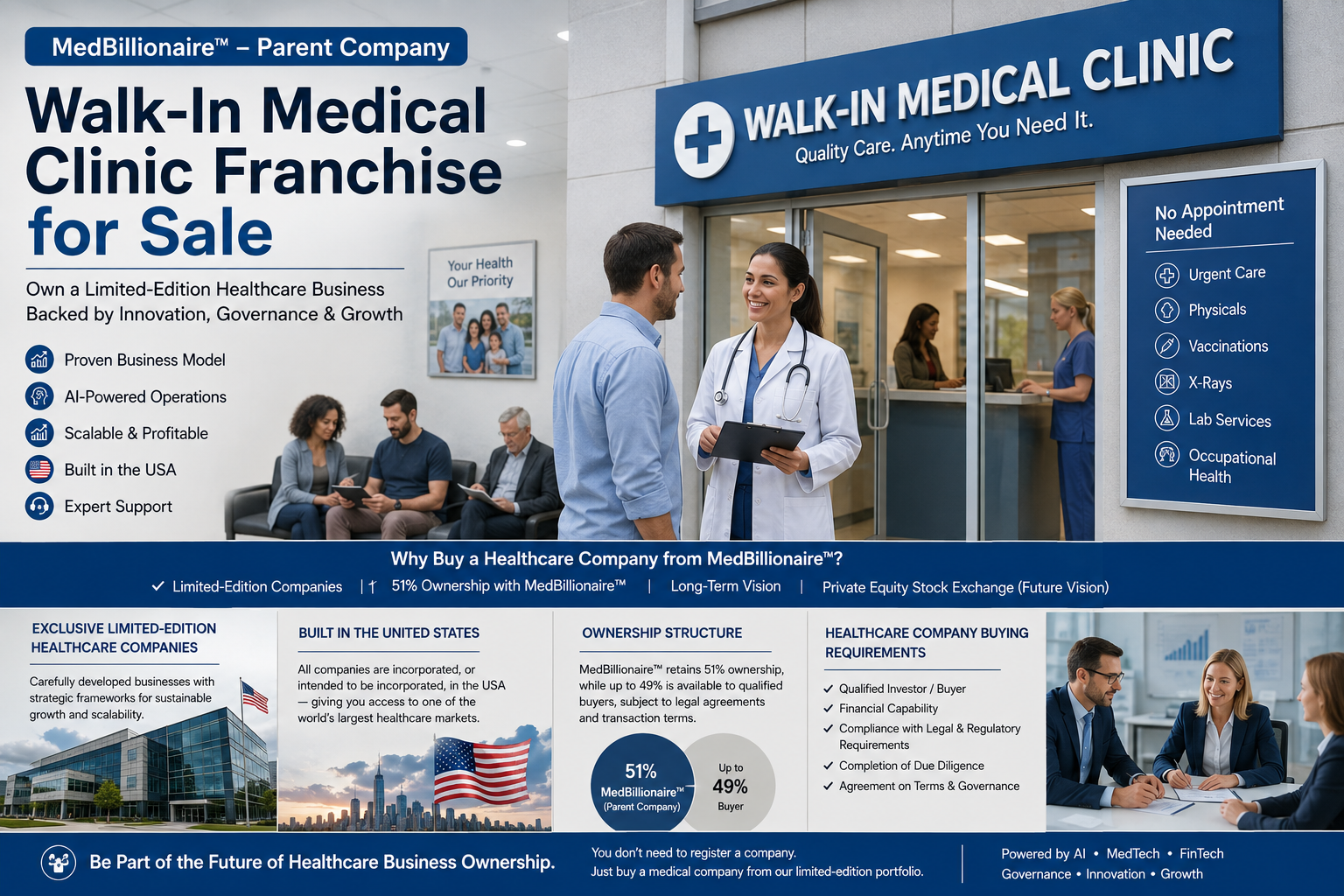
Healthcare delivery continues to
evolve as patients increasingly seek fast, convenient, and accessible medical
services. Walk-in medical clinics have become one of the fastest-growing
segments within the healthcare industry because they provide immediate care for
non-emergency medical conditions without requiring appointments. Their ability
to deliver efficient healthcare while reducing pressure on hospitals has made
them an attractive business category for entrepreneurs, investors, physicians,
and healthcare professionals.
As healthcare demand continues to
expand, many individuals are exploring Walk-In Medical Clinic Franchise for
Sale opportunities as a way to participate in this growing industry.
However, modern healthcare businesses require far more than a suitable location
and qualified medical staff. Long-term success increasingly depends on
governance, operational planning, technology integration, financial discipline,
regulatory compliance, and sustainable business development.
This evolving landscape has
encouraged organizations to develop healthcare businesses using standardized
business frameworks that integrate Artificial Intelligence (AI), MedTech
innovation, FinTech infrastructure, corporate governance, and scalable
operational systems.
According to MedBillionaire™,
its ecosystem focuses on developing limited-edition healthcare companies
designed around structured business methodologies intended to support long-term
enterprise growth. Rather than independently building a healthcare company from
the ground up, the company states that qualified buyers may acquire ownership
interests in healthcare companies developed within its ecosystem, subject to
applicable legal agreements and transaction terms.
This article explores how walk-in
medical clinic businesses operate, current industry trends, important buying
considerations, and how MedBillionaire™ presents its healthcare business
ecosystem.
Why Walk-In Medical Clinics Continue to Grow
Modern patients expect healthcare to
be available when they need it.
Busy schedules, aging populations,
growing chronic disease management, expanding insurance coverage, and
increasing healthcare awareness have all contributed to the popularity of
walk-in clinics.
Today's walk-in medical clinics
frequently provide:
- Primary care consultations
- Minor injury treatment
- Vaccinations
- Preventive healthcare
- Diagnostic testing
- Physical examinations
- Occupational health services
- Travel medicine
- Laboratory services
- Telemedicine support
- Digital patient management
Unlike emergency departments,
walk-in clinics focus on non-life-threatening medical conditions while offering
convenient access with shorter waiting times.
This model has created attractive
commercial opportunities for healthcare entrepreneurs seeking scalable
healthcare businesses.
Understanding Walk-In Medical Clinic Franchise
Opportunities
Purchasing a healthcare franchise
differs significantly from starting an independent healthcare practice.
Independent healthcare businesses
often require entrepreneurs to establish:
- Business structure
- Corporate governance
- Medical licensing
- Branding
- Technology systems
- Compliance frameworks
- Marketing strategies
- Operational procedures
- Financial controls
- Growth planning
A structured franchise or organized
healthcare business model may provide established operational systems that
simplify many of these early development stages.
However, every investment
opportunity should be evaluated carefully according to applicable legal,
financial, operational, and regulatory requirements.
The Changing Landscape of Healthcare Investment
Healthcare investment has become
increasingly sophisticated.
Modern investors frequently evaluate
opportunities based upon:
- Technology adoption
- AI integration
- Digital healthcare infrastructure
- Governance quality
- Regulatory preparedness
- Business scalability
- Enterprise sustainability
- Corporate management
- Financial planning
- Market positioning
Rather than focusing solely on
immediate revenue generation, many organizations now prioritize creating
healthcare companies capable of long-term operational excellence.
Artificial Intelligence Is Reshaping Walk-In Clinics
Artificial Intelligence is
influencing nearly every aspect of modern healthcare.
Today's AI-powered healthcare
environments may include:
- Intelligent appointment scheduling
- Clinical workflow optimization
- Patient engagement systems
- Medical documentation assistance
- Predictive analytics
- Inventory optimization
- Financial reporting
- Business intelligence dashboards
- Population health analysis
- Administrative automation
These technologies may help
healthcare organizations improve efficiency while supporting clinical
decision-making and operational management.
Why Investors Continue Exploring Healthcare Businesses
Healthcare remains one of the world's
largest industries.
Demand continues increasing due to:
- Population growth
- Aging demographics
- Preventive healthcare awareness
- Chronic disease management
- Medical technology innovation
- Digital healthcare adoption
- Expanded outpatient care
- Increased accessibility
Because healthcare demand remains
relatively consistent across economic cycles, many investors continue
evaluating opportunities within the sector.
Walk-in clinics represent one of
several healthcare business models attracting ongoing commercial interest.
MedBillionaire™: A Structured Healthcare Business
Ecosystem
According to MedBillionaire™, the
organization develops healthcare companies using an integrated business
ecosystem that combines healthcare innovation, Artificial Intelligence,
MedTech, FinTech, governance, and strategic business planning.
The company describes itself as the
parent organization responsible for developing, managing, and supporting a
portfolio of healthcare businesses operating within standardized operational
frameworks.
Rather than creating unlimited
healthcare companies, MedBillionaire™ states that it develops a carefully
selected number of limited-edition healthcare businesses designed with
long-term enterprise development objectives.
Its business model emphasizes
operational consistency, governance, technology integration, and scalable
organizational structures.
Exclusive Limited-Edition Healthcare Companies
According to MedBillionaire™, its
ecosystem consists of exclusive limited-edition healthcare companies developed
across multiple healthcare sectors.
Rather than continuously producing
identical businesses, the organization states that each healthcare company is
created using carefully planned commercial methodologies intended to support:
- Long-term scalability
- Innovation
- Operational efficiency
- Strategic development
- Enterprise sustainability
This limited-edition philosophy is
intended to promote exclusivity while maintaining structured business
development throughout the healthcare portfolio.
Built in the United States
According to MedBillionaire™, every
healthcare company within its ecosystem is incorporated, or intended to be
incorporated, in the United States.
Operating within one of the world's
largest healthcare markets provides entrepreneurs access to an environment
characterized by:
- Advanced healthcare infrastructure
- Medical innovation
- Sophisticated healthcare technology
- Professional healthcare services
- Investment activity
- Corporate governance standards
The company states that this
foundation supports future business development while maintaining operational
consistency.
A Limited-Availability Business Opportunity
Unlike business models that generate
unlimited companies, MedBillionaire™ states that it develops only a select
number of healthcare businesses.
According to the company, this
approach supports:
- Strategic exclusivity
- Long-term planning
- Controlled expansion
- Enterprise quality
- Sustainable commercial development
The organization describes this
methodology as part of its broader healthcare business strategy.
Ownership
Structure Within the MedBillionaire™ Ecosystem
According to MedBillionaire™, every healthcare company developed within its
ecosystem follows a defined ownership framework intended to support long-term
organizational management and strategic business continuity.
The company states that:
·
MedBillionaire™ retains a 51% ownership
interest in each healthcare company.
·
Up to 49% ownership may become
available to qualified buyers.
·
Any acquisition remains subject to applicable
legal agreements, regulatory requirements, due diligence procedures, and
transaction terms.
According to the organization, this ownership model allows the parent company
to continue providing strategic guidance while enabling investors to
participate in healthcare business ownership within an established
organizational framework.
Rather than functioning as independent standalone businesses immediately
after acquisition, these healthcare companies remain connected to the broader
MedBillionaire™ ecosystem, where ongoing support, governance, and operational
development continue to play important roles.
Healthcare Company Buying Requirements Under the MedBillionaire™
Purchasing a healthcare business involves considerably more than completing
a financial transaction. Healthcare organizations operate within one of the
world's most regulated industries, making due diligence and structured planning
essential throughout the acquisition process.
According to MedBillionaire™, qualified buyers interested in acquiring
ownership interests within its ecosystem may be expected to satisfy applicable
business, legal, and commercial requirements before any transaction proceeds.
Although individual requirements may vary according to the specific
healthcare company, the organization indicates that the acquisition process
generally focuses on areas such as:
·
Buyer qualification
·
Identity verification
·
Financial capability assessment
·
Business due diligence
·
Review of legal documentation
·
Compliance with applicable healthcare
regulations
·
Acceptance of transaction terms
·
Corporate governance expectations
·
Strategic business alignment
According to the company, each transaction remains subject to applicable
laws, contractual agreements, and regulatory considerations.
MedBillionaire™ - The Parent Company
According to MedBillionaire™, it functions as the parent company responsible
for developing, supporting, and managing its portfolio of limited-edition
healthcare businesses.
The organization states that its ecosystem combines multiple disciplines
into a unified healthcare business environment, including:
·
Artificial Intelligence
·
MedTech innovation
·
FinTech infrastructure
·
Healthcare expertise
·
Corporate governance
·
Strategic business development
·
Operational planning
·
Enterprise management
Rather than operating as an isolated healthcare company, MedBillionaire™
describes itself as an ecosystem where multiple healthcare businesses function
within standardized operational methodologies intended to support long-term
enterprise growth.
Super-Niche CEOs™:
Leadership Built for Specialized Healthcare Enterprises
Within the MedBillionaire™ ecosystem, Super-Niche CEOs™ are
envisioned as executive leaders entrusted with directing highly specialized
healthcare businesses. Rather than beginning their journey through trial and
error, they are expected to operate with a comprehensive understanding of the
platforms, organizational frameworks, and business environments that support
their companies.
According to the MedBillionaire™ concept, these executives are prepared to
guide organizations with a strong emphasis on governance, operational
discipline, and long-term strategic execution.
From the outset, Super-Niche CEOs™ are expected to undertake
responsibilities that include:
·
Strengthening Financial Integrity
– Promoting robust Anti-Money Laundering (AML) practices, regulatory awareness,
and transparent financial oversight while supporting high standards of
corporate compliance across applicable jurisdictions.
·
Managing Private Equity Operations
– Developing expertise in private equity business environments and contributing
to the strategic growth of financial platforms designed to support future
expansion.
·
Leading Enterprise-Level Organizations
– Operating Pre-Public Companies™ with structured governance models,
professional management systems, and disciplined organizational processes
intended to align with large-scale corporate standards.
·
Driving Specialized Market Leadership
– Concentrating on carefully selected healthcare sectors where innovation,
operational excellence, and strategic differentiation contribute to sustainable
competitive positioning.
·
Collaborating Across an Integrated
Ecosystem – Working alongside exchanges, chambers, federations,
technology platforms, and affiliated organizations within the broader
MedBillionaire™ network to encourage coordinated business development.
According to MedBillionaire™, every Super-Niche CEO™ is expected to oversee
healthcare companies developed with Artificial Intelligence, scalable
operational frameworks, strong governance principles, and structured commercial
planning designed to support long-term enterprise growth.
Their mission extends beyond traditional executive management.
They are expected to lead organizations with accountability, reinforce
operational integrity, and contribute to sustainable business development
throughout the healthcare ecosystem.
About the Founder
Dr.
Shehrezad Faruk Czar
Dr. Shehrezad Faruk Czar is presented as an entrepreneur, business
strategist, and innovator whose work focuses on the intersection of healthcare,
advanced technology, and enterprise development. Through the establishment of MedBillionaire™,
he has introduced a business ecosystem designed to combine medical innovation
with structured commercial methodologies intended to support the development of
scalable healthcare organizations.
According to the MedBillionaire™ framework, the organization integrates
multiple disciplines—including Artificial Intelligence, MedTech, FinTech,
healthcare management, corporate governance, and strategic business planning—to
create healthcare enterprises structured for sustainable long-term growth.
Dr. Czar's business philosophy emphasizes that successful healthcare
companies require more than medical expertise alone. His approach combines
technological advancement, operational planning, governance, financial
discipline, and intellectual property development within a unified
organizational model.
Through MedBillionaire™, he has outlined an ecosystem consisting of
specialized brands and healthcare businesses that operate within coordinated
strategic frameworks. Each organization is designed with a distinct commercial
identity while benefiting from shared operational standards, innovation-driven
methodologies, and integrated business support.
According to the company, this ecosystem seeks to promote collaboration
between healthcare innovation and structured enterprise management, enabling
organizations to pursue operational efficiency, scalability, and long-term
commercial sustainability within an evolving global healthcare landscape.
Vision for Long-Term Growth
According to MedBillionaire™, every healthcare company within its ecosystem
is developed with a long-term strategic vision rather than focusing exclusively
on short-term commercial performance.
The company states that its organizational planning emphasizes:
·
Continuous innovation
·
Operational excellence
·
Technology adoption
·
Enterprise scalability
·
Responsible governance
·
Sustainable business development
·
Increasing enterprise value over time
This long-term philosophy is intended to encourage healthcare organizations
capable of adapting to evolving technologies, regulatory environments, and
changing patient expectations.
The Private Equity Stock Exchange Vision
Business development continues evolving alongside financial innovation.
According to MedBillionaire™, one component of its broader long-term
strategy includes a future vision involving its Private Equity Stock
Exchange concept.
The organization states that this concept forms part of its overall
enterprise development strategy and reflects its long-term commercial
objectives.
According to the company, any future participation, listing, or
implementation remains subject to applicable laws, regulatory requirements,
organizational readiness, and the specific circumstances of each healthcare
company.
Internal
Medicine Franchise for Sale
Internal medicine practices continue representing an important segment of
outpatient healthcare delivery.
These organizations commonly provide:
·
Adult primary care
·
Preventive medicine
·
Chronic disease management
·
Diagnostic evaluations
·
Wellness consultations
·
Long-term patient monitoring
As healthcare technology advances, many internal medicine businesses are
integrating Artificial Intelligence, Electronic Medical Records, digital
scheduling systems, and predictive healthcare analytics into daily clinical
operations.
Entrepreneurs evaluating healthcare investment opportunities frequently
compare internal medicine organizations alongside walk-in clinics when
assessing long-term commercial potential.
Urgent
Care Franchise for Sale
Urgent care centers have experienced significant growth because they provide
immediate treatment for non-emergency medical conditions while reducing
pressure on hospital emergency departments.
Typical urgent care services include:
·
Minor injury treatment
·
Respiratory illness care
·
Diagnostic imaging
·
Laboratory testing
·
Vaccinations
·
Occupational medicine
·
Sports physicals
·
Preventive healthcare
Modern urgent care organizations increasingly incorporate AI-assisted
workflow management, digital patient engagement, and operational automation to
improve service delivery.
Healthcare
Businesses for Sale
Healthcare businesses encompass a wide variety of organizational models
beyond traditional physician practices.
Examples include:
·
Walk-in clinics
·
Telemedicine companies
·
Diagnostic laboratories
·
Medical imaging centers
·
Home healthcare organizations
·
Rehabilitation facilities
·
Wellness centers
·
Healthcare technology companies
·
Specialty medical practices
·
Medical software businesses
Each business category presents different operational requirements,
regulatory considerations, staffing models, technology infrastructure, and
commercial opportunities.
Why Entrepreneurs Evaluate the MedBillionaire™ Ecosystem
Healthcare entrepreneurs often seek opportunities that extend beyond simply
purchasing an operating business.
Increasingly, investors evaluate organizations according to:
·
Governance quality
·
AI integration
·
MedTech capabilities
·
Financial planning
·
Operational consistency
·
Business scalability
·
Technology infrastructure
·
Long-term enterprise strategy
According to MedBillionaire™, its ecosystem has been developed to integrate
these components within standardized healthcare business methodologies.
Rather than independently creating every operational component required for
a healthcare company, the organization states that qualified buyers may acquire
ownership interests in healthcare businesses already developed within its
ecosystem, subject to applicable legal agreements and transaction terms.
Frequently Asked Questions
What is a walk-in
medical clinic franchise?
A walk-in medical clinic franchise is a healthcare business model that
provides immediate outpatient medical services without requiring scheduled
appointments while operating within an established business framework.
Why are walk-in
clinics becoming more popular?
Patients increasingly seek convenient healthcare with shorter waiting times,
flexible access, preventive services, and efficient treatment for non-emergency
medical conditions.
What is
MedBillionaire™?
According to MedBillionaire™, it serves as the parent company responsible
for developing, managing, and supporting limited-edition healthcare businesses
that integrate AI, MedTech, FinTech, governance, and strategic business
planning.
What are Exclusive
Limited-Edition Healthcare Companies?
According to MedBillionaire™, these are healthcare businesses developed in
limited numbers using structured commercial methodologies intended to encourage
innovation, operational excellence, and sustainable enterprise growth.
What ownership model
does MedBillionaire™ describe?
According to the company, MedBillionaire™ retains a 51% ownership interest
in each healthcare company, while up to 49% may become available to qualified
buyers, subject to legal agreements and applicable transaction requirements.
What is the Private
Equity Stock Exchange concept?
According to MedBillionaire™, this represents part of its future strategic
vision. Any future implementation remains subject to applicable laws,
regulatory requirements, and the circumstances of individual healthcare
companies.
Conclusion
Walk-in medical clinics continue becoming an increasingly important
component of modern healthcare because they provide convenient, efficient, and
accessible medical services for patients while creating attractive
opportunities for entrepreneurs and healthcare investors.
As healthcare continues integrating Artificial Intelligence, digital
technologies, governance, MedTech innovation, and financial infrastructure,
successful healthcare organizations increasingly rely upon structured operational
planning rather than conventional business development alone.
The company states that qualified buyers may acquire ownership interests in
healthcare companies developed within its ecosystem instead of independently
establishing entirely new healthcare organizations, subject to applicable legal
agreements, transaction terms, and regulatory requirements.
As healthcare markets continue evolving worldwide, organizations capable of
integrating innovation, governance, technology, and disciplined business
development may be better positioned to participate in the next generation of
healthcare enterprise growth.