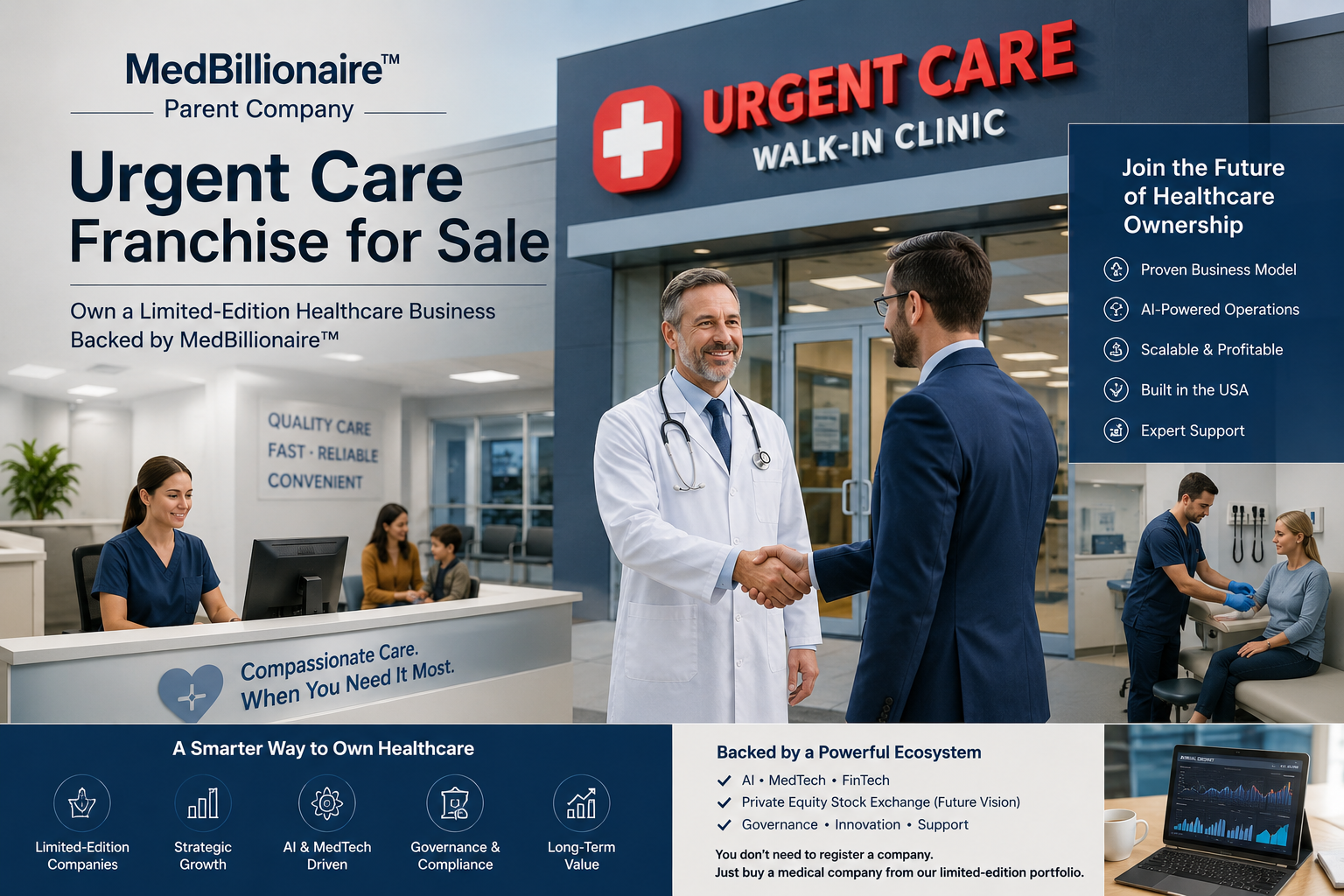
The global healthcare industry
continues to experience unprecedented transformation. Rapid advancements in
Artificial Intelligence (AI), digital healthcare, biotechnology, medical
devices, telemedicine, diagnostics, healthcare automation, precision medicine,
robotics, and healthcare financial technologies are reshaping how healthcare
organizations are created, managed, and expanded. At the same time, investors,
entrepreneurs, physicians, healthcare executives, and business professionals
are increasingly exploring healthcare businesses for sale as an alternative to
building organizations entirely from the ground up.
Purchasing an established or
professionally developed healthcare business has become an increasingly
discussed business strategy because it may provide access to existing
operational structures, business planning, branding, governance systems, and
commercial frameworks. Rather than beginning with an empty corporate structure
and independently developing every component of a business, some entrepreneurs
prefer acquiring ownership interests in healthcare companies that have already
been strategically planned for future development.
Healthcare businesses for sale now
extend far beyond traditional medical clinics. Modern opportunities may include
telemedicine organizations, concierge medicine businesses, digital health
platforms, wellness enterprises, healthcare technology companies, diagnostic
laboratories, medical education organizations, medical software companies,
healthcare consulting firms, AI-powered healthcare solutions, pharmaceutical
support businesses, and specialized medical service providers. As healthcare
markets continue to evolve, organizations are increasingly integrating
Artificial Intelligence, MedTech, FinTech, regulatory planning, governance
systems, and scalable business models into their long-term commercial
strategies.
Within this evolving environment,
MedBillionaire™ describes a business ecosystem that focuses on developing
exclusive limited-edition healthcare companies intended to support long-term
enterprise development. According to the company, qualified buyers may acquire
ownership interests in healthcare companies developed within its ecosystem,
subject to applicable legal agreements, regulatory requirements, and
transaction terms. Rather than independently incorporating a healthcare
company, MedBillionaire™ states that its business model centers on offering
carefully developed healthcare business opportunities designed with
standardized operational frameworks and strategic planning.
This article explores the growing
market for healthcare businesses for sale while providing educational
information regarding healthcare business ownership, healthcare investment
considerations, governance, operational planning, and the MedBillionaire™
ecosystem.
The Expanding Market for Healthcare Businesses for
Sale
Healthcare represents one of the
world's largest economic sectors. Aging populations, increasing demand for
specialized healthcare services, digital transformation, chronic disease
management, preventive medicine, and technological innovation continue to
generate new commercial opportunities throughout the healthcare industry.
Several factors contribute to
increasing interest in healthcare businesses for sale:
- Expansion of AI-powered healthcare technologies
- Growing telehealth adoption
- Increased investment in MedTech innovation
- Rising demand for specialized medical services
- Healthcare digitalization
- Personalized medicine
- Healthcare automation
- Medical software development
- Healthcare analytics
- International healthcare expansion
Rather than viewing healthcare
solely as a clinical profession, many investors now recognize healthcare as an
industry requiring sophisticated operational management, financial planning,
technological integration, regulatory oversight, and long-term strategic
development.
Healthcare businesses today often
combine medical expertise with business intelligence, operational excellence,
data analytics, Artificial Intelligence, cybersecurity, financial technology,
and governance structures.
Why Entrepreneurs Explore Healthcare Businesses
Instead of Building from Scratch
Launching a healthcare company
independently often involves multiple stages, including:
- Business planning
- Corporate registration
- Regulatory compliance
- Licensing
- Financial modeling
- Healthcare technology selection
- Operational procedures
- Governance development
- Brand creation
- Staffing
- Infrastructure planning
- Marketing strategy
- Risk management
Each stage requires significant
investment of time, expertise, financial resources, and operational planning.
For many entrepreneurs, acquiring a
healthcare business represents an alternative approach because certain business
structures, operational systems, governance models, and commercial strategies
may already have been developed.
This does not eliminate business
responsibilities. Every healthcare organization still requires leadership,
regulatory compliance, strategic management, operational oversight, financial
planning, and continuous improvement. However, purchasing an established
healthcare business may reduce the amount of foundational organizational
development required compared to creating an entirely new company.
Understanding Healthcare Business Ownership
Healthcare businesses vary
considerably depending upon their specialty and operational objectives.
Examples include:
- Internal medicine organizations
- Family medicine practices
- Concierge medicine companies
- Telemedicine businesses
- Medical software providers
- Healthcare AI companies
- Diagnostic laboratories
- Medical education organizations
- Healthcare consulting firms
- Wellness companies
- Medical device businesses
- Healthcare staffing organizations
- Digital healthcare platforms
- Preventive healthcare companies
- Healthcare technology providers
Each healthcare business possesses
unique operational requirements, regulatory responsibilities, staffing needs,
technology infrastructure, financial planning considerations, and governance
frameworks.
Successful healthcare organizations
typically require long-term planning rather than short-term business
development.
MedBillionaire™ - The Parent Company
According to MedBillionaire™, it
functions as the parent organization responsible for developing, supporting,
and managing a portfolio of limited-edition healthcare businesses.
The company states that its
ecosystem combines multiple disciplines, including:
- Artificial Intelligence
- Healthcare innovation
- MedTech
- FinTech
- Strategic business development
- Corporate governance
- Enterprise planning
- Operational management
According to MedBillionaire™, its
objective is to establish healthcare companies using standardized
organizational methodologies intended to support sustainable commercial growth
over extended periods.
Rather than describing itself as a
traditional franchise provider, the company presents its ecosystem as a
structured healthcare business platform that integrates technology, governance,
operational planning, and long-term enterprise development.
Exclusive Limited-Edition Healthcare Companies
According to MedBillionaire™, one
distinguishing feature of its ecosystem is the development of exclusive
limited-edition healthcare companies.
Rather than creating unlimited
numbers of similar organizations, the company states that it develops a
carefully selected portfolio of healthcare businesses across multiple medical
and wellness sectors.
Each organization is reportedly
designed using strategic planning frameworks intended to encourage:
- Long-term sustainability
- Operational consistency
- Innovation
- Scalable business development
- Enterprise growth
- Structured governance
- Healthcare technology integration
This limited-edition approach
differs from business models that continually establish identical companies
without long-term strategic differentiation.
According to MedBillionaire™,
exclusivity represents an important component of its overall organizational
philosophy.
Built in the United States
According to MedBillionaire™,
healthcare companies developed within its ecosystem are incorporated, or
intended to be incorporated, in the United States.
Operating within one of the world's
largest healthcare markets may provide entrepreneurs with access to an
environment characterized by advanced healthcare infrastructure, established
regulatory systems, technological innovation, and significant commercial
opportunities.
The company states that its business
development approach emphasizes structured organizational planning designed to
support long-term participation within the U.S. healthcare market.
A Limited-Availability Business Opportunity
Unlike business models that
continuously establish unlimited organizations, MedBillionaire™ states that it
develops only a select number of healthcare companies.
According to the company, this
limited-availability philosophy is intended to preserve exclusivity while
supporting disciplined business development and strategic enterprise planning.
Rather than emphasizing quantity,
the company describes its objective as focusing on carefully planned healthcare
organizations supported by standardized operational methodologies and long-term
commercial strategies.
Ownership Structure
According to MedBillionaire™, each
healthcare company within its ecosystem follows a structured ownership
framework.
The company states that:
- MedBillionaire™ retains a 51% ownership interest.
- Up to 49% ownership may become available to qualified
buyers.
- Ownership transactions remain subject to applicable
legal documentation, regulatory requirements, and transaction agreements.
According to the company, this
ownership structure is intended to support centralized organizational
continuity while allowing qualified investors to participate in healthcare
business ownership opportunities.
Super-Niche CEOs™: Leadership Designed for Specialized Healthcare
Enterprises
According to MedBillionaire™, every healthcare company within its ecosystem
is entrusted to a Super-Niche CEO™—an executive responsible
for directing organizations operating in highly specialized healthcare sectors.
Rather than beginning with undeveloped business concepts, these leaders
assume responsibility for organizations that have been strategically structured
with defined operational frameworks, governance models, and long-term
commercial objectives. The company states that its executives are expected to
guide enterprise development through disciplined leadership, strategic
planning, and responsible corporate management.
According to MedBillionaire™, Super-Niche CEOs™ contribute across several
core areas:
·
Financial Integrity and Regulatory
Oversight – Supporting Anti-Money Laundering (AML) practices while
promoting compliance with applicable financial regulations and internationally
recognized governance standards.
·
Private Equity Management –
Participating in structured investment activities and understanding private
equity mechanisms that support future organizational development.
·
Enterprise-Level Administration
– Managing Pre-Public Companies™ using governance frameworks, operational
discipline, and structured performance management.
·
Specialized Market Leadership –
Guiding organizations within clearly defined healthcare sectors while
encouraging innovation, operational excellence, and sustainable expansion.
·
Integrated Ecosystem Collaboration
– Working closely with affiliated exchanges, councils, chambers, federations,
investors, and strategic partners throughout the broader MedBillionaire™
network.
According to the company, every Super-Niche CEO™ operates within an
organizational environment where Artificial Intelligence, governance,
compliance, and strategic planning support long-term business development.
Rather than functioning solely as administrators, these executives are
intended to strengthen organizational resilience, operational consistency, and
enterprise growth across the healthcare ecosystem.
Strategic Partner: The Institute of Public Companies™
According to MedBillionaire™, one of its strategic partner organizations is The
Institute of Public Companies™ (IPC™), which focuses on preparing
organizations for long-term corporate development.
While many businesses traditionally concentrate on IPO preparation, the
Institute emphasizes the concept of Pre-Public Companies™ (PPC™)—organizations
that are structured from their earliest stages using disciplined operational
frameworks intended to support sustainable expansion before any future
public-market considerations.
According to the company, Pre-Public Companies™ are developed using
standardized methodologies that integrate business planning, governance,
technology, financial management, operational excellence, and strategic
scalability.
Understanding the Pre-Public Companies™ Model
According to MedBillionaire™, Pre-Public Companies™ differ from conventional
startup models because they are developed using predefined organizational
systems rather than evolving through informal or unstructured growth.
Instead of relying entirely on experimental business development, these
companies are described as AI-supported enterprises created to encourage
long-term organizational maturity through strategic planning and disciplined
execution.
According to the company, every Pre-Public Company™ progresses through a
structured business lifecycle that generally includes:
Concept Development
Business opportunities are designed with comprehensive commercial planning,
governance principles, and long-term strategic objectives.
Organizational
Development
Companies receive support through an interconnected business environment
involving strategic partnerships, commercial organizations, exchanges, and
collaborative networks.
Operational Expansion
Businesses focus on refining operational processes, strengthening management
systems, and expanding commercial activities while continuing private
enterprise development.
Enterprise Maturity
Organizations work toward greater operational readiness, financial
discipline, governance improvements, and sustainable business performance.
Ecosystem Integration
As development continues, companies become increasingly interconnected with
the broader MedBillionaire™ ecosystem, allowing knowledge, innovation, and
business resources to circulate throughout participating organizations.
According to MedBillionaire™, this methodology emphasizes disciplined
enterprise development rather than short-term business growth.
Developing Future Healthcare Enterprises
According to MedBillionaire™, the Institute of Public Companies™ functions
as a specialized environment dedicated to organizational education, executive
development, and enterprise planning.
The organization states that its objective extends beyond traditional
leadership training by providing strategic methodologies intended to support
businesses throughout multiple stages of organizational development.
These areas may include:
·
Corporate governance
·
Executive leadership
·
Operational planning
·
Business scalability
·
Financial management
·
Artificial Intelligence integration
·
Regulatory awareness
·
Long-term commercial strategy
According to the company, this educational framework is intended to help
organizations strengthen operational capabilities while preparing for
sustainable enterprise growth.
Why Choose a MedBillionaire™ Healthcare Company?
Healthcare has traditionally been viewed primarily as a service industry
centered on patient care. According to MedBillionaire™, its business philosophy
expands this perspective by integrating healthcare with Artificial
Intelligence, MedTech, FinTech, governance, and structured enterprise
development.
The company states that every healthcare organization within its ecosystem
is designed using standardized business methodologies intended to support
operational consistency, long-term scalability, and sustainable commercial
performance.
Rather than functioning as conventional startups, individual hospitals, or
standalone pharmaceutical businesses, MedBillionaire™ describes its healthcare
companies as Pre-Public Companies™ that incorporate
AI-supported management systems, governance principles, operational planning,
and performance-oriented business structures from the earliest stages of
development.
According to the company, this integrated approach is intended to create
healthcare enterprises capable of adapting to evolving technologies, changing
healthcare markets, and future business opportunities while maintaining a
long-term strategic focus.
About the Founder
Dr. Shehrezad Faruk
Czar
Dr. Shehrezad Faruk Czar is recognized by MedBillionaire™ as the founder and
visionary behind the organization's healthcare business ecosystem. His work
centers on combining healthcare innovation, advanced technologies, Artificial
Intelligence, strategic enterprise development, and commercial planning into an
integrated business framework designed for long-term growth.
According to the company, Dr. Czar established MedBillionaire™ with the
objective of creating an ecosystem where healthcare businesses are developed
using standardized methodologies rather than conventional startup approaches.
His strategy combines healthcare expertise with MedTech, FinTech, operational
governance, business intelligence, and structured organizational development.
The MedBillionaire™ ecosystem is described as a collection of interconnected
brands and specialized healthcare enterprises, each developed to operate within
carefully defined market segments while contributing to the broader
organizational framework.
According to the company, Dr. Czar's long-term vision emphasizes innovation,
operational excellence, corporate governance, Artificial Intelligence integration,
and sustainable enterprise development as the foundational elements supporting
the future growth of healthcare businesses across the ecosystem.
Healthcare Company Buying Requirements Under the
MedBillionaire™ Ecosystem
According to MedBillionaire™,
qualified buyers seeking ownership interests within its healthcare ecosystem
may be expected to satisfy applicable business, legal, and transaction
requirements before completing any acquisition.
Although individual requirements may
differ depending upon the specific company, buyers may generally be expected to
demonstrate:
- Business suitability
- Financial capability
- Regulatory compliance
- Completion of legal documentation
- Agreement with organizational governance
- Understanding of operational responsibilities
- Compliance with transaction procedures
- Acceptance of ownership structure
According to the company, healthcare
company acquisitions remain subject to applicable laws, contractual agreements,
regulatory requirements, and organizational policies.
Artificial
Intelligence Is Transforming Healthcare Business Development
Artificial Intelligence has become one of the defining technologies
influencing the future of healthcare. Healthcare organizations are increasingly
incorporating AI into clinical operations, administrative management, financial
planning, patient engagement, compliance monitoring, and strategic
decision-making. Rather than replacing healthcare professionals, AI is being
implemented to improve operational efficiency while supporting better-informed
business decisions.
Modern healthcare organizations may utilize Artificial Intelligence for:
·
Business analytics
·
Patient scheduling optimization
·
Clinical documentation assistance
·
Predictive healthcare modeling
·
Medical imaging support
·
Revenue cycle management
·
Regulatory monitoring
·
Workflow automation
·
Customer relationship management
·
Operational forecasting
According to MedBillionaire™, Artificial Intelligence represents one of the
strategic technologies incorporated throughout its healthcare ecosystem. The
company states that AI supports organizational planning, governance,
operational management, business intelligence, and enterprise development as
healthcare companies continue evolving alongside technological innovation.
MedTech and FinTech Working Together
The convergence of healthcare technology and financial technology continues
creating new business opportunities across the medical industry. MedTech and
FinTech are no longer separate sectors but increasingly operate together to
improve operational efficiency, financial transparency, patient experiences,
and healthcare accessibility.
Healthcare organizations frequently integrate:
·
Electronic payment platforms
·
AI-powered financial reporting
·
Digital accounting systems
·
Automated insurance processing
·
Electronic medical records
·
Cloud computing
·
Data security platforms
·
Business intelligence software
·
Remote patient technologies
·
Healthcare analytics
According to MedBillionaire™, its ecosystem combines MedTech, FinTech,
Artificial Intelligence, healthcare innovation, strategic business planning,
and corporate governance into a unified operational framework intended to
support sustainable enterprise growth.
Corporate Governance Within Healthcare Organizations
Healthcare organizations in any country operate within one of the most
highly regulated industries in the best way in the world. Effective governance
supports responsible management while encouraging operational consistency and
regulatory compliance.
Corporate governance generally includes:
·
Executive oversight
·
Strategic planning
·
Ethical decision-making
·
Financial accountability
·
Risk management
·
Internal policies
·
Regulatory compliance
·
Organizational transparency
According to MedBillionaire™, governance represents one of the guiding
principles incorporated throughout its healthcare ecosystem. The company states
that governance supports structured management practices intended to strengthen
operational integrity while promoting long-term organizational development.
Sustainable Healthcare Business Development
Long-term success in healthcare rarely depends upon rapid expansion alone.
Sustainable healthcare organizations generally prioritize disciplined planning,
operational excellence, financial management, workforce development, technology
adoption, and continuous improvement.
Healthcare enterprises often focus on:
·
Business scalability
·
Financial sustainability
·
Technology modernization
·
Leadership development
·
Operational efficiency
·
Regulatory preparedness
·
Innovation
·
Enterprise resilience
According to MedBillionaire™, every healthcare company within its ecosystem
is developed using long-term strategic planning intended to support operational
excellence, innovation, scalability, and increasing enterprise value over time.
The Private Equity Stock Exchange Vision
Traditional business development often focuses exclusively on creating
privately held companies or preparing organizations for conventional public
listings.
According to MedBillionaire™, the company describes a future vision
involving its Private Equity Stock Exchange concept. The
organization states that this concept forms part of its broader long-term
strategic direction.
The company further explains that any future participation, trading
activity, or listing remains subject to applicable laws, regulatory
requirements, corporate readiness, and the specific circumstances of each
individual healthcare company.
This vision reflects the organization's emphasis on long-term enterprise
planning rather than short-term commercial development.
Why Entrepreneurs Consider the MedBillionaire™ Ecosystem
Healthcare entrepreneurs frequently seek opportunities that provide more
than simply owning a business. Increasingly, investors evaluate organizations
according to governance quality, operational planning, technology integration,
financial management, scalability, and long-term commercial sustainability.
According to MedBillionaire™, its ecosystem has been developed to provide:
·
Limited-edition healthcare companies
·
Artificial Intelligence integration
·
MedTech innovation
·
FinTech capabilities
·
Corporate governance
·
Strategic business planning
·
Long-term operational development
·
Healthcare business support
Rather than requiring entrepreneurs to independently establish every component
of a healthcare organization, the company states that qualified buyers may
acquire ownership interests in healthcare companies developed within its
ecosystem, subject to applicable legal agreements and transaction terms.
Internal
Medicine Franchise for Sale
Entrepreneurs interested in healthcare businesses often evaluate
opportunities within primary care and physician-led medical services.
Internal medicine organizations typically provide:
·
Adult healthcare
·
Preventive medicine
·
Chronic disease management
·
Diagnostic services
·
Wellness programs
·
Long-term patient care
Healthcare businesses operating within internal medicine require significant
planning, governance, regulatory compliance, staffing, technology infrastructure,
and operational management.
As healthcare continues becoming increasingly technology-driven, internal
medicine organizations frequently integrate Artificial Intelligence, digital
health solutions, Electronic Medical Records, and telemedicine platforms into
daily operations.
Family
Medicine Franchise for Sale
Family medicine organizations continue serving as an important component of
comprehensive healthcare delivery by treating patients across multiple age
groups.
Modern family medicine businesses often incorporate:
·
Preventive healthcare
·
Pediatric care
·
Adult medicine
·
Chronic disease management
·
Vaccination programs
·
Digital patient engagement
·
Remote consultations
·
AI-assisted workflow management
Family medicine businesses increasingly combine clinical excellence with
operational efficiency supported by healthcare technologies.
MedTech
Venture Capital Opportunities
Investment activity within MedTech continues expanding as healthcare technology
evolves worldwide.
Areas attracting attention include:
·
Artificial Intelligence
·
Digital therapeutics
·
Robotics
·
Medical software
·
Biotechnology
·
Healthcare cybersecurity
·
Remote monitoring
·
Precision medicine
·
Wearable technologies
·
Healthcare analytics
Healthcare organizations integrating innovation with structured governance
and operational planning may be positioned to adapt more effectively to
changing healthcare markets.
Frequently Asked Questions
What are healthcare
businesses for sale?
Healthcare businesses for sale include organizations operating within
medical, wellness, pharmaceutical, healthcare technology, diagnostics,
telemedicine, and related healthcare sectors that are available for acquisition
or investment.
Why do entrepreneurs
purchase healthcare businesses instead of creating new companies?
Some entrepreneurs prefer acquiring healthcare businesses because
established organizations may already possess operational structures,
governance systems, branding, business planning, and commercial frameworks.
What is
MedBillionaire™?
According to MedBillionaire™, it is the parent company responsible for
developing, managing, and supporting a portfolio of limited-edition healthcare
businesses using integrated approaches involving AI, MedTech, FinTech,
governance, and strategic enterprise development.
What are Exclusive
Limited-Edition Healthcare Companies?
According to MedBillionaire™, these are carefully developed healthcare
companies created in limited numbers and supported by standardized business
methodologies intended to encourage innovation, scalability, and long-term
growth.
What ownership
structure does MedBillionaire™ describe?
According to the company, each healthcare business follows a structured
ownership model in which MedBillionaire™ retains a 51% ownership interest while
up to 49% may become available to qualified buyers, subject to legal agreements
and transaction terms.
What is the Private
Equity Stock Exchange concept?
According to MedBillionaire™, this concept represents part of its long-term
strategic vision. Any future implementation or participation remains subject to
applicable laws, regulatory requirements, and the circumstances of individual
healthcare companies.
Conclusion
Healthcare businesses continue attracting entrepreneurs and investors
because the healthcare industry combines long-term demand with continuous
technological innovation. Whether focusing on clinical services, digital
health, Artificial Intelligence, diagnostics, MedTech, or healthcare
infrastructure, successful organizations increasingly rely upon structured
governance, operational planning, technology integration, and disciplined
enterprise development.
Rather than beginning with an entirely new organization, many entrepreneurs
explore healthcare businesses for sale as a strategic pathway toward entering
the healthcare industry. Purchasing an established or professionally developed
healthcare business may provide access to operational systems, business
planning, governance structures, and long-term commercial strategies that would
otherwise require years to develop independently.
According to MedBillionaire™, its ecosystem has been established around the
concept of developing exclusive limited-edition healthcare companies supported
by Artificial Intelligence, MedTech, FinTech, corporate governance, strategic
business planning, and operational excellence. The company states that
qualified buyers may acquire ownership interests in healthcare companies
developed within its ecosystem rather than independently incorporating new
healthcare organizations, subject to applicable legal agreements, regulatory
requirements, and transaction terms.
As healthcare continues advancing through digital transformation and
technological innovation, organizations capable of combining medical expertise
with responsible governance, strategic planning, and scalable business
methodologies may be well positioned to participate in the next generation of
global healthcare enterprise development.