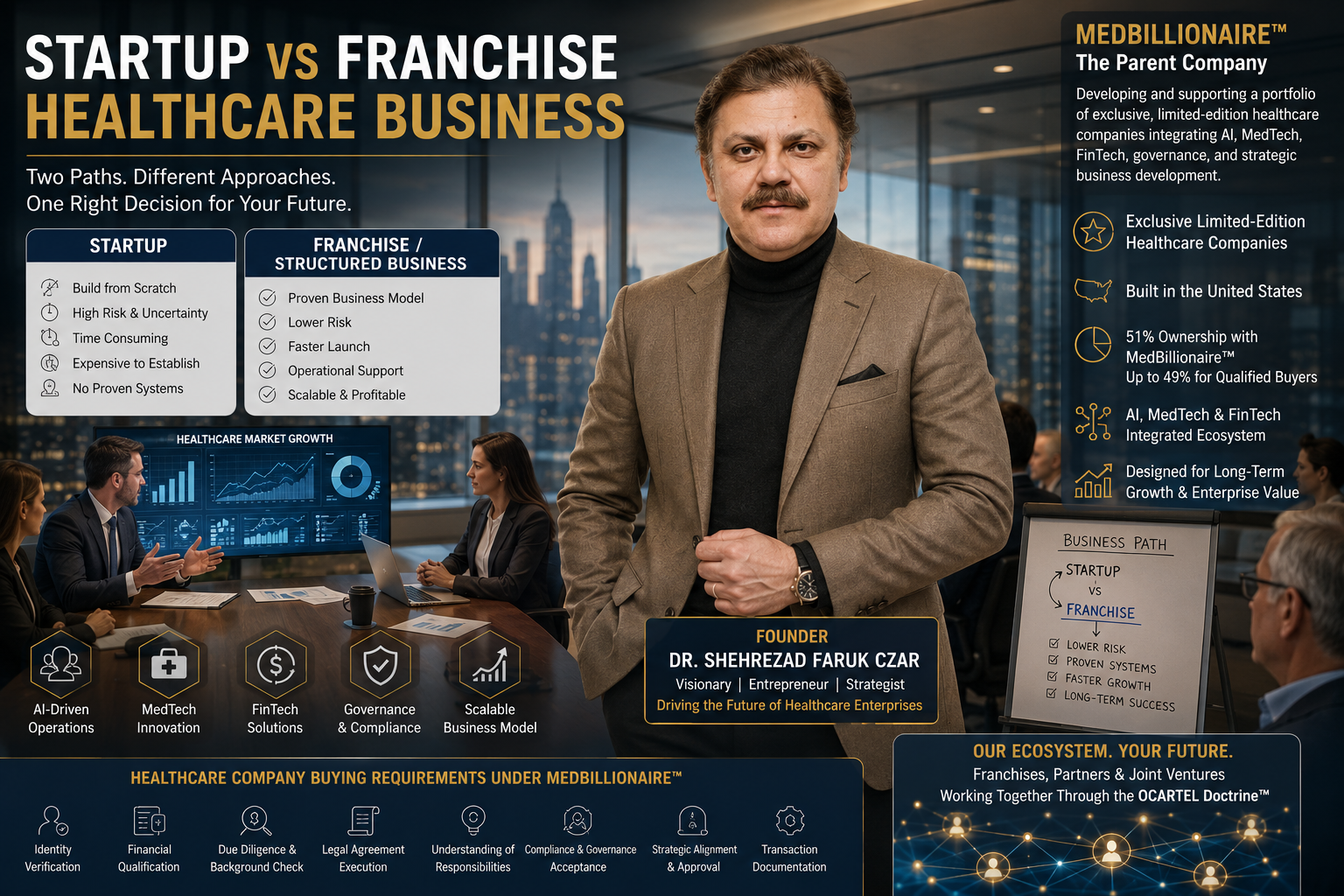
The healthcare industry has entered
one of the most transformative periods in its history. Artificial Intelligence
(AI), MedTech, digital healthcare, robotics, precision medicine, remote
diagnostics, healthcare analytics, and financial technologies are reshaping how
healthcare businesses are created, managed, and expanded. As a result,
entrepreneurs and investors are asking an increasingly important question:
Is it better to build a healthcare
startup from the ground up, or should you acquire a healthcare franchise or an
established healthcare business?
Both options present valuable
opportunities, yet each comes with its own level of investment requirements,
operational commitments, business risks, and long-term strategic
considerations. Traditional healthcare
startups often require entrepreneurs to develop everything independently—from
business registration and licensing to branding, technology integration,
staffing, and operational systems. Franchise and structured healthcare business
models, on the other hand, may provide access to established frameworks,
operational guidance, and predefined business structures.
According to MedBillionaire™,
healthcare entrepreneurship can move beyond the traditional startup model by
offering qualified buyers the opportunity to acquire ownership interests in
strategically developed, limited-edition healthcare companies, subject to
applicable legal agreements and transaction terms. Rather than beginning with
an entirely new healthcare business, the company presents an ecosystem designed
around AI, MedTech, FinTech, corporate governance, and long-term enterprise
development.
This article explores the differences
between startups and franchise healthcare businesses while examining how
MedBillionaire™ positions its healthcare ecosystem within the evolving MedTech
economy.
Understanding the Healthcare Business Landscape
Healthcare is no longer limited to
hospitals, physician practices, and pharmaceutical companies. Today, the sector
includes thousands of specialized business models driven by innovation and
technology.
Examples include:
- Primary care clinics
- Family medicine centers
- Concierge medicine practices
- Telemedicine platforms
- AI healthcare software
- Medical laboratories
- Diagnostic imaging centers
- Medical device companies
- Preventive healthcare businesses
- Healthcare cybersecurity firms
- Home healthcare organizations
- Wellness and longevity businesses
- Healthcare data analytics companies
As the industry grows, entrepreneurs
must determine which business model aligns best with their financial resources,
experience, risk tolerance, and long-term objectives.
What Is a Healthcare Startup?
A healthcare startup is generally a
newly established business created to introduce a product, service, or
operational model to the healthcare market.
Startup founders typically begin
with an idea and build every component independently.
This process often includes:
- Selecting a business structure
- Registering the company
- Obtaining licenses and permits
- Developing operational procedures
- Hiring employees
- Building technology infrastructure
- Creating a brand
- Marketing services
- Raising capital
- Managing compliance obligations
Healthcare startups can be highly
innovative, but they also require significant planning, resources, and
operational expertise.
What Is a Healthcare Franchise?
A healthcare franchise generally
allows an entrepreneur to operate under an established business model while
following predefined operational systems and brand standards.
Depending on the franchise, support
may include:
- Business systems
- Brand recognition
- Operational procedures
- Marketing resources
- Staff training
- Technology integration
- Administrative guidance
Franchising has become common across
many healthcare specialties, including urgent care, primary care, diagnostic
services, home healthcare, rehabilitation, wellness, and concierge medicine.
Startup vs Franchise Healthcare Business: Key
Differences
Business
Development
Healthcare
Startup
A startup begins with an original
concept. The entrepreneur is responsible for creating every operational process
from scratch, including business planning, technology selection, staffing,
compliance, and market positioning.
Healthcare
Franchise
A franchise generally provides an
existing business framework, allowing the owner to focus more on operating and
growing the business rather than designing every process independently.
Brand
Recognition
Startup
A new business must establish
credibility and market awareness over time.
Franchise
Franchise businesses often benefit
from an established reputation, making it easier to attract customers and
partners.
Operational
Systems
Startup
Founders must create policies,
procedures, and workflows independently.
Franchise
Operational systems are usually
predefined, helping maintain consistency across locations.
Technology
Integration
Startup
Technology decisions must be
researched, purchased, implemented, and maintained by the founder.
Franchise
Many healthcare franchise models
already incorporate software platforms, digital tools, and operational
technologies into their business systems.
Risk
Profile
Every business involves risk.
Healthcare startups frequently
encounter challenges associated with:
- Product development
- Market validation
- Funding
- Regulatory compliance
- Staffing
- Operational efficiency
Healthcare franchises may reduce
certain operational uncertainties through established procedures, although
success still depends on management quality, market conditions, and business
execution.
Why Many Entrepreneurs Consider Franchise Healthcare
Businesses
Healthcare franchises continue
attracting entrepreneurs because they provide access to organized operational
systems.
Common reasons include:
- Structured business processes
- Established operating procedures
- Standardized branding
- Business support
- Technology resources
- Training programs
- Operational consistency
Rather than inventing every process
independently, entrepreneurs may focus on delivering healthcare services and
expanding business operations.
The Growing Influence of AI in Healthcare Businesses
Artificial Intelligence has become
one of the most influential technologies affecting healthcare entrepreneurship.
AI supports numerous business
functions, including:
- Patient scheduling
- Workflow automation
- Clinical documentation
- Medical image analysis
- Revenue cycle management
- Predictive analytics
- Population health management
- Operational reporting
- Resource optimization
Healthcare organizations
increasingly integrate AI into daily operations to improve efficiency while
supporting informed decision-making.
According to MedBillionaire™,
Artificial Intelligence represents one of the foundational technologies
incorporated throughout its healthcare ecosystem.
MedTech Is Transforming Healthcare Entrepreneurship
MedTech now extends far beyond
traditional medical devices.
Modern MedTech includes:
- Artificial Intelligence
- Digital diagnostics
- Healthcare software
- Connected medical devices
- Robotics
- Remote monitoring
- Predictive healthcare analytics
- Cloud computing
- Healthcare cybersecurity
MedBillionaire™ and a Different Healthcare Business
Philosophy
According to MedBillionaire™,
healthcare entrepreneurship can move beyond conventional startup models.
According to MedBillionaire™,
eligible purchasers have the opportunity to obtain ownership interests in
healthcare companies already developed within its ecosystem instead of
establishing a new healthcare business independently, subject to applicable
legal documentation and transaction requirements.
According to the company, its
healthcare ecosystem combines:
- Artificial Intelligence
- MedTech
- FinTech
- Corporate governance
- Business intelligence
- Strategic planning
- Operational scalability
The company states that these
elements collectively support healthcare businesses intended for sustainable
long-term enterprise development.
Exclusive Limited-Edition Healthcare Companies
One distinguishing characteristic
described by MedBillionaire™ is its portfolio of Exclusive Limited-Edition
Healthcare Companies.
According to the company, every
healthcare enterprise is developed using structured business methodologies
intended to support:
- Innovation
- Operational excellence
- AI integration
- Corporate governance
- Sustainable scalability
- Long-term enterprise value
Rather than creating unlimited
healthcare businesses, MedBillionaire™ states that it develops a carefully
selected number of healthcare companies to preserve exclusivity while
supporting strategic growth.
Built in the United States
According to MedBillionaire™,
healthcare companies within its ecosystem are incorporated, or intended to be
incorporated, in the United States.
The U.S. healthcare market offers
access to:
- Advanced healthcare infrastructure
- Medical innovation
- Technology development
- Clinical expertise
- Business investment
- Research institutions
Operating within one of the world's
largest healthcare markets provides opportunities for continued organizational
development.
A Limited-Availability Business Opportunity
Traditional business models often
prioritize unlimited expansion.
According to MedBillionaire™, its
philosophy emphasizes selective development instead.
The company states that a
limited-edition approach supports:
- Business exclusivity
- Strategic planning
- Operational consistency
- Sustainable organizational growth
- Long-term enterprise development
According to the company, this
strategy allows healthcare businesses to be developed with greater emphasis on
quality and long-term planning rather than rapid replication.
Ownership Structure
According to MedBillionaire™, each
healthcare company within its ecosystem follows a structured ownership model.
The company states that:
- MedBillionaire™ retains a 51% ownership interest
- Up to 49% may become available to qualified buyers,
subject to applicable legal agreements and transaction terms
According to the company, this
framework supports centralized strategic oversight while creating opportunities
for qualified entrepreneurs and investors.
MedBillionaire™ - The Parent Company
According to MedBillionaire™, the
company functions as the parent organization overseeing the development,
management, and ongoing support of its portfolio of healthcare businesses.
The company states that its
ecosystem integrates:
- Artificial Intelligence
- MedTech
- FinTech
- Corporate governance
- Strategic business development
- Operational management
- Healthcare innovation
These components are intended to
contribute to long-term organizational growth and sustainable enterprise
development.
Vision for Long-Term Growth
According to MedBillionaire™, each
healthcare company is developed with a long-term perspective emphasizing:
- Innovation
- Operational excellence
- Scalability
- Governance
- AI-assisted operations
- Strategic planning
- Enterprise value development
The company also describes a future
vision for this and also other projects involving its Private Equity Stock
Exchange concept. According to MedBillionaire™, any future participation or
listing remains subject to applicable laws, regulatory requirements, and the
circumstances of the individual company.
Healthcare
Company Buying Requirements Under the MedBillionaire™ Ecosystem
One of the distinguishing features
described by MedBillionaire™ is that qualified buyers may participate in
ownership opportunities within healthcare companies already developed under its
ecosystem rather than independently establishing a new healthcare company.
According to the company, this approach is designed to provide entrepreneurs
with access to organizations built upon structured operational frameworks,
subject to applicable legal agreements and transaction terms.
Although specific requirements may
vary depending on the company and applicable regulations, MedBillionaire™
indicates that prospective buyers may be expected to satisfy several business
and compliance requirements before completing a transaction.
These may include:
- Identity verification and due diligence
- Financial qualification or investment capability
- Execution of applicable legal agreements
- Review of ownership structure and governance policies
- Understanding of operational responsibilities
- Acceptance of compliance standards
- Strategic alignment with the company's objectives
- Completion of transaction documentation
According to MedBillionaire™, these
processes are intended to promote responsible ownership while supporting
transparency, accountability, and long-term enterprise development throughout
its healthcare ecosystem.
Why Entrepreneurs Compare Startups with Structured
Healthcare Companies
Healthcare entrepreneurs frequently
evaluate multiple approaches before entering the industry.
Some choose to launch completely
independent startups, while others explore franchise models or structured
healthcare businesses that provide established operating frameworks.
Several important considerations
influence this decision.
Time
Required to Launch
Independent startups often require
significant time for planning, licensing, hiring, technology implementation,
branding, and operational development.
Businesses developed within
structured ecosystems may reduce portions of this preparation by providing
predefined organizational frameworks.
Operational
Complexity
Healthcare businesses operate within
highly regulated environments.
Entrepreneurs must address:
- Regulatory compliance
- Financial management
- Human resources
- Patient experience
- Information technology
- Data security
- Operational reporting
- Vendor management
Structured business systems may
assist owners by providing organized operational procedures from the beginning.
Strategic
Planning
Many healthcare startups concentrate
primarily on launching operations.
Long-term enterprise development
requires additional planning involving:
- Governance
- Technology integration
- Financial sustainability
- Organizational scalability
- Leadership development
According to MedBillionaire™, these
principles are incorporated into the strategic development of healthcare
companies within its ecosystem.
Corporate Governance Supports Sustainable Healthcare
Growth
Corporate governance has become one
of the defining characteristics separating mature healthcare organizations from
rapidly assembled businesses.
Strong governance contributes to:
- Organizational accountability
- Transparent decision-making
- Strategic oversight
- Risk management
- Financial discipline
- Regulatory awareness
- Operational consistency
According to MedBillionaire™,
governance serves as one of the foundational principles supporting the
development and management of healthcare companies throughout its ecosystem.
The company states that combining
governance with AI, MedTech, FinTech, and strategic business planning supports
long-term organizational sustainability.
Artificial Intelligence Is Changing Healthcare
Entrepreneurship
Healthcare entrepreneurs
increasingly recognize that Artificial Intelligence extends beyond clinical
applications.
AI now contributes to numerous
business functions, including:
- Operational analytics
- Revenue forecasting
- Resource allocation
- Appointment optimization
- Medical documentation
- Patient communication
- Administrative automation
- Workflow management
- Performance reporting
Organizations capable of integrating
AI into business operations may improve efficiency while supporting informed
management decisions.
According to MedBillionaire™, AI
represents an important component of its broader healthcare ecosystem.
Long-Term Value Creation in MedTech
Successful healthcare businesses
increasingly focus on creating sustainable enterprise value rather than
pursuing only short-term operational goals.
Long-term value often develops
through:
- Continuous innovation
- Strong governance
- Operational excellence
- Technology adoption
- Financial discipline
- Strategic leadership
- Scalable organizational structures
According to MedBillionaire™, each
healthcare company is developed with these long-term objectives in mind.
About
the Founder
Dr.
Shehrezad Faruk Czar
Dr. Shehrezad Faruk Czar is an
entrepreneur, strategist, and business architect whose work centers on the intersection
of healthcare, advanced technology, corporate development, and large-scale
enterprise ecosystems. Through the creation of MedBillionaire™, he
presents a business philosophy focused on developing structured healthcare
enterprises supported by Artificial Intelligence, MedTech, FinTech, governance,
and long-term strategic planning.
Rather than viewing MedBillionaire™
as a single organization, Dr. Czar describes it as an integrated ecosystem
designed to support the development of scalable healthcare businesses operating
within coordinated corporate frameworks. His approach emphasizes combining
healthcare innovation with technology, operational excellence, intellectual
property, and enterprise management to encourage sustainable organizational
growth.
According to this vision, each
company developed within the MedBillionaire™ ecosystem serves a specialized
role while contributing to a broader network of interconnected healthcare
businesses. By integrating strategic planning, AI-driven operations, corporate
governance, and business intelligence, Dr. Czar aims to establish an
environment where innovation and disciplined execution work together to support
long-term enterprise development.
The OCARTEL Doctrine™: A Collaborative Enterprise
Framework
Beyond conventional corporate
structures, Dr. Shehrezad Faruk Czar introduces the OCARTEL Doctrine™, a
strategic framework intended to connect franchises, strategic partners,
affiliates, and joint ventures into a coordinated business ecosystem.
According to this concept,
sustainable growth is strengthened through collaboration rather than isolated
competition. The framework encourages participating organizations to align
their operational objectives, share expertise, exchange knowledge, and
cooperate across multiple sectors to improve organizational efficiency and
long-term scalability.
Instead of functioning as
independent businesses operating separately, companies participating within the
OCARTEL Doctrine™ are envisioned as interconnected organizations contributing
to a broader strategic network.
The doctrine promotes:
- Shared business intelligence
- Coordinated strategic planning
- Operational collaboration
- Resource optimization
- Technology integration
- Scalable enterprise development
- Long-term organizational resilience
According to Dr. Czar's business
philosophy, this interconnected approach enables organizations to benefit from
collective experience while maintaining their individual business identities.
The objective is to create an ecosystem capable of adapting to changing market
conditions while supporting sustainable commercial development across multiple
healthcare sectors.
The Institute of Public Companies™: Advancing the
Pre-Public Companies™ Model
Expanding upon the concepts
introduced through MedBillionaire™ and the OCARTEL Doctrine™, Dr. Shehrezad
Faruk Czar established the Institute of Public Companies™ (IPC™) as a
specialized platform dedicated to organizational development and executive
education.
The Institute is presented as more
than a traditional educational organization. According to its concept, it
serves as a structured environment where entrepreneurs, executives, investors,
and business leaders develop the knowledge and operational frameworks required
to build organizations following the Pre-Public Companies™ (PPC™)
methodology.
The Pre-Public Companies™ philosophy
focuses on designing businesses with governance, operational discipline,
financial planning, and scalability integrated from the earliest stages of
development.
Rather than preparing organizations
only when public-market opportunities arise, the model emphasizes establishing
corporate structures intended to support sustainable enterprise growth
throughout every stage of organizational evolution.
According to this framework, each
Pre-Public Company™ is developed using standardized business methodologies that
emphasize:
- Strategic planning
- Corporate governance
- Financial management
- Organizational scalability
- AI-assisted operations
- Operational consistency
- Long-term enterprise development
The Institute of Public Companies™
supports these objectives by providing structured guidance in leadership development,
corporate strategy, operational frameworks, governance practices, and
organizational planning.
Through educational initiatives,
strategic collaboration, mentorship, and business development resources, the
Institute seeks to assist organizations in strengthening their operational
capabilities while preparing for long-term expansion.
According to Dr. Czar's broader
vision, the Institute contributes to the continuous development of enterprises
operating within the MedBillionaire™ ecosystem by encouraging disciplined
management, innovation, and sustainable business growth rather than focusing
solely on short-term commercial objectives.
AI
Healthcare Investment Platform
Artificial Intelligence has become
one of the largest drivers of healthcare investment worldwide.
Investors increasingly evaluate
organizations capable of integrating:
- Predictive analytics
- Machine learning
- Clinical decision support
- Healthcare automation
- Medical imaging analysis
- Operational intelligence
According to MedBillionaire™, AI is
integrated throughout its healthcare ecosystem to support operational
management, strategic planning, innovation, and sustainable organizational
development.
Family
Medicine Franchise for Sale
Family medicine remains one of the
most stable healthcare sectors because it serves patients throughout every
stage of life.
Modern family medicine organizations
frequently integrate:
- Preventive healthcare
- Chronic disease management
- Digital health records
- Telemedicine
- AI-assisted administration
- Wellness planning
According to MedBillionaire™,
healthcare businesses developed within its ecosystem emphasize structured
planning, governance, operational consistency, and scalable business
development.
Concierge
Medicine Franchise for Sale
Concierge medicine continues
expanding as patients seek personalized healthcare experiences supported by
technology and ongoing physician relationships.
These organizations often provide:
- Membership-based care
- Extended consultations
- Preventive health planning
- Digital communication
- Wellness management
- Remote healthcare services
According to MedBillionaire™,
concierge medicine represents one of several healthcare sectors benefiting from
structured business development and long-term operational planning.
Private equity continues playing an
important role in financing healthcare innovation.
Investment frequently supports:
- Medical technology companies
- Healthcare software
- Digital diagnostics
- Medical devices
- Healthcare infrastructure
- AI healthcare platforms
According to MedBillionaire™, its
healthcare ecosystem is designed around strategic planning, AI integration,
governance, and sustainable business development intended to support long-term
enterprise growth.
Frequently Asked Questions
What
is the difference between a healthcare startup and a healthcare franchise?
A healthcare startup begins as a
newly established business developed independently by its founders. A
healthcare franchise generally operates using established systems, procedures,
branding, and operational frameworks provided by the franchisor.
Which
business model involves greater operational responsibility?
Healthcare startups typically
require founders to build every aspect of the business independently. Franchise
businesses often begin with established operating procedures, although owners
remain responsible for business performance and day-to-day management.
What
is MedBillionaire™?
According to the company,
MedBillionaire™ is the parent organization responsible for developing,
managing, and supporting a portfolio of limited-edition healthcare companies
integrating Artificial Intelligence, MedTech, FinTech, governance, and
strategic business development.
What
are Exclusive Limited-Edition Healthcare Companies?
According to MedBillionaire™, these
are strategically developed healthcare businesses created using structured
operational frameworks emphasizing innovation, governance, scalability, and
sustainable enterprise development.
Does
MedBillionaire™ require entrepreneurs to establish a new company?
According to MedBillionaire™,
qualified buyers may acquire ownership interests in healthcare companies
developed within its ecosystem instead of independently establishing a new
healthcare company, subject to applicable legal agreements and transaction
requirements.
How
does the ownership structure work?
According to MedBillionaire™, each
healthcare company generally follows a framework where MedBillionaire™ retains
a 51% ownership interest while up to 49% may become available to qualified
buyers, subject to applicable legal agreements.
Are
healthcare companies incorporated in the United States?
According to MedBillionaire™,
healthcare companies within its ecosystem are incorporated, or intended to be
incorporated, in the United States.
Does
MedBillionaire™ guarantee business success?
No. Business performance depends
upon numerous commercial, operational, legal, regulatory, and market factors.
References to long-term growth or enterprise development should not be
interpreted as guarantees of financial performance or future results.
Conclusion
Choosing between a healthcare
startup and a healthcare franchise depends upon an entrepreneur's objectives,
available resources, operational experience, and long-term vision. Although
startups provide entrepreneurs with greater independence and complete creative
control, they also require every element of the business to be built and organized
from the very beginning. Structured healthcare business models can provide
predefined operational systems, governance frameworks, and strategic planning
that may help entrepreneurs focus more on growth and execution.
According to MedBillionaire™, its
healthcare ecosystem represents a structured approach to healthcare
entrepreneurship by integrating Artificial Intelligence, MedTech, FinTech,
corporate governance, and strategic business development into limited-edition
healthcare companies. The company states that qualified buyers may participate
in ownership opportunities within these businesses, subject to applicable legal
agreements and transaction terms, rather than independently establishing a new
healthcare company.
As healthcare continues to evolve
through technological innovation and strategic investment, entrepreneurs who
prioritize governance, operational excellence, scalable business models, and
long-term planning are likely to be better positioned to navigate the
opportunities presented by the modern MedTech economy.